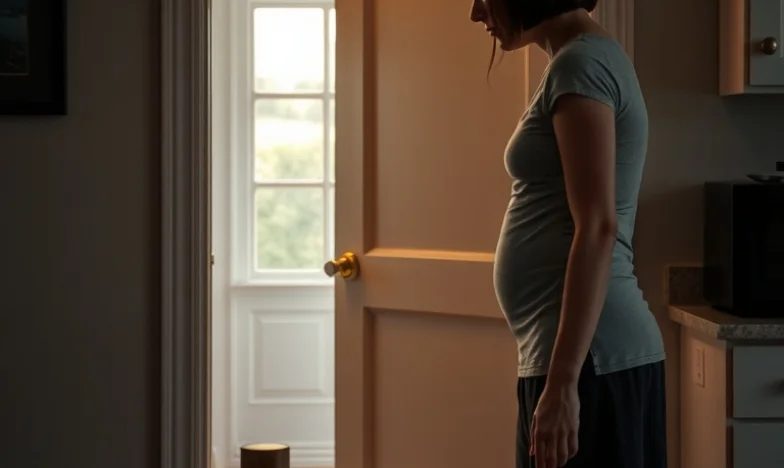
I Left My Pregnant Wife Because She Was Expecting a Girl—But Fate Had a Cruel Twist in Store for Me

“You’re really going to leave me because we’re having a girl?”
Jessica’s voice trembled as she stood in the doorway of our kitchen, one hand resting protectively on her swollen belly. The ultrasound photo was still on the table, the little black-and-white blur that had changed everything.
I couldn’t meet her eyes. “Jess, you know how important this is to me. My father… he always wanted a grandson. I can’t—”
She cut me off, tears streaming down her face. “You can’t what, Mark? Love your own child because she’s not a boy?”
I didn’t answer. I just grabbed my keys and walked out, the sound of her sobs echoing in my ears.
—
I grew up in a small town in Ohio, where men were expected to carry on the family name. My father, a Vietnam vet with a voice like gravel, made it clear from the time I was a kid: “A man’s worth is measured by his legacy.”
When Jessica told me she was pregnant, I was over the moon. I imagined teaching my son to throw a baseball, taking him fishing, passing down the stories my father told me. But when the doctor said it was a girl, something inside me snapped.
I started spending more time at work, avoiding home. That’s when I met Rachel. She was younger, ambitious, and she listened to me in a way Jessica hadn’t in years. When Rachel told me she was pregnant—and that it was a boy—I felt like fate was giving me a second chance.
I moved out of the house I’d shared with Jessica, leaving her alone to face the whispers of our neighbors and the disappointment of her parents. I paid for Rachel to have the best care at a private clinic in Cleveland. I told myself I was doing the right thing, that I was finally going to be the man my father wanted me to be.
—
The day Rachel went into labor, I was a bundle of nerves. I paced the waiting room, checking my phone every few seconds. My father called, his voice gruff but proud. “This is it, son. You’re finally making things right.”
I tried not to think about Jessica, about the home I’d abandoned, about the little girl I’d never meet.
Rachel’s doctor came out, a look of concern on her face. “Mr. Harris, there were complications. The baby… he’s in critical condition. We’re doing everything we can.”
My world spun. I rushed to Rachel’s side, but she was unconscious, pale and still. The nurses wouldn’t let me see my son.
Hours passed. I sat in that sterile room, my hands shaking, praying to a God I hadn’t spoken to in years. Finally, a nurse came in, her eyes red. “I’m so sorry. Your son didn’t make it.”
I felt like the air had been sucked out of the room. I’d given up everything—my wife, my family, my dignity—for this moment, and it was gone.
—
Rachel never forgave me. She blamed me for pushing her, for making her feel like she had to give me a son. She moved back to her parents’ house in Michigan, refusing to take my calls.
I tried to go back to Jessica, but she wouldn’t even open the door. Her parents threatened to call the police if I came near her again. I heard through a mutual friend that she’d given birth to a healthy baby girl, named Emily.
I saw them once, at the grocery store. Jessica looked tired but happy, cradling Emily in her arms. I wanted to run to them, to beg for forgiveness, but I knew I didn’t deserve it.
—
I spent months alone in my apartment, haunted by what I’d done. My father stopped calling. My friends drifted away. I stared at the empty crib I’d bought for Rachel’s son, the blue walls I’d painted with such hope.
One night, I found myself outside Jessica’s house, watching through the window as she read to Emily. Her voice was soft, her smile gentle. I realized then that I’d lost everything that mattered because I couldn’t accept the gift I’d been given.
—
I started going to therapy, trying to unravel the knots inside me. I wrote letters to Jessica and Emily, letters I never sent. I volunteered at a local shelter, trying to make amends in small ways.
Sometimes, I see fathers with their daughters at the park, laughing and playing. I wonder what kind of father I could have been if I’d just let go of my pride.
I don’t know if Jessica will ever forgive me. I don’t know if I’ll ever forgive myself. But I’ve learned that love isn’t about legacy or expectations—it’s about showing up, even when it’s hard.
If you’re reading this, and you’re facing a choice like mine, please—don’t make the same mistake. Don’t let fear and pride steal your happiness.
Based on a true story.