When the Truth Hurts: My Husband’s Betrayal and the Courage to Start Over at 55

“You deserve to know the truth, Linda.”
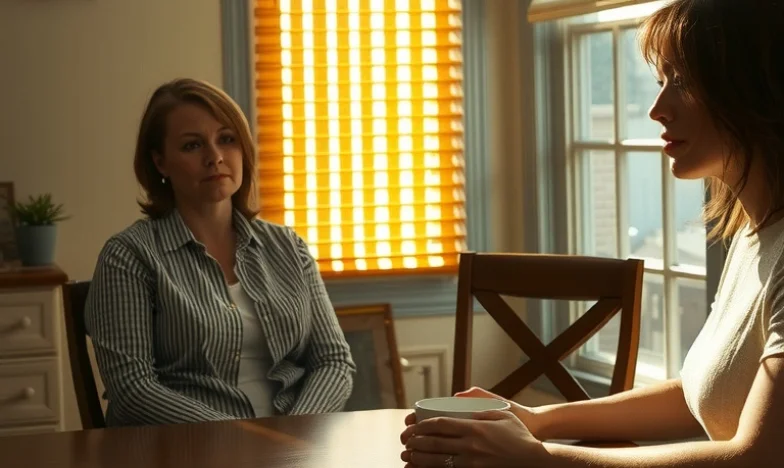
Her voice was steady, but her hands trembled as she clutched her purse. I stared at her across my kitchen table, the morning sun slicing through the blinds, painting harsh lines on her face. My husband, Mark, was nowhere to be found. He’d left for work early, or so he said. But now, sitting across from me was his colleague, the woman I’d met at last year’s office party—the woman who was about to shatter my world.
I felt my heart pounding in my chest, my breath shallow. I wanted to scream, to run, to wake up from this nightmare. But I sat frozen, clutching my coffee mug so tightly my knuckles turned white.
“Linda, I’m so sorry. I never meant for this to happen.”
I barely heard her. My mind raced back over the past year: the late nights, the sudden business trips, the way Mark’s eyes darted away when I asked about his day. I’d ignored the signs, convinced myself it was just stress, just work. But now, the truth was sitting in my kitchen, looking me in the eye.
—
I’d always thought Mark and I were solid. We’d built a life together in our quiet Ohio suburb, raised two kids who were now grown and living their own lives. We had our routines—Sunday pancakes, Friday movie nights, summer trips to Lake Erie. I thought we were happy. Or at least, content.
But contentment, I realized, can be a dangerous thing. It can lull you into complacency, blind you to the cracks forming beneath the surface.
The woman—her name was Jessica—told me everything. How it started with late-night projects at the office, how they bonded over shared frustrations, how one thing led to another. She said she ended it weeks ago, wracked with guilt. She said Mark was too afraid to tell me himself.
I wanted to hate her. I wanted to scream at her, to throw her out of my house. But all I could do was sit there, numb, as she apologized again and again.
When she finally left, I sat alone in the kitchen, staring at the empty chair across from me. The silence was deafening.
—
That night, Mark came home late. I was waiting for him in the living room, the TV flickering in the background. He looked tired, older than I remembered. When he saw me, he hesitated in the doorway.
“Linda, I—”
“Don’t,” I said, my voice barely above a whisper. “She told me everything.”
He sank onto the couch, burying his face in his hands. For a long time, neither of us spoke. The only sound was the ticking of the old clock on the mantel.
“I’m sorry,” he finally said. “I never wanted to hurt you.”
I wanted to believe him. I wanted to rewind time, to go back to before all of this. But I couldn’t. The trust we’d built over thirty years was gone, shattered in an instant.
“Why, Mark?” I asked, my voice breaking. “Wasn’t I enough?”
He shook his head, tears in his eyes. “It wasn’t about you. I was… lost. I felt invisible. Work was the only place I felt alive.”
I wanted to scream at him, to tell him how selfish he was. But all I could do was cry.
—
The days that followed were a blur. I went through the motions—work, groceries, laundry—but everything felt hollow. Friends called, sensing something was wrong, but I couldn’t bring myself to talk about it. Our kids called, too, but I didn’t want to burden them with my pain.
At night, I lay awake, replaying every moment of our marriage, searching for the moment it all went wrong. Was it when the kids left for college? When I started working more hours at the library? When Mark’s father died and he withdrew into himself?
I blamed myself. I blamed him. I blamed the world for making love so fragile.
—
One afternoon, I found myself standing in front of the mirror, studying the lines on my face, the gray in my hair. I barely recognized the woman staring back at me. When had I become so invisible?
That was the moment I realized I had a choice. I could let this betrayal define me, or I could find a way to move forward.
I started small. I signed up for a painting class at the community center, something I’d always wanted to do but never made time for. I reconnected with old friends, went for long walks in the park, let myself feel the sun on my face.
Mark tried to make amends. He suggested counseling, promised to do whatever it took to rebuild my trust. Part of me wanted to try, for the sake of our history, our family. But another part of me wondered if it was too late.
—
One evening, our daughter Emily called. She must have heard the strain in my voice, because she asked, “Mom, are you okay?”
I hesitated, then told her everything. She cried with me, told me she loved me, that I deserved better. Her words were a balm, a reminder that I wasn’t alone.
A week later, Emily and her brother, Josh, came home for the weekend. We sat around the kitchen table, laughing, sharing stories, just like old times. For the first time in weeks, I felt a glimmer of hope.
—
The emotional turning point came on a rainy Sunday afternoon. Mark and I sat across from each other in the therapist’s office, the air thick with unspoken words.
“I don’t know if I can ever trust you again,” I said, my voice trembling.
He nodded, tears streaming down his face. “I know. But I want to try. I want to be the man you deserve.”
I looked at him, really looked at him, and saw the pain, the regret, the love that was still there, buried beneath the hurt. I realized that forgiveness wasn’t about letting him off the hook—it was about freeing myself from the weight of anger and resentment.
I didn’t have all the answers. I didn’t know if our marriage could survive. But I knew I was stronger than I’d ever realized.
—
It’s been six months since that day. Mark and I are still working through our issues, one day at a time. Some days are better than others. Some days, the pain feels fresh, like a wound that refuses to heal. But other days, I catch a glimpse of the life we once had, and I wonder if it’s possible to build something new from the ashes.
I’ve learned that betrayal doesn’t have to be the end of the story. It can be the beginning of something new—a chance to rediscover myself, to find joy in unexpected places, to open my heart to forgiveness and hope.
I don’t know what the future holds. Maybe Mark and I will find our way back to each other. Maybe we won’t. But I do know this: I am not defined by his betrayal. I am defined by my strength, my resilience, my capacity to love and be loved.
And that, I’ve realized, is enough.
Based on a true story.