When My Father Chose Her: The Year I Lost My Place at Home

“You’re late again, Val,” Dad’s voice echoed from the kitchen, sharp as the clatter of his coffee mug.
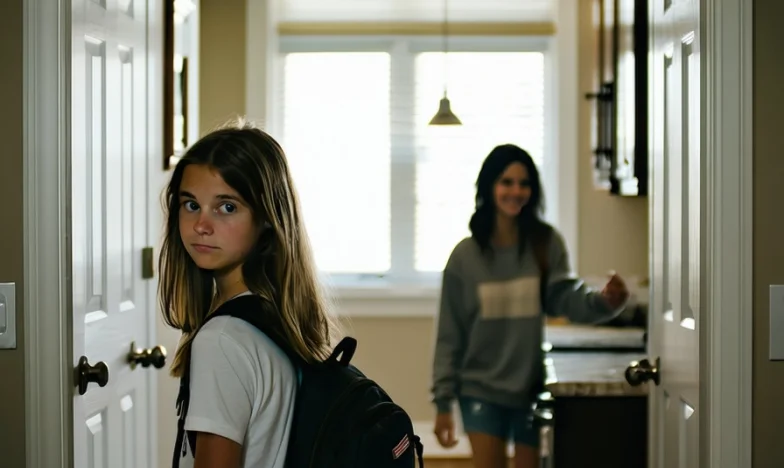
I stood in the hallway, backpack slung over one shoulder, heart pounding. Through the doorway, I saw her—Camila—laughing at something Dad said, her dark hair shining in the morning sun. She looked so at home, so comfortable, as if she’d always belonged here.
I swallowed hard. “Sorry. I had to finish a project.”
Camila turned, her smile wide and easy. “Hey, Valeria! Want some pancakes? I made extra.”
I shook my head, mumbling something about not being hungry. But the truth was, I couldn’t stand the way she’d slipped into our lives so seamlessly. My father’s old friend had died suddenly last spring, and Camila—his only daughter—needed a place to stay. Dad didn’t hesitate. “She’s family now,” he said.
But what did that make me?
—
The first few weeks were a blur of polite smiles and awkward silences. Camila was everything I wasn’t: outgoing, funny, quick to make friends. At school, people gravitated toward her like moths to a porch light. Even my best friend, Jess, seemed dazzled by her.
One afternoon, I found them together in the cafeteria, laughing over something on Camila’s phone. Jess waved me over, but I hesitated at the edge of their circle, suddenly aware of how invisible I felt.
“Valeria! Come sit with us,” Camila called.
I forced a smile and sat down, but the conversation flowed around me like water around a rock.
—
At home, things were worse. Dad started asking Camila about her day at dinner, listening intently as she described her classes and new friends. When I spoke up, he barely looked up from his plate.
One night, after Camila had gone to bed, I confronted him.
“You never ask me about my day anymore,” I said quietly.
He sighed. “Valeria, you never want to talk. Camila’s been through a lot. Try to be patient.”
I bit my lip to keep from crying. “I’m trying. But it feels like you don’t see me anymore.”
He reached for my hand, but I pulled away.
—
The months passed. Camila joined the drama club and convinced Dad to come see her perform in the school play. He brought flowers and took her out for ice cream afterward. I watched from my bedroom window as they laughed together in the driveway.
That night, I overheard them talking in the living room.
“You’re like the daughter I never had,” Dad said softly.
My heart twisted in my chest. What was I, then?
—
I started spending more time at the library, burying myself in books and homework. Jess tried to reach out, but I pushed her away. It was easier to be alone than to watch everyone else move on without me.
One rainy afternoon, I came home early and found Camila crying in the kitchen. She jumped when she saw me.
“Sorry,” she sniffed, wiping her eyes. “I just… miss my dad sometimes.”
For a moment, my anger faded. “I’m sorry,” I said quietly.
She looked at me, her eyes red-rimmed and vulnerable. “I know it’s weird for you. But I’m not trying to take your place.”
I wanted to believe her. But the ache in my chest wouldn’t go away.
—
The breaking point came on Thanksgiving.
Dad announced that Camila would make her family’s traditional stuffing recipe—a dish he’d never let anyone else prepare before.
As we sat around the table, Dad raised his glass. “To family—old and new.”
Camila beamed at him. I stared at my plate, fighting back tears.
After dinner, I locked myself in my room and wrote a letter:
“Dear Dad,
I don’t know who I am in this house anymore. Maybe you don’t need me here at all…”
I never gave it to him.
—
Winter came, and with it a silence that settled over our home like snow on bare branches.
One night, Camila knocked on my door.
“Can we talk?” she asked softly.
I hesitated, then nodded.
She sat on the edge of my bed. “I know you hate me. But I wish you didn’t.”
I shook my head. “I don’t hate you. I just… miss how things used to be.”
She reached for my hand—tentative, gentle.
“Me too,” she whispered.
We sat there in silence for a long time.
—
In January, Dad got sick—just a bad flu, but enough to scare us both.
Camila and I took turns making soup and checking his temperature. For the first time, we worked together instead of against each other.
One night while Dad slept, Camila turned to me in the hallway.
“He loves you so much,” she said quietly. “He talks about you all the time when you’re not around.”
Tears stung my eyes. “It doesn’t feel like it sometimes.”
She squeezed my shoulder. “He’s just scared of losing you too.”
—
When Dad recovered, he called us both into the living room.
“I know things have been hard,” he began. “But you’re both my daughters now—whether by blood or by choice.”
He looked at me then—really looked at me—for the first time in months.
“Valeria, I’m sorry if I made you feel invisible. That was never my intention.”
Camila reached for my hand again, and this time I didn’t pull away.
—
Things didn’t magically get better overnight.
But slowly—over shared breakfasts and late-night talks—Camila and I found common ground: our love for books, our fear of being left behind.
Jess forgave me for pulling away; we rebuilt our friendship brick by brick.
And Dad? He learned to listen more—to both of us.
—
Sometimes I still feel jealous or lost or afraid that there’s not enough love to go around.
But then I remember that families aren’t just born—they’re built, day by day, choice by choice.
And maybe there’s room for all of us after all.
Based on a true story.