Two Years After the Wedding: When My Husband’s Daughter Moved In, Everything Changed

“You never asked me if I wanted her here!” My voice cracked as I slammed the bathroom door, the echo bouncing off the cheap tile. I pressed my forehead against the cool wood, trying to steady my breath. On the other side, David’s footsteps hesitated, then retreated.
I never thought I’d be the kind of woman who resented a child. But two years after marrying David, I was drowning in guilt, anger, and confusion. Emily, his fifteen-year-old daughter, was moving in with us. Not for a weekend. Not for the summer. For good.
The news came on a rainy Tuesday. David’s ex-wife, Lisa, called while I was making dinner. I heard his voice in the kitchen, low and tense. When he hung up, he looked at me with those tired blue eyes. “Lisa’s moving to Texas for work. Emily wants to stay here. With us.”
I dropped the spatula. “Here? In our apartment?”
He nodded. “It’s her home too.”
I wanted to scream. Our place was barely big enough for two adults. My home office was a corner of the living room. The second bedroom was a glorified closet. But I swallowed my protest. I loved David. I wanted to be supportive. I told myself I could handle it.
The first night Emily arrived, she barely looked at me. She tossed her backpack on the couch and scrolled through her phone. David tried to bridge the gap. “Emily, this is Sarah. You remember Sarah.”
She shrugged. “Yeah.”
I forced a smile. “Welcome home, Emily.”
She didn’t answer.
That was the beginning.
—
The days blurred together. Emily’s presence filled every inch of our apartment. Her shoes in the hallway, her music thumping through the walls, her sighs and slammed doors. I tried to connect. I offered to help with homework. I made her favorite mac and cheese. She ignored me, or worse, rolled her eyes.
David was caught in the middle. He’d squeeze my hand at night, whisper, “She just needs time.” But I saw the worry in his face. He was afraid, too.
One Saturday, I found Emily crying in her room. I knocked gently. “Emily? Can I come in?”
She wiped her eyes, glaring. “What do you want?”
I hesitated. “I just wanted to check on you.”
She stared at me, her face hard. “You’re not my mom.”
The words stung. I nodded, closing the door softly behind me. In the kitchen, I broke down. David held me, but I felt alone.
—
The conflicts grew. Emily missed curfew. She failed a math test. She started hanging out with a group of kids I didn’t trust. I tried to talk to David about boundaries, about rules. He bristled. “She’s been through a lot. Cut her some slack.”
I felt invisible. My needs, my fears, my home—none of it seemed to matter. I started working late, avoiding the tension. I missed the easy laughter David and I once shared. Now, every conversation was a negotiation, every night a silent standoff.
One evening, I found a bottle of vodka hidden in Emily’s closet. My hands shook as I showed David. He paled. “I’ll talk to her.”
But the talk turned into a shouting match. Emily accused us of spying, of not trusting her. She stormed out, slamming the door so hard a picture fell from the wall.
I picked up the broken frame, my heart pounding. “This isn’t working, David. We’re falling apart.”
He looked at me, defeated. “What do you want me to do? She’s my daughter.”
“And I’m your wife!” I snapped. “Don’t I matter?”
He didn’t answer.
—
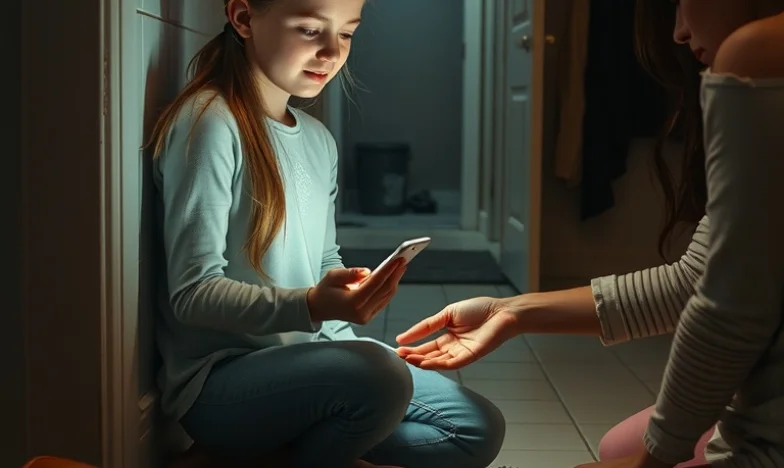
The emotional turning point came late one night. I woke to the sound of muffled sobs. I found Emily curled up on the bathroom floor, clutching her phone. She looked so small, so lost.
I sat beside her, unsure. “Emily, what’s wrong?”
She didn’t look at me. “Mom doesn’t call. Dad’s always mad. I don’t belong anywhere.”
My anger melted. I remembered being fifteen, feeling invisible. I reached out, hesitated, then put my hand on her shoulder. She didn’t pull away.
“I’m sorry,” I whispered. “I know I’m not your mom. But I care about you. I want this to work.”
She wiped her nose. “It’s not your fault. I just… I miss how things used to be.”
We sat in silence. For the first time, I saw her—not as an intruder, but as a scared kid, trying to survive a world she never asked for.
—
Things didn’t magically get better. There were still fights, slammed doors, awkward silences. But there were also small moments—Emily asking for help with homework, David and I sharing a quiet cup of coffee, laughter at a bad movie.
I learned to let go of perfection. To accept that family is messy, that love is a choice we make every day. David and I started therapy. Emily joined us, reluctantly at first. We talked, we yelled, we cried. We tried.
Some days, I still wonder if our marriage will survive. If love is enough. But I know this: we’re all fighting for the same thing—a place to belong.
And maybe, just maybe, that’s enough.
Based on a true story.