“This Is My Son’s House, and You Are Nobody Here” – The Day I Chose Myself Over My Mother-in-Law’s Cruelty

“This is my son’s house, and you are nobody here.”
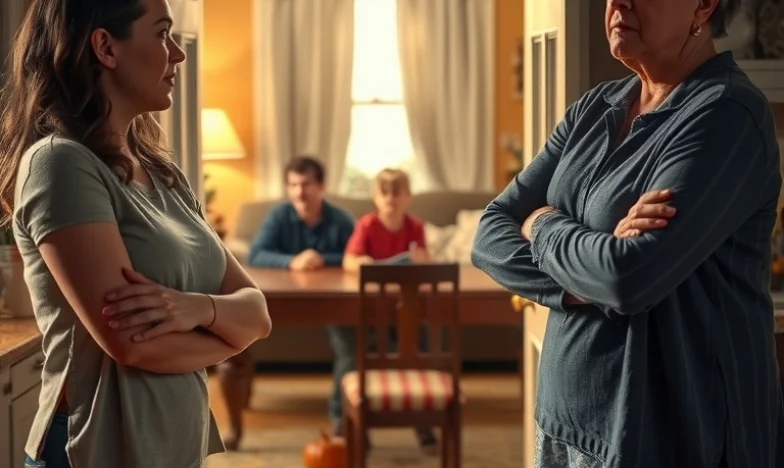
The words hit me like a slap, echoing through the kitchen as I stood there, hands trembling over a tray of Thanksgiving pies. The scent of cinnamon and pumpkin filled the air, but all I could taste was humiliation. Mark’s mother, Barbara, stood in the doorway, arms crossed, her eyes cold as a Minnesota winter. Mark was in the living room, laughing with his brother over the football game, oblivious to the storm brewing just ten feet away.
I tried to steady my voice. “Barbara, I just wanted to help set the table—”
She cut me off with a sharp wave of her hand. “You don’t belong here. This is my son’s home. You’re just… passing through.”
I swallowed hard, blinking back tears. It wasn’t the first time she’d said something like this. Since Mark and I got married last spring, every visit to our apartment felt like walking into a battlefield. Barbara would rearrange our furniture, criticize my cooking, and make snide remarks about my job at the library. She’d even once told Mark that he could have done better than “a girl who reads all day.”
But this—this was different. Today was Thanksgiving. My first as Mark’s wife. I’d spent hours making everything perfect: the turkey brined overnight, sweet potatoes with marshmallows just like Mark liked them, even his favorite pecan pie. I wanted to create a home where we could build our own traditions. But Barbara made sure I knew: this wasn’t my home.
I set the pies down and slipped into the hallway, heart pounding. I could hear Barbara’s voice behind me, low and venomous: “She’ll never fit in with us.”
I found Mark in the living room, his face flushed from beer and excitement. “Hey babe,” he grinned, “come watch the game!”
I hesitated. “Mark… can we talk?”
He barely glanced away from the screen. “Can it wait? The Cowboys are about to score.”
I felt invisible. Like a ghost in my own life.
That night, after everyone left and the last dish was washed, I sat on the edge of our bed while Mark scrolled through his phone. The silence between us was thick.
“Mark,” I said quietly, “your mom… she said some really hurtful things today.”
He sighed without looking up. “That’s just how she is. She doesn’t mean anything by it.”
“But it hurts me,” I whispered. “I feel like I’m not welcome in my own home.”
He shrugged. “She’s my mom. What do you want me to do?”
I wanted him to stand up for me. To tell her that I mattered. But he didn’t.
The weeks that followed were a blur of small humiliations: Barbara showing up unannounced with boxes of Mark’s childhood things (“He’ll want these when you’re gone”), criticizing my Christmas decorations (“We always use gold, not silver”), and telling me in front of Mark’s cousins that “some people just aren’t cut out for marriage.”
Christmas Eve was the breaking point.
Barbara arrived early with her famous green bean casserole and a bottle of wine she insisted was “too good for cheap glasses.” She watched as I set out stockings for Mark and me—just two—and sniffed disapprovingly.
“Where are the stockings for your future children?” she asked loudly.
I blushed. We’d been trying for months with no luck. The question felt like a knife.
Mark tried to laugh it off, but I saw the way he avoided my eyes.
After dinner, as we cleaned up, Barbara cornered me in the kitchen again.
“You know,” she said softly, “Mark deserves a real family. Someone who can give him children.”
I dropped a plate; it shattered on the tile.
She smiled thinly. “Accidents happen.”
That night, after she left, I broke down sobbing on the bathroom floor. Mark knocked on the door but didn’t come in.
The next morning—Christmas Day—I woke up alone. Mark had gone to his mom’s house for breakfast without telling me.
I sat at our kitchen table, staring at the empty stockings and cold coffee, and something inside me snapped.
I called my sister Emily in Ohio. She listened as I poured out everything—the insults, the loneliness, the way Mark always took his mother’s side.
“Come home,” she said gently. “Just for a while.”
I packed a bag and left a note for Mark: “I need some time to think.”
The drive to Ohio was long and silent except for the hum of tires on asphalt and my own thoughts swirling like snowflakes in a blizzard.
Emily hugged me tight when I arrived. Her house was chaos—kids running around in pajamas, Christmas music blaring—but it felt warm and safe in a way I hadn’t felt in months.
Over hot cocoa that night, Emily looked at me seriously. “You deserve better than this, Sarah.”
I started to cry again—not out of sadness this time, but relief.
Mark called every day for a week. At first he was angry (“How could you embarrass me like this?”), then pleading (“Just come home and we’ll work it out”), then finally silent.
Barbara never called at all.
In Ohio, I remembered who I was before all this: someone who loved books and laughter and long walks in the snow; someone who believed in kindness and second chances.
On New Year’s Eve, as fireworks lit up Emily’s backyard and her kids shrieked with joy, I made a resolution: I would not go back to being nobody in my own life.
When I returned to Minnesota two weeks later, Mark was waiting at our apartment with flowers and apologies. He promised things would change—that he’d talk to his mother, that he’d put me first.
But when Barbara showed up unannounced again that Sunday morning and started rearranging our living room—without so much as a hello—I realized nothing had changed at all.
I looked at Mark. He looked away.
So I packed my things for good this time.
It wasn’t easy—divorce never is—but slowly, painfully, I built a new life for myself. I moved into a tiny apartment above a coffee shop downtown. I adopted a rescue dog named Daisy who greeted me every day with unconditional love. I started volunteering at the library on weekends again.
And when Thanksgiving rolled around the next year, Emily and her family drove out to spend it with me. We crowded around my little table—laughing, eating too much pie—and for the first time in years, I felt truly at home.
Sometimes late at night I still hear Barbara’s voice in my head: “You are nobody here.” But now I know better.
Because if you can’t be somebody in your own life—where else will you ever belong?
Have you ever had to choose yourself over family? How did you find the courage to say enough is enough?