The Silence of Sunday Dinners: When Family Falls Apart at the Table

The Silence of Sunday Dinners: When Family Falls Apart at the Table
“Mom, maybe it’s best if you don’t come next Sunday.”
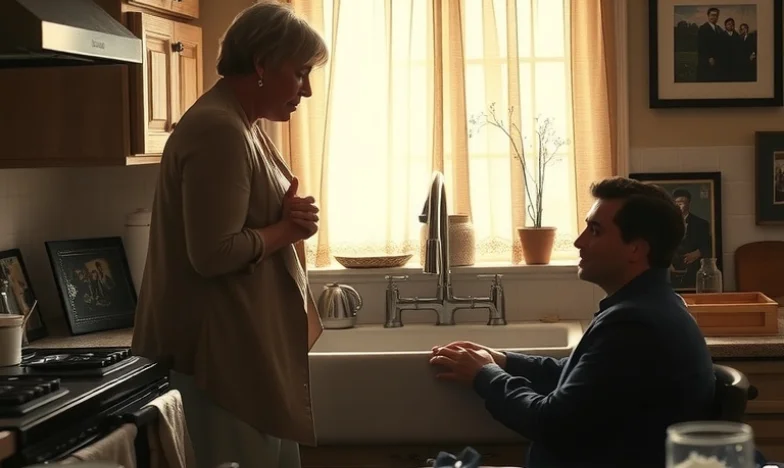
Those words echoed in my mind, sharp as broken glass. I stood in my kitchen, hands trembling over the sink, the scent of roast chicken still lingering in the air. My son, Michael, had just left with his wife, Emily, and their two little girls. The house felt emptier than ever.
I stared at the clock. 3:17 PM. Sundays used to be sacred. The laughter, the clatter of dishes, the girls chasing each other around the table. Now, only silence remained.
—
I remember the first Sunday dinner after Michael married Emily. She brought her famous apple pie, and we all joked about how it was better than mine. I laughed, pretending not to care, but inside, I felt the first twinge of being replaced.
Over the years, the dinners changed. Emily started bringing her own dishes, rearranging the table, suggesting new traditions. I tried to keep up, but sometimes I felt like a guest in my own home.
Last Sunday, it all came to a head. Emily arrived late, her face tight with exhaustion. The girls were cranky, Michael distracted. I tried to lighten the mood, but every comment seemed to land wrong.
“Grandma, why do you always make the same chicken?” Lily, the youngest, asked, wrinkling her nose.
Emily shot me an apologetic look. “She’s just tired, Susan.”
I smiled, but my heart ached. I’d spent hours preparing that meal, hoping to recreate the warmth of the past. Instead, I felt invisible.
After dessert, as I cleared the plates, I overheard Emily whispering to Michael in the hallway.
“She means well, but it’s just… too much. I need space. The girls need a break.”
Michael sighed. “I know. I’ll talk to her.”
That’s when he came into the kitchen, his eyes soft but determined.
“Mom, maybe it’s best if you don’t come next Sunday.”
—
The days that followed were a blur. I wandered through the house, touching the framed photos on the wall: Michael’s graduation, our first Christmas with Emily, the girls’ birthdays. Each memory felt like a door closing.
I called my sister, Janet, in Ohio. “Am I a bad mother?” I asked, voice cracking.
“Oh, Susan,” she sighed. “You gave him everything. But kids grow up. They make their own families.”
“But what about me?” I whispered. “Where do I fit now?”
Janet didn’t have an answer.
I tried to fill the silence. I joined a book club, started volunteering at the library. But nothing replaced the warmth of those Sunday afternoons.
One evening, I baked a batch of cookies and drove to Michael’s house, hoping to surprise the girls. Emily answered the door, her smile polite but strained.
“Oh, Susan, the girls are at a playdate. Maybe next time?”
I handed her the cookies, forcing a smile. “Of course. Tell them Grandma loves them.”
Driving home, I fought back tears. Was I being pushed out, or was I holding on too tight?
—
Weeks passed. Michael called, but our conversations were brief. Emily sent photos of the girls, but I noticed they never mentioned Sunday dinners.
One rainy afternoon, Michael stopped by. He looked tired, older than his thirty-five years.
“Mom, I’m sorry about everything,” he said, sitting at the kitchen table where he’d eaten a thousand meals as a boy.
“I just want to help,” I said softly. “I miss you. I miss all of you.”
He reached for my hand. “Emily’s overwhelmed. The girls are growing up. We’re all just… trying to figure things out.”
I nodded, swallowing the lump in my throat. “I know. But I feel like I’m losing you.”
He squeezed my hand. “You’re not. We just need some space. Maybe we can start a new tradition. Maybe you come over once a month, and we go out somewhere. Or you take the girls for a weekend.”
It wasn’t what I wanted. But maybe it was what we needed.
—
The first Sunday without them was the hardest. I set the table for one, the silence pressing in. I thought about calling, but I didn’t want to intrude.
Instead, I wrote a letter to Emily.
“Dear Emily,
I know things have been tense. I want you to know I appreciate all you do for Michael and the girls. I’m sorry if I’ve made things harder. I love our family, and I want us all to be happy. Please let me know how I can help, or if you need space, I understand.
Love,
Susan”
I never got a reply, but a week later, Emily called. Her voice was softer.
“Thank you for your letter, Susan. I’m sorry, too. Maybe we can try again, just… slower this time.”
—
Now, Sunday afternoons are different. Sometimes I visit, sometimes I don’t. Sometimes I take the girls to the park, just the three of us. The old tradition is gone, but something new is growing in its place.
I still miss the noise, the chaos, the feeling of being needed. But I’m learning that love changes shape. That being a mother doesn’t end when your children grow up. It just means finding new ways to belong.
Some days, the silence is heavy. But other days, I hear laughter on the phone, or see a drawing from Lily on my fridge, and I know I still have a place in their lives.
Maybe not at the head of the table. But somewhere close by, always loving, always waiting.
Based on a true story.