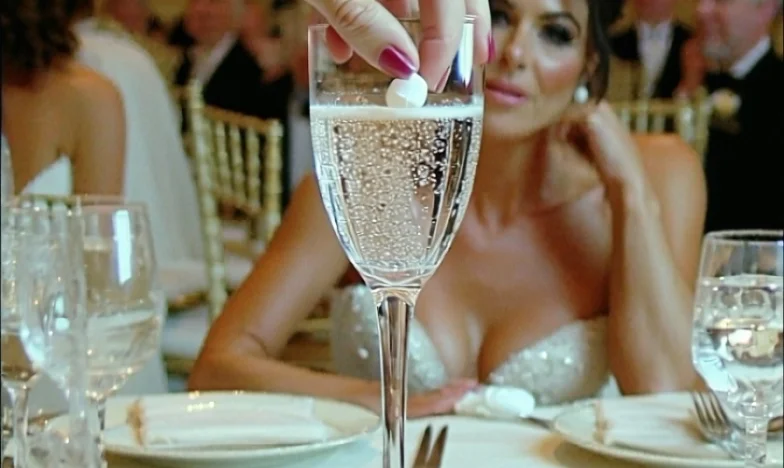
On My Wedding Day, I Swapped the Glasses: The Secret My Mother-in-Law Tried to Bury

The first thing I remember is the way the crystal glass caught the light—how it shimmered on the white linen, right there at the head table. The ballroom was buzzing with laughter and clinking silverware, but all I could hear was my own heartbeat, thudding in my ears. My hands were shaking, but I tried to steady them as I watched her: Linda, my new mother-in-law, hovering over my glass with a smile that didn’t reach her eyes.
“Emily, honey, you look so beautiful,” she said, her voice syrupy sweet. She reached out to adjust my veil, but her hand lingered a moment too long over my champagne. Three seconds. That’s all it took for me to see the tiny white pill slip from her palm and dissolve into the bubbles.
I froze. My mind raced through every Lifetime movie I’d ever watched, every warning my own mother had whispered about Linda’s jealousy and possessiveness. But this was real. This was happening to me.
“Everything okay?” my husband, Tyler, asked, squeezing my hand under the table. He looked so happy, so oblivious. I wanted to scream.
“Yeah,” I lied, forcing a smile. “Just a little nervous.”
Linda raised her own glass for the toast. “To Emily and Tyler—may your love last forever.”
I glanced at the two glasses—mine and hers—identical except for the faint swirl in mine where the pill was dissolving. My heart hammered as I made a decision that would change everything. As everyone stood for the toast, I reached for Linda’s glass instead of mine and handed her mine with a trembling hand.
“Here, Linda,” I said softly. “You should have the bride’s glass.”
She hesitated, eyes narrowing for just a split second before she plastered on that fake smile again. “Why, thank you, dear.”
We clinked glasses. She drank. I watched.
The rest of the night blurred by in a haze of forced laughter and fake smiles. Linda grew pale and quiet as the evening wore on. By dessert, she excused herself to the restroom and never returned.
Tyler found me outside on the balcony an hour later, shivering in my wedding dress.
“Em, what’s going on? Mom’s sick—Dad’s taking her home.”
I stared at him, searching his face for any sign that he knew what his mother had done. But he just looked confused and worried.
“I think your mom tried to poison me,” I whispered.
He laughed—a short, nervous bark. “What? Emily, that’s crazy.”
I told him everything: the pill, the switch, the way Linda had looked at me all year as we planned the wedding. Tyler’s face went from disbelief to anger to something like fear.
“You’re serious?” he asked finally.
“I’m serious.”
He ran a hand through his hair. “We need to go to the hospital. We need to find out what she took.”
But by then it was too late—Linda had left with Tyler’s dad, and no one answered their phones all night.
The next morning was Christmas Eve. Instead of waking up in our honeymoon suite with breakfast in bed, we were sitting in a sterile hospital waiting room while doctors ran tests on Linda. She’d collapsed at home—unconscious but alive.
Tyler’s dad glared at me when we arrived. “What did you do?” he hissed.
I wanted to scream that it wasn’t me—that Linda had tried to hurt me—but no one wanted to hear it. Not on Christmas Eve. Not after a wedding.
The doctors said it was an accidental overdose of sleeping pills—maybe she’d mixed up her medications in all the excitement. Tyler’s dad believed it. Tyler wanted to believe it. But I saw the way Linda looked at me from her hospital bed—cold and calculating.
That night, Tyler and I fought for hours in our tiny apartment above his dad’s garage—the place we’d planned to live until we could afford our own house. He accused me of making things up, of trying to ruin his family. I accused him of not protecting me.
“Why would she do that?” he shouted finally. “Why would my mom want to hurt you?”
I couldn’t answer him—not really. All I knew was that Linda had always hated me: for taking Tyler away from her, for not being good enough, for not being what she wanted for her only son.
Christmas morning came with no presents and no peace. Tyler left early to see his mom; I stayed home alone, staring at our unopened wedding gifts and wondering if this was what marriage was supposed to feel like.
Days turned into weeks. Linda recovered physically but refused to speak to me or see me. Tyler grew distant—caught between his loyalty to his mother and his love for me. Our first New Year’s Eve as husband and wife passed in silence; we watched the ball drop on TV from opposite ends of the couch.
One night in February, after another fight about Linda, Tyler packed a bag and left.
“I need space,” he said quietly. “I can’t do this anymore.”
I watched him go, tears streaming down my face, wondering how everything had gone so wrong so fast.
For months after that, I replayed that moment at the wedding over and over in my mind—the glass, the pill, the choice I made. Was I paranoid? Was I right? Did I destroy my own marriage by refusing to let it go?
Eventually, Tyler filed for divorce. The papers arrived on a rainy day in April—my name spelled wrong on the first page. It felt like a joke.
I moved out of his dad’s garage apartment and back in with my parents in Ohio. My mom hugged me tight and told me I’d done the right thing—that sometimes family isn’t who you’re born with or who you marry into, but who stands by you when everything falls apart.
It took a long time to heal—to stop blaming myself for loving someone whose family would never accept me. But slowly, I started to rebuild: new job, new friends, new dreams that didn’t include Tyler or Linda or anyone who made me feel small.
Sometimes I still wonder what would have happened if I hadn’t switched those glasses—if I’d just trusted Linda or ignored that flicker of suspicion. Would things have been different? Would Tyler have believed me then?
But deep down, I know I did what I had to do—to survive, to protect myself when no one else would.
Now, every time I see a bride raise her glass at a wedding toast, I think about how quickly everything can change—and how sometimes the hardest choices are the ones that save us.
Do you think you would have done what I did? Or would you have trusted your new family—even when your gut told you not to?