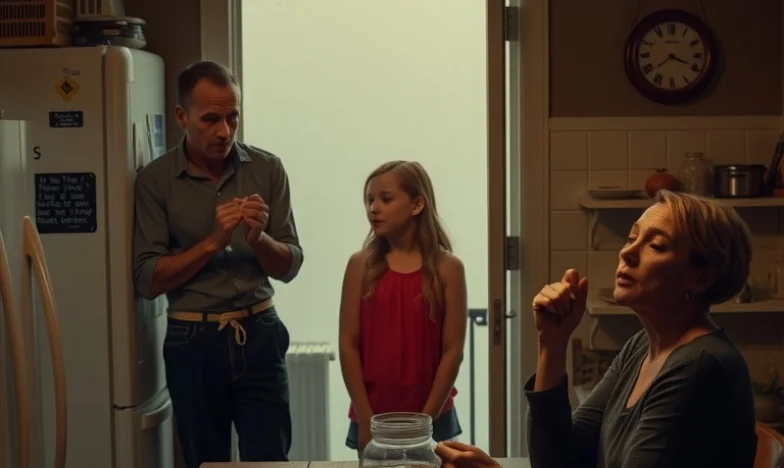
My Son-in-Law, the Troublemaker: When Justice Tears a Family Apart

“You got fired again?” I asked, my voice trembling as I clutched the phone. The kitchen clock ticked louder than usual, and I could hear my daughter, Emily, crying softly in the next room.
Peter’s voice was tight, defensive. “I couldn’t just stand by, Martha. They were cheating the workers out of overtime. Someone had to say something.”
I closed my eyes, pressing my palm to my forehead. This was the third job he’d lost in less than a year. And every time, it was the same story: Peter, my son-in-law, standing up for what he called ‘justice,’ and our family left to pick up the pieces.
—
I never imagined my life would be like this. I grew up in a small town in Ohio, where people kept their heads down and worked hard. My husband, Tom, passed away five years ago, and since then, I’ve tried to be the glue that holds our family together. Emily moved back in with me after Peter lost his first job, bringing their two kids, Lily and Max. Our house, once quiet, now echoed with laughter, arguments, and the constant hum of worry.
Peter wasn’t a bad man. He loved his kids, and he loved Emily. But he had a temper, and a sense of right and wrong that was as rigid as steel. He’d grown up poor in Detroit, raised by a single mother who taught him never to let anyone walk over him. That lesson, I realized, had become both his armor and his curse.
The first time he lost his job, it was at a warehouse. He’d confronted his supervisor about unsafe working conditions. “They’re treating us like machines, Martha,” he’d said, his eyes blazing. “Someone has to stand up.”
I admired his courage, but I also saw the fear in Emily’s eyes. Rent was due. Groceries were running low. The kids needed new shoes. I offered to help, dipping into my savings, but I knew it wasn’t sustainable.
After that, it became a pattern. Peter would find work—at a factory, a construction site, a delivery company. He’d last a few months, sometimes only weeks, before another confrontation. Sometimes it was about wages, sometimes about safety, sometimes about a coworker being mistreated. Each time, he’d come home with a pink slip and a story about how he’d tried to do the right thing.
Emily tried to be supportive, but I could see the strain wearing her down. She took on a part-time job at the grocery store, working nights so Peter could watch the kids during the day. Our schedules became a patchwork of exhaustion and resentment.
One evening, after the kids were in bed, Emily sat at the kitchen table, her head in her hands. “I can’t do this anymore, Mom,” she whispered. “I love him, but I need stability. The kids need stability.”
I reached across the table, squeezing her hand. “He’s trying, honey. He just… doesn’t know how to stop fighting.”
She looked up at me, tears in her eyes. “But what about us? Who’s fighting for us?”
—
The next morning, Peter stormed in, slamming the door behind him. “They’re all cowards!” he shouted. “Nobody wants to stand up for what’s right!”
I tried to keep my voice calm. “Peter, you have to think about your family. Maybe sometimes it’s better to just… let things go.”
He glared at me. “That’s what’s wrong with this country, Martha. People just let things go. That’s why nothing ever changes.”
I wanted to scream. Instead, I took a deep breath. “But what about Emily? What about Lily and Max? They need you. They need you to keep a job.”
He looked away, jaw clenched. “I know. I’m trying.”
But I could see the storm brewing inside him, the battle between his principles and his responsibilities.
—
A few weeks later, Peter found another job, this time at a local hardware store. For a while, things seemed better. He came home tired but in good spirits. Emily smiled more. The kids laughed louder. I dared to hope.
Then, one night, Peter came home late, his face red with anger. “They’re stealing from the customers,” he said. “Overcharging for supplies, lying about discounts. I called them out in front of everyone.”
Emily’s face fell. “Peter, please. Just this once, can’t you let it go?”
He shook his head. “I can’t, Em. I can’t be part of something like that.”
The next day, he was fired.
—
That night, the house was silent. Emily didn’t speak to him. The kids sensed the tension and tiptoed around us. I sat in my room, staring at the ceiling, wondering how much more we could take.
The next morning, Emily packed a bag. “I’m taking the kids to my sister’s for a few days,” she said quietly. “I need to think.”
Peter watched her go, his face crumpling. For the first time, I saw fear in his eyes—not anger, not defiance, but real, raw fear.
He sat at the kitchen table, head in his hands. “I don’t know how to stop, Martha,” he whispered. “I don’t know how to be any different.”
I sat beside him, my own heart breaking. “Maybe you don’t have to stop caring about what’s right. But you have to find a way to care for your family, too. Maybe… maybe you need help.”
He looked at me, tears in his eyes. “I don’t want to lose them.”
—
Emily came back after a week. She and Peter talked late into the night. I heard their voices—sometimes angry, sometimes soft, sometimes just silent. In the morning, they told me they were going to try counseling. Peter promised to look for work, but also to work on himself.
It wasn’t a fairy-tale ending. Money was still tight. There were still arguments, still moments when Peter’s anger flared. But there were also moments of hope—Peter apologizing to the kids after snapping at them, Emily hugging him after a long day, the four of them laughing over pancakes on a Sunday morning.
I don’t know what the future holds. I still worry, every day, that the next job will end like the last. But I also see the strength in my daughter, the love in my grandchildren, and the stubborn hope in my son-in-law.
Sometimes, I wonder if justice and peace can ever truly live under the same roof. But I know this: family is worth fighting for, too.
Based on a true story.