An Unexpected Letter: Family Ties and Financial Strain

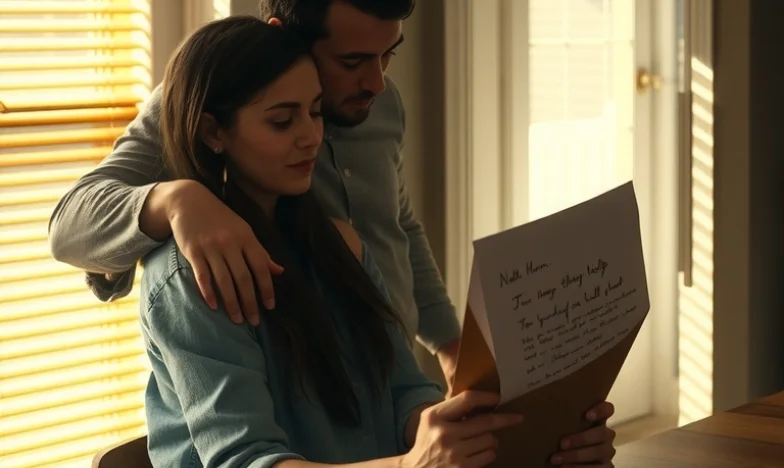
The envelope was thick, the handwriting unmistakably hers—neat, practiced, and cold. I stood in the kitchen, the late afternoon sun slanting through the blinds, the world suddenly too quiet. My hands trembled as I slid my finger under the flap, heart pounding. Ruben glanced up from his laptop, concern flickering in his eyes.
“Everything okay, Jess?” he asked, his voice gentle.
I didn’t answer right away. Instead, I unfolded the letter, my mother’s words staring back at me in black ink: “Jessica, I am writing to formally request your assistance. My financial situation has become untenable. I need your help.”
The words felt like a punch. My mother, who had always prided herself on her independence, who had never once said she needed me—not even when Dad left, not when I moved out at seventeen—was now asking for money. Not a phone call, not a visit. A letter, formal and distant, like a business transaction.
I sat down hard at the kitchen table. Ruben closed his laptop and moved to sit beside me, his hand covering mine. “What is it?”
I handed him the letter. He read it, his brow furrowing. “Wow. Did you know things were this bad?”
I shook my head. “She never tells me anything. Not really.”
The silence between us was heavy. I could hear the hum of the refrigerator, the distant bark of a neighbor’s dog. My mind raced back to childhood—my mother’s stern face, her clipped tone, the way she’d dismiss my tears as weakness. I remembered the day I left home, suitcase in hand, her only words: “Don’t expect me to bail you out.”
Now, she was the one asking for help.
—
That night, I lay awake, staring at the ceiling. Ruben’s breathing was steady beside me, but my thoughts churned. I kept replaying the letter in my mind, the formality of it, the lack of warmth. Was this her way of reaching out? Or just another transaction, another obligation?
The next morning, over coffee, Ruben broke the silence. “What do you want to do?”
I shrugged. “I don’t know. Part of me wants to help her. But another part—”
He nodded. “You’re angry.”
I looked at him, surprised by the tears in my eyes. “I am. I’m angry that she only comes to me when she needs something. I’m angry that she never tried to understand me. And now, she wants money, not a relationship.”
Ruben reached across the table, squeezing my hand. “You don’t have to decide right away. But maybe this is a chance to talk. Really talk.”
I nodded, wiping my eyes. “Maybe.”
—
I called her that afternoon. My heart thudded as the phone rang. She answered on the third ring, her voice as brisk as ever. “Jessica.”
“Hi, Mom. I got your letter.”
A pause. “I thought it would be better in writing.”
“Why?”
She hesitated. “I didn’t want to put you on the spot. I know we haven’t…talked much.”
I swallowed. “No, we haven’t.”
Another silence. I could hear the clink of her coffee cup, the faint sound of the TV in the background. “I wouldn’t ask if I had any other choice.”
I took a deep breath. “How bad is it?”
She sighed. “I lost my job three months ago. The bills are piling up. I’m behind on the mortgage. I didn’t want to worry you.”
I felt a surge of conflicting emotions—anger, guilt, pity. “Why didn’t you tell me sooner?”
Her voice was small. “I didn’t want you to think I was weak.”
I closed my eyes, the old wounds aching. “You always told me not to be weak. Not to rely on anyone.”
She was quiet for a long moment. “I know. I’m sorry.”
The words hung between us, fragile and unfamiliar.
—
Ruben and I spent the next few days talking, arguing, weighing our options. We weren’t rich ourselves—student loans, a mortgage, daycare for our son, Ethan. But we could help, at least a little. The bigger question was whether I wanted to.
One evening, after Ethan was asleep, Ruben poured us each a glass of wine. “You know, Jess, helping her doesn’t mean you have to forgive everything. But maybe it’s a start.”
I stared into my glass. “What if she just takes the money and disappears again? What if nothing changes?”
He shrugged. “Then at least you tried. You did what you could.”
I nodded, feeling the weight of the decision pressing down on me.
—
I called my mother again. This time, my voice was steadier. “Mom, we can help with some of the bills. But I need something from you, too.”
She sounded wary. “What do you mean?”
“I want us to talk. Really talk. Not just about money. About everything. About Dad, about the past. About us.”
She was silent for so long I thought she’d hung up. Then, quietly: “Okay. I’d like that.”
—
The first few conversations were awkward, stilted. We danced around old hurts, old resentments. But slowly, something shifted. She told me about losing her job, about the fear that kept her up at night. I told her about my own struggles—postpartum depression after Ethan was born, the anxiety that sometimes threatened to swallow me whole.
We cried together, for the first time in years.
One afternoon, she said, “I’m sorry I wasn’t there for you. I thought I was protecting you, making you strong. But I see now I was just pushing you away.”
I wiped my eyes. “I wanted you to be proud of me. But I always felt like I was never enough.”
She reached across the table, her hand trembling. “You’ve always been enough, Jessica. I just didn’t know how to show it.”
—
We sent her a check to cover the mortgage for two months. It wasn’t much, but it was enough to give her some breathing room. She started looking for work again, and I helped her update her resume. We talked every week, sometimes about money, but more often about life—about Ethan, about memories, about hope.
The anger didn’t disappear overnight. The wounds didn’t magically heal. But something new took root—a fragile, tentative trust.
—
One evening, as I watched Ethan play in the backyard, Ruben came up behind me, wrapping his arms around my waist. “You did a good thing, Jess.”
I leaned into him, feeling the warmth of his embrace. “I don’t know if it’s enough.”
He kissed my cheek. “Maybe it’s not about enough. Maybe it’s about trying.”
I nodded, watching the sun dip below the trees, the sky painted in shades of gold and pink. For the first time in a long time, I felt a glimmer of peace.
—
Family isn’t easy. It’s messy, complicated, full of old wounds and new demands. But sometimes, in the midst of the chaos, there’s a chance for something better—a chance to heal, to forgive, to begin again.
Would I do it all over? I don’t know. But I do know this: sometimes, the hardest conversations are the ones that matter most.
Based on a true story.