A Guest in My Own Daughter’s Home: The Story of Mary

The first night I slept in my daughter’s guest room, I stared at the ceiling, listening to the distant hum of the dishwasher and the muffled laughter from the living room. My suitcase sat unopened at the foot of the bed, a silent reminder that I was no longer the mistress of my own home.
I heard Emily’s voice—my daughter—soft and low, talking to her husband, Tom. I couldn’t make out the words, but I caught the tone: tense, weary. I pressed my hand to my chest, feeling the ache of loss, not just for my husband, but for the life I’d left behind.
“Mom, are you okay?” Emily’s voice startled me the next morning. She stood in the doorway, her hair pulled back, eyes tired.
“I’m fine, honey. Just… getting used to things.” I tried to smile, but it felt brittle.
She nodded, glancing at her phone. “Breakfast is ready if you want some.”
I followed her to the kitchen, where Tom sat reading the news on his tablet, their son, Jacob, already gone for school. The kitchen smelled of coffee and toast, but the air was thick with something unspoken.
—
After my husband, John, passed away last fall, the house felt impossibly empty. The silence was suffocating. Emily called every day, her voice bright and insistent: “Mom, you can’t stay there alone. Move in with us. We have the space.”
I resisted at first. I didn’t want to be a burden. But the loneliness wore me down, and when winter came, I packed my life into three suitcases and boarded a flight to Seattle.
The first weeks were awkward, but I told myself it was just an adjustment. I tried to help—folding laundry, cooking dinner, tidying up. But Emily would gently correct me: “Mom, we don’t use that detergent,” or “Tom likes his shirts hung, not folded.”
One evening, I made chicken pot pie, John’s favorite. Emily picked at her food, Tom barely touched his. “It’s a little heavy for a weeknight, Mom,” Emily said, forcing a smile. I swallowed my disappointment, telling myself I’d get it right next time.
I started to notice the small things. My things, tucked away in the guest room, never quite blending in. The family’s routines continued as if I were invisible. They watched shows I didn’t know, laughed at jokes I didn’t understand. I tried to join in, but the conversation always seemed to move just out of reach.
One afternoon, I overheard Emily on the phone. “She means well, but it’s like having a guest who never leaves. I just wish she’d… I don’t know, settle in or something.”
I sat on the edge of the bed, tears stinging my eyes. I wanted to go home, but I had no home to return to.
—
The days blurred together. I walked the neighborhood, trying to fill the hours. I volunteered at the library, hoping to find purpose. But every evening, I returned to the same guest room, the same polite distance.
One night, I heard Jacob arguing with Emily. “Why does Grandma have to live here? She’s always in my room, moving my stuff.”
Emily’s voice was sharp. “She’s family, Jacob. She needs us.”
I pressed my pillow over my ears, wishing I could disappear.
—
The turning point came on a rainy Saturday. Emily and Tom were arguing in the kitchen. Their voices rose, then fell, then rose again. I tried to stay out of the way, but Emily found me in the hallway.
“Mom, can we talk?”
I nodded, my heart pounding.
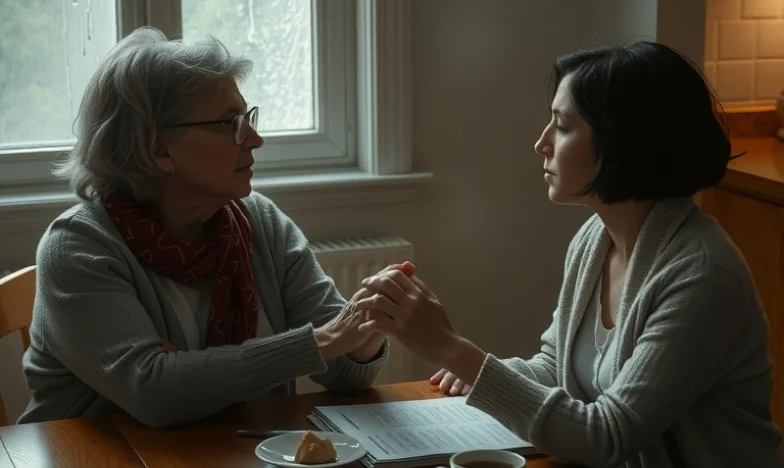
She sat across from me at the kitchen table, her hands twisting in her lap. “I know this isn’t easy for you. It’s not easy for us, either. We love you, but… it feels like we’re all walking on eggshells.”
I looked at her, really looked at her—the lines of worry on her face, the exhaustion in her eyes. “I never wanted to make things harder for you, Emily. I just… I didn’t want to be alone.”
She reached for my hand. “I know, Mom. I want you here. I just don’t know how to make it work.”
We sat in silence, the rain tapping against the window. I realized then that love wasn’t enough to bridge the gap between us. We were both grieving—her for the mother she remembered, me for the life I’d lost.
—
I started looking for senior apartments the next week. Emily helped, though her relief was obvious. We toured a few places together, and I found a small, sunny unit not far from their house.
On moving day, Emily hugged me tight. “You’ll always have a place with us, Mom.”
I smiled, tears in my eyes. “I know, honey. But I need a place of my own, too.”
—
Now, I visit Emily and her family every Sunday. We laugh, we share stories, and when I leave, I go home to my own space. The ache of loneliness is still there, but it’s softer now, edged with acceptance.
Sometimes, love means letting go—not of each other, but of the idea that family has to look a certain way. I’m still learning what it means to belong, even if it’s just to myself.
Based on a true story.