“Just a Little for Food!” – How One Request Changed My View of People and Family

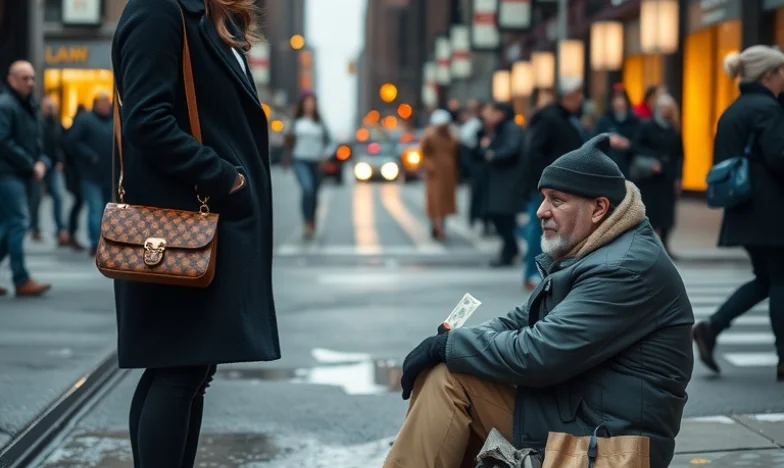
“Ma’am, could you spare just a little for food?”
The man’s voice was rough, desperate, and it cut through the icy wind that whipped down Michigan Avenue. I stopped, my gloved hand tightening around my purse. His eyes—blue, bloodshot, rimmed with exhaustion—met mine for a second. I could smell the city on him: sweat, diesel, old cigarettes.
I hesitated. My mother’s voice echoed in my head: “Don’t trust anyone who begs. They’ll just use it for booze.” But something in his face—maybe the way his lips trembled, maybe the way he looked away, ashamed—made me pause.
“Are you really hungry?” I asked, my own voice barely above a whisper.
He nodded. “Just a little for food. Please.”
I reached into my wallet and handed him a five. He took it like it was a lifeline, mumbling thanks, and shuffled away. I watched him disappear into the crowd, my heart pounding.
That night, at dinner, I told my family what happened. My father slammed his fork down. “You did what?!”
My brother, Matt, rolled his eyes. “You know he’s just gonna buy booze, right?”
I felt my cheeks burn. “He said he was hungry. I believed him.”
My mom sighed, her voice tired. “Honey, you can’t save everyone. People take advantage.”
I pushed my plate away, appetite gone. “Why is it so hard to believe someone might just need help?”
The argument spiraled. Dad accused me of being naïve. Matt called me a sucker. Mom tried to mediate, but her words only made me feel more alone. I stormed upstairs, slamming my door, tears stinging my eyes.
Lying in bed, I replayed the scene over and over. Was I really that gullible? Or were they just too cynical? I remembered being a kid, watching my parents drop coins in the Salvation Army bucket every Christmas. When did we become so suspicious?
The next morning, I woke up early, unable to shake the heaviness in my chest. I skipped breakfast and walked back downtown. I found the man from yesterday sitting on a bench, clutching a paper bag. My heart sank. Was Matt right?
I sat beside him. “Did you get something to eat?”
He looked startled, then nodded. “Yeah. Got a sandwich. Thanks.”
I glanced at the bag. It was from a deli. Relief flooded me, mixed with shame for doubting him. We talked for a while. His name was Carl. He’d lost his job after a back injury, then his apartment. He had a daughter in Indiana he hadn’t seen in years. He told me he was trying to get enough money for a bus ticket.
I listened, really listened, for the first time in a long while. His story was messy, complicated, full of mistakes and regrets. But it was real.
When I got home, I tried to explain to my family what I’d learned. Dad shook his head. “You can’t trust every sob story.”
“But what if we never trust anyone?” I shot back. “What does that make us?”
Matt shrugged. “Safe.”
Mom looked at me, her eyes softening. “It’s hard, honey. We want to help, but we’re scared. People have hurt us before.”
I realized then that it wasn’t just about Carl. It was about us—our fears, our disappointments, the walls we’d built to protect ourselves. I saw how Dad’s business partner had stolen from him years ago, how Matt’s friend had lied about needing money for rent. I saw the cracks in our family, the way we’d all been let down.
But I also saw how those cracks kept us from reaching out, from believing in the good that still existed. I didn’t want to live like that.
A week later, I went back to see Carl. He was gone. I never found out if he made it to Indiana, if he saw his daughter again. But I kept thinking about him, about the way he’d thanked me, about the hope in his eyes when I listened.
I started volunteering at a local shelter. At first, my family thought it was a phase. But over time, they saw how much it meant to me. Mom even came with me once, serving soup and chatting with the women in line. Dad never said much, but he started leaving his change in the tip jar at the coffee shop.
We still argued, still disagreed about who to trust and how to help. But something shifted. We talked more, listened more. We tried to see the person behind the story, even when it was hard.
Sometimes, I still wonder if I was naïve that day on Michigan Avenue. Maybe I was. But I’d rather risk being fooled than lose my faith in people altogether.
Because sometimes, all it takes is a little for food—a little kindness, a little trust—to change everything.
Based on a true story.