A Little Boy’s Corn and the Billionaire’s Tears: An American Story of Loss and Hope

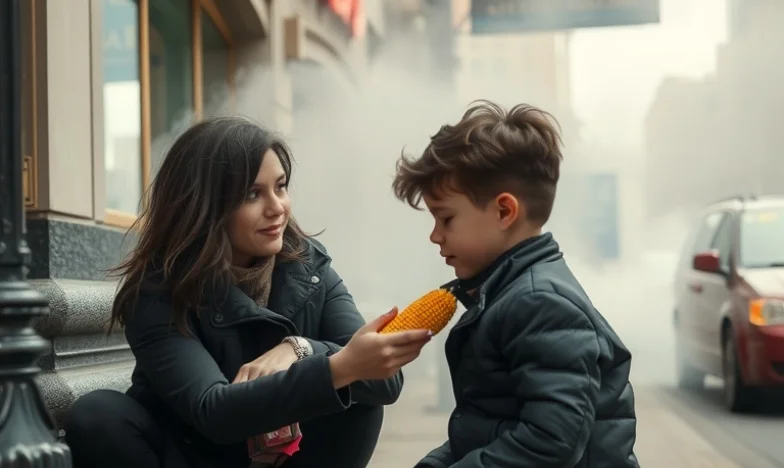
The wind off Lake Michigan cut through my jacket like a knife, and I huddled closer to the steam vent outside the old Marshall Field’s building. My hands were numb, but I clutched the ear of corn I’d managed to snag from a vendor’s trash. It was my only meal for the day, maybe for two. I was used to hunger, but that morning, something else gnawed at me—a kind of loneliness that made the city’s noise seem far away.
That’s when I saw her. She was sitting on the curb, her knees pulled up to her chest, her face hidden behind a curtain of perfect brown hair. Even through the tears, I recognized her. Isabela Ross. Her face was on billboards all over Chicago: ISABELA ROSS, CEO, ROSS GLOBAL HOLDINGS. She was the kind of woman people whispered about in awe or envy, the kind who owned penthouses and private jets. But right then, she looked like she had nothing at all.
I hesitated. What could a kid like me say to a woman like her? But something about the way her shoulders shook made me forget my own hunger. I shuffled over, holding out my corn. “Ma’am, are you okay?”
She looked up, mascara streaked down her cheeks. Her eyes were red, but sharp. “Do I look okay to you?” she snapped, her voice brittle as glass.
I flinched, but didn’t move. “No, ma’am. But… you can have this. It’s not much, but it’s all I got.”
She stared at the corn, then at me. For a second, I thought she might laugh or yell. Instead, she took a shaky breath and said, “Why would you give me your only food?”
I shrugged. “You look like you need it more than me.”
She let out a sound—half laugh, half sob. “I could buy a thousand ears of corn. I could buy this whole block. But I can’t buy what I lost.”
I sat down beside her, ignoring the cold seeping through my jeans. “What did you lose?”
She was quiet for a long time. The city moved around us—cars honking, people rushing by, nobody noticing the billionaire and the beggar on the sidewalk. Finally, she whispered, “My son. He hasn’t spoken to me in three years. Today would’ve been his birthday.”
I didn’t know what to say. My own mom was gone—drugs, jail, the usual story. My dad was a ghost, a name on a birth certificate. I knew what it was to lose someone, but not like that.
“Maybe he’ll come back,” I said, my voice small.
She shook her head. “I don’t think so. I chose money over him. I thought I could fix everything with enough success. But you can’t buy forgiveness.”
We sat in silence. My stomach growled, but I ignored it. I thought about all the times I’d watched families through restaurant windows, laughing over burgers and fries, and wondered what it would be like to have someone miss me if I disappeared.
She handed the corn back to me. “You keep it, kid. But thank you.”
I pushed it back. “No, really. You need it.”
She smiled, a real smile this time, though her eyes were still sad. “What’s your name?”
“Eli. Eli Carter.”
She nodded. “I’m Isabela.”
“I know,” I said, grinning. “You’re famous.”
She laughed, and for a moment, she looked almost happy. “Not for the right reasons.”
A limo pulled up to the curb. A man in a suit jumped out, looking frantic. “Ms. Ross! We’ve been looking everywhere—”
She waved him off. “It’s fine, Mark. I just needed some air.”
He glanced at me, his eyes narrowing. “Is this boy bothering you?”
She shook her head. “No. He’s helping.”
Mark looked confused, but he didn’t argue. Isabela stood, brushing off her coat. She looked down at me. “Eli, do you have somewhere to go?”
I shook my head. “Not really.”
She hesitated, then reached into her purse and handed me a business card. “If you ever need anything, call me. I mean it.”
I stared at the card, not sure if it was a joke. But her eyes were serious. “Thank you, ma’am.”
She got into the limo and was gone, swallowed by the city.
That night, I slept in the shelter, the card clutched in my hand. I thought about calling her, but what would I say? I was just a kid with nothing to offer. But the next morning, I saw her on the news—Isabela Ross, announcing a new foundation for homeless youth. She talked about a boy who gave her his only food, and how he reminded her that kindness mattered more than money.
A week later, I called the number. Mark answered, and soon I was sitting in Isabela’s office, staring at the skyline from a chair that probably cost more than my mom’s old car. She offered me a place in her new program, a chance to go back to school, a real bed, real meals.
I took it. I worked hard. I got my GED, then a scholarship to college. Isabela and I stayed in touch—she became like a second mom. On Thanksgiving, she invited me to her house. Her son, Daniel, was there. They were talking again, slowly rebuilding what they’d lost.
One night, after dinner, Daniel and I sat on the porch, watching the snow fall. “You know,” he said, “my mom talks about you all the time. She says you saved her.”
I shook my head. “She saved me.”
He smiled. “Maybe you saved each other.”
Years later, when I graduated, Isabela was in the front row, cheering louder than anyone. She hugged me, tears in her eyes. “You gave me hope when I had none, Eli. Never forget that.”
Now, I work for her foundation, helping kids like I used to be. Every time I see someone lost or hurting, I remember that cold morning, the taste of hunger, and the warmth of a stranger’s gratitude.
Sometimes I wonder—how many lives could change if we all gave away our only ear of corn? What would happen if we saw each other, really saw each other, even just for a moment?