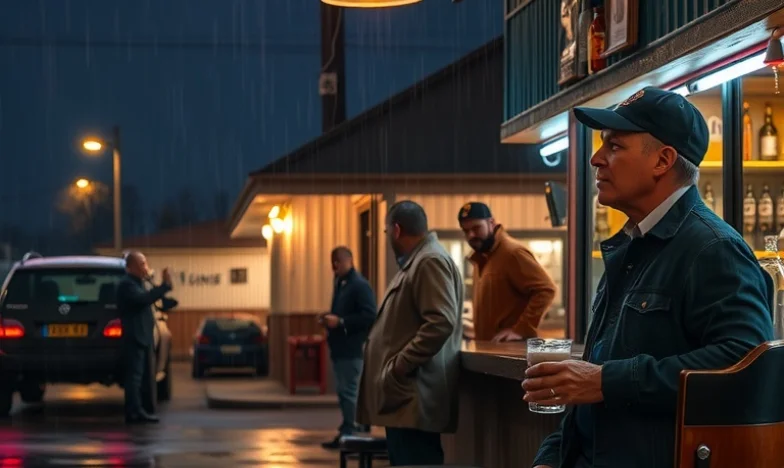
The Stranger at Murphy’s Bar: The Night I Learned What Strength Really Means

The rain hammered the windshield so hard I could barely see the faded sign: “Murphy’s Bar & Grill.” The neon flickered, half the letters dead, casting a sickly blue glow over the parking lot. I killed the engine of my Tesla and just sat there, listening to the storm and the hollow ache in my chest.
I was supposed to be on my way to a board meeting in Chicago, but something in me snapped two hours back on I-80. I turned off the highway, letting the GPS reroute, not caring where I ended up. I just needed to breathe, to get away from the endless demands, the fake smiles, the suffocating weight of being “Ethan Carter, billionaire tech mogul.”
I pushed open the bar’s door and was hit by the smell of fried food and spilled beer. The place was nearly empty—just a couple of truckers hunched over their drinks and a woman at the far end of the counter, her hair a tangled mess, rainwater dripping from her coat. The bartender, a grizzled man with a Red Sox cap, nodded at me. “Kitchen’s closing in ten.”
I slid onto a stool, ordered a coffee, and tried to disappear into my phone. But the Wi-Fi was down, and my cell signal was dead. For the first time in years, I was alone with my thoughts.
The woman at the end of the bar caught my eye. She looked up, her face streaked with mascara, eyes red and swollen. She raised her glass in a silent toast. I nodded back, awkwardly.
“Rough night?” she called, her voice hoarse.
I hesitated, then shrugged. “You could say that.”
She laughed, a bitter sound. “Join the club.”
I sipped my coffee, the silence stretching between us. The bartender turned up the radio, some old Springsteen song about lost dreams and broken promises. I felt the words settle in my bones.
After a while, she slid down a few stools, close enough that I could smell the cheap whiskey on her breath. “You look like you’ve got the world on your shoulders.”
I almost told her who I was. That I owned three houses, a private jet, and a company worth billions. That I could buy this whole bar and not notice the dent in my bank account. But instead, I just said, “Yeah. Feels like it.”
She studied me, her gaze sharp. “Money problems?”
I snorted. “Not exactly.”
She smiled, but it didn’t reach her eyes. “Lucky you.”
I wanted to ask her story, but something held me back. Maybe it was the way her hands shook as she lifted her glass, or the haunted look in her eyes. Instead, I asked, “You okay?”
She laughed again, softer this time. “You ever lose everything in one night?”
I shook my head. “No.”
She stared at her drink. “I did. Husband left. Took the kids. Lost my job the next day. Car broke down on the way to my sister’s. Now I’m here, waiting for a tow that probably won’t come.”
I felt a pang of guilt. I could fix her problems with a single phone call. But I didn’t offer. I just listened.
“You know what’s funny?” she said, voice trembling. “I always thought if I just worked hard enough, kept my head down, things would work out. But life doesn’t care how hard you try. Sometimes it just… breaks you.”
I looked at her, really looked. For the first time in years, I saw someone who wasn’t asking me for anything. She just wanted to be heard.
“I’m sorry,” I said, and meant it.
She wiped her eyes. “What about you? What’s your story?”
I hesitated. The words caught in my throat. “I spent my whole life chasing success. Built an empire. But somewhere along the way, I lost my family. My wife left last year. My son won’t talk to me. I have everything, and it feels like nothing.”
She nodded, understanding in her eyes. “Funny how that works.”
The bartender brought over another round, on the house. “You two look like you could use it.”
We drank in silence for a while, the storm raging outside. I felt something shift inside me—a crack in the armor I’d built around my heart.
“You know,” she said quietly, “sometimes the strongest thing you can do is ask for help. Or give it.”
I thought about all the times I’d thrown money at problems, hoping it would make them go away. All the people I’d ignored, too busy chasing the next big deal. My son’s last words to me echoed in my mind: “You care more about your company than your own family.”
I looked at the woman beside me. “What’s your name?”
She smiled, a real smile this time. “Maggie.”
“Ethan,” I said, offering my hand.
We sat there, two strangers in a forgotten bar, sharing the weight of our regrets. For the first time in a long time, I felt human.
The bar closed, and the bartender offered to call Maggie a cab. I paid her tab, quietly, and slipped the bartender a hundred to make sure she got home safe. As I stepped out into the rain, I felt lighter, as if I’d left some of my burdens behind.
Driving away, I called my son. It went to voicemail, but I left a message anyway. “Hey, it’s Dad. I’m sorry. I want to make things right. Call me.”
The next morning, I donated a million dollars to a local shelter. But more importantly, I showed up. I volunteered, listened to stories, handed out meals. For the first time, I gave something that couldn’t be measured in dollars.
Weeks passed. Maggie called me one night, just to say thank you. She’d found a job, was getting back on her feet. We talked for hours, two lost souls finding their way.
I’m still rich. But now, I measure my worth by the lives I touch, not the numbers in my account. That night in Murphy’s Bar changed everything.
Because true strength isn’t about what you own. It’s about the kindness you give, even when no one’s watching.
Based on a true story.