A Hundred Dollar Bill and a Moment of Truth: My Night at St. Mary’s ER

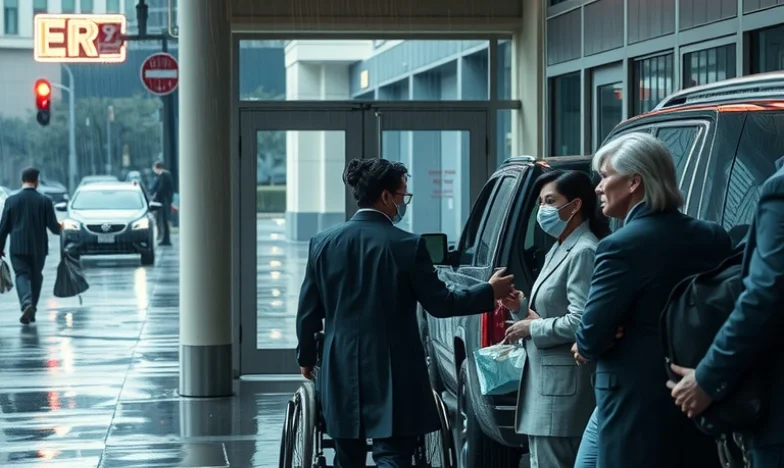
The rain was coming down in sheets, blurring the city lights as our black Escalade screeched to a halt in front of St. Mary’s ER. I barely waited for the valet to open my door before I rushed out, clutching my husband’s hand as he groaned in pain beside me. “Ma’am, we need a wheelchair!” I barked, my voice slicing through the chaos of the emergency entrance. My husband, Richard, was pale as a ghost, sweat beading on his forehead. His breathing was shallow, and every second felt like a countdown to something irreversible.
As the nurses swarmed around us, I caught sight of a woman huddled under the overhang, her hair matted, a battered duffel bag at her feet. She looked up at me with eyes that seemed to see right through my tailored coat and diamond earrings. I felt a flicker of annoyance—why did she have to be here, now, in my moment of crisis?
“Spare some change, ma’am?” she whispered, her voice barely audible over the rain and sirens. I didn’t even look at her. Instead, I reached into my purse, pulled out a crisp hundred-dollar bill, and tossed it at her feet. “Here. Get yourself something warm,” I said, my words clipped, my heart racing with fear for Richard. I didn’t wait for her thanks. I turned away, following the gurney as they wheeled my husband inside.
But as I passed, she called out, her voice suddenly strong and clear: “Money won’t fix what’s broken inside, honey.”
I stopped dead in my tracks. For a moment, the world seemed to tilt. The nurses’ voices faded, the beeping monitors and the smell of antiseptic all blurred into the background. I turned to look at her, really look at her. She was older than I’d thought, maybe in her fifties, with lines etched deep into her face. But her eyes—her eyes were sharp, almost accusing.
“Excuse me?” I snapped, my composure slipping. “You don’t know anything about me.”
She just shrugged, tucking the bill into her coat. “Maybe not. But I know pain when I see it.”
I wanted to scream at her, to tell her she had no right. But the truth was, I felt exposed, as if she’d peeled back the layers of my expensive clothes and seen the raw, aching mess underneath.
Inside, the hospital was chaos. Nurses rushed past, doctors barked orders, and the waiting room was packed with people clutching tissues, children, or each other. I sat in a stiff plastic chair, my coat still damp, my hands trembling. Richard was somewhere behind those double doors, and I had no idea if he’d come back out.
My phone buzzed. It was my daughter, Emily. “Mom, what’s happening? Is Dad okay?”
I hesitated. Emily was at college in Boston, and I hadn’t wanted to worry her. “He’s…he’s in surgery. They think it’s his heart.”
She started to cry. “I’m coming home. I’ll get the next flight.”
“No, Em, stay there. I’ll call you as soon as I know more.”
But she hung up, and I knew she’d be on her way, no matter what I said. I stared at the wall, at the faded posters about handwashing and flu shots, and felt utterly alone.
Hours passed. I watched as families came and went, some leaving with relief, others in tears. I thought about the woman outside. Her words echoed in my head: Money won’t fix what’s broken inside. Was she talking about Richard? About me? About us?
Richard and I had built a life that looked perfect from the outside. He was a partner at a big law firm; I ran a boutique in the city. We had a house in the suburbs, a lake cabin in Vermont, and a daughter at an Ivy League school. But lately, it felt like we were living parallel lives, passing each other in the hallway, our conversations reduced to logistics and pleasantries. The last time we’d laughed together, really laughed, I couldn’t even remember.
A nurse finally called my name. “Mrs. Carter? The doctor will see you now.”
I followed her down a maze of corridors, my heels clicking on the linoleum. The doctor was young, with tired eyes and a gentle voice. “Your husband had a massive heart attack. We were able to stabilize him, but he’s not out of the woods yet. He’s asking for you.”
I nodded, swallowing the lump in my throat. When I entered his room, Richard looked so small, so fragile, hooked up to tubes and monitors. He tried to smile. “Hey, Lizzie.”
I sat beside him, taking his hand. “You scared me half to death, you know.”
He squeezed my fingers, his grip weak. “I’m sorry. I guess I haven’t been taking care of myself. Or you.”
I blinked back tears. “We’ve both been…busy.”
He looked at me, really looked at me, for the first time in months. “Do you ever wonder how we got here?”
I nodded. “All the time.”
We sat in silence, the machines beeping a steady rhythm. I thought about the woman outside, about the money I’d thrown at her like it was a magic fix. I thought about all the times I’d tried to buy my way out of discomfort—donating to charities instead of volunteering, sending gifts instead of apologies, booking vacations instead of having hard conversations.
“Lizzie,” Richard whispered, “if I don’t make it—”
“Don’t,” I interrupted, my voice shaking. “Don’t say that.”
He squeezed my hand again. “If I don’t, I want you to know I love you. I always have. Even when I didn’t show it.”
Tears spilled down my cheeks. “I love you too. I’m sorry for…for everything. For not being here. For thinking money could fix things.”
He smiled, a real smile this time. “Maybe we get another chance. To do it right.”
I stayed with him until he drifted off to sleep. When I left his room, the sun was rising, painting the city in gold and pink. I walked outside, half-expecting the woman to be gone. But she was still there, sipping coffee from a paper cup, the hundred-dollar bill nowhere in sight.
I approached her, my heart pounding. “Thank you,” I said quietly. “For what you said last night.”
She looked up, her eyes softer now. “Didn’t say anything you didn’t already know.”
I nodded. “Maybe. But I needed to hear it.”
She smiled, a gap-toothed grin. “We all do, sometimes.”
I reached into my purse, but this time, I didn’t pull out money. Instead, I sat down beside her on the cold concrete, feeling the weight of the night settle into my bones. We talked for a while—about life, about loss, about the things money can’t buy. When I finally stood to leave, I felt lighter, as if a burden I’d carried for years had finally slipped away.
As I walked back inside to check on Richard, I wondered: How many times had I missed the chance to really see someone? To really be seen? Maybe this was our second chance, after all.
Would you have stopped to listen, or just kept walking? How many moments do we miss, thinking we already know the answers?