When Love Is All You Have Left: My Life After Emily’s Diagnosis

“David, can you help me with my hair?” Emily’s voice trembled from the bathroom, barely audible over the hum of the morning news. I stood frozen in the kitchen, coffee mug halfway to my lips, staring at the calendar where I’d circled her neurology appointment in red.
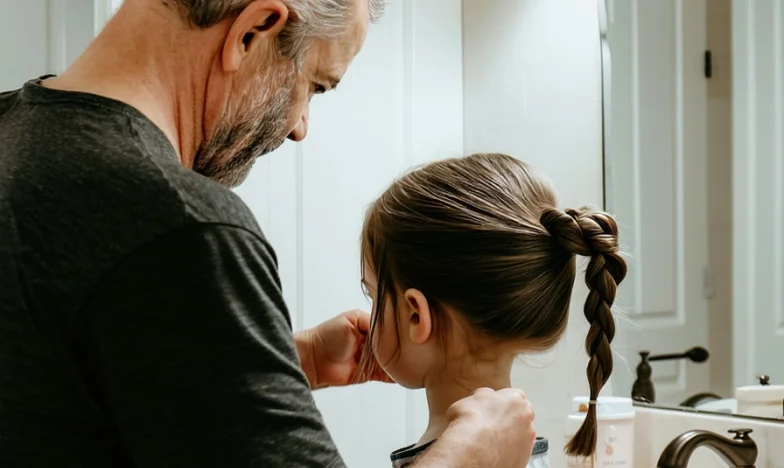
I’d never braided hair before. Not for our daughter, not for anyone. But that morning, with Emily’s hands shaking too much to grip a brush, I set my mug down and walked into the bathroom, heart pounding.
“Of course,” I said, forcing a smile. “Show me how.”
She handed me the brush and closed her eyes. “Just… do your best.”
—
That was the day everything changed. The day multiple sclerosis stopped being a distant threat and became our daily reality.
I’m David Miller—forty-two, father of two, husband to Emily for sixteen years. We live in a small town outside Columbus, Ohio. Until last year, our biggest worries were mortgage payments and PTA meetings. Now, every morning starts with a silent inventory: Can Emily walk today? Can she hold a fork? Will she remember the kids’ names?
The diagnosis came after months of unexplained fatigue and numbness in her legs. At first, we blamed it on stress—Emily worked full-time as a nurse, juggling night shifts and soccer practices. But when she collapsed in the grocery store aisle, clutching at cans of soup as her knees buckled, I knew something was terribly wrong.
The MRI confirmed it: lesions on her brain and spine. Multiple sclerosis. The doctor’s words echoed in my head for weeks: “There’s no cure. Only management.”
—
Our home changed overnight. Ramps replaced steps. Pill bottles lined the kitchen counter like soldiers. The kids—Sophie, twelve, and Ben, nine—watched with wide eyes as their mom transformed from energetic to exhausted.
One night, after tucking them in, Sophie whispered, “Is Mom going to die?”
I knelt beside her bed, fighting tears. “No, honey. She’s sick, but we’re going to help her. We’re a team.”
But inside, I was terrified.
Emily tried to keep her spirits up. She joked about her “wonky legs” and made up silly songs about her medication schedule. But some days she couldn’t get out of bed. On those days, I learned to braid Sophie’s hair for school—clumsy at first, but better with practice.
I learned to cook more than just spaghetti and grilled cheese. I learned to do laundry without shrinking everything pink. I learned that love isn’t flowers or fancy dinners—it’s holding someone’s hand through the worst pain of their life.
—
The hardest part wasn’t the physical changes—it was watching Emily lose pieces of herself.
One afternoon, she tried to help Ben with his math homework but couldn’t remember how to divide fractions. She burst into tears at the kitchen table.
“I’m useless,” she sobbed. “I can’t even help my own son.”
I wrapped my arms around her. “You’re not useless. You’re still his mom. You’re still my Emily.”
But I could see the fear in her eyes—the fear that one day she’d forget us all.
Our friends drifted away. At first they brought casseroles and cards, but as months passed and Emily’s illness didn’t improve, they stopped calling. It was just us—the four of us against the world.
Money got tight when Emily had to quit her job. My hours at the auto shop weren’t enough to cover everything. I picked up night shifts at a warehouse, sleeping in snatches between school drop-offs and doctor appointments.
Sometimes I resented it—the endless grind, the loneliness, the way people looked at us with pity or discomfort.
But then there were moments—small miracles—that kept me going.
Like when Ben made Emily a card that said “You’re still my superhero.” Or when Sophie learned to cook pancakes so Emily could rest on Saturdays.
Or when Emily smiled at me across the dinner table and whispered, “Thank you for not giving up on me.”
—
The turning point came one icy January night.
Emily had a bad fall in the bathroom—her legs just gave out beneath her. I heard the crash from the hallway and ran in to find her sobbing on the tile floor.
“I can’t do this anymore,” she gasped. “I’m ruining your life.”
I knelt beside her, heart breaking. “You are my life,” I said fiercely. “We promised ‘in sickness and in health.’ This is what that means.”
She shook her head. “You deserve better.”
I took her face in my hands. “There is no better than you.”
We sat there for a long time—her head on my shoulder, both of us crying quietly while snow fell outside.
That night changed us both. We stopped pretending everything was fine and started asking for help—from family, from neighbors, from support groups online.
We found a counselor who helped us talk about our fears without shame or guilt.
We learned that love isn’t about fixing someone—it’s about standing by them when they can’t fix themselves.
—
Life is still hard.
Some days Emily can walk around the block; other days she can barely sit up in bed.
I still mess up Sophie’s braids sometimes—she laughs and calls them “dad knots.” Ben still asks if Mom will ever get better.
But we’ve found a new kind of happiness—a quieter joy in small victories: a good day without pain; a family movie night; pancakes on Saturday mornings.
Sometimes I wonder what our lives would be like if Emily hadn’t gotten sick—if we’d be traveling or planning for college instead of fighting insurance companies and learning about wheelchairs.
But then I look at my family—at Emily’s tired smile, at our kids’ resilience—and I know this is still love. Maybe even more so than before.
—
If you’re reading this because you’re facing something similar—illness, loss, heartbreak—I want you to know: You’re not alone.
Love isn’t always pretty or easy or fair. Sometimes it’s just showing up every day, even when you’re scared or angry or exhausted beyond words.
Sometimes it’s learning to braid hair with shaking hands.
And sometimes it’s sitting on a cold bathroom floor in January, holding each other until the world feels safe again.
Based on a true story.