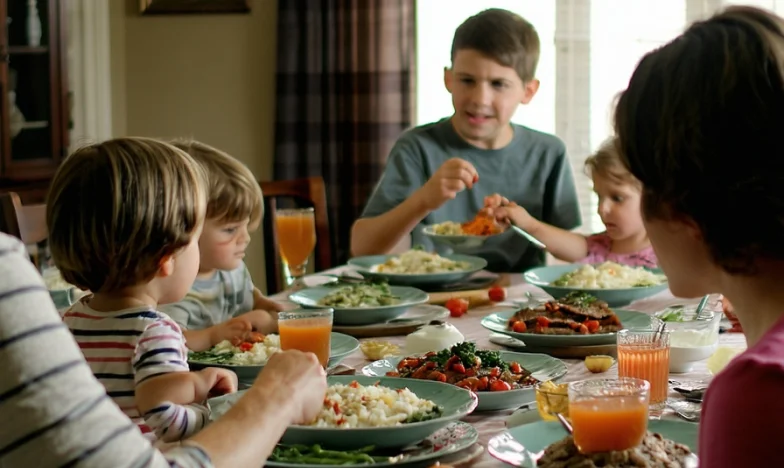
The Night My Family Fell Apart at the Dinner Table

“Why can’t you just listen for once in your life?”
My mother’s voice cracked like thunder across the dinner table. The fork in my hand trembled, peas rolling off onto the tablecloth. My father’s jaw clenched, his knuckles white around his glass of sweet tea. My little sister, Emily, stared at her plate, eyes wide and unblinking.
It was supposed to be a normal Thursday night. Meatloaf, mashed potatoes, green beans. The kind of meal that’s supposed to bring families together. But tonight, it felt like we were sitting on a fault line, waiting for the earth to split beneath us.
I could feel my heart pounding in my chest. I wanted to scream back, to tell her she never listened to me either. But the words stuck in my throat, thick and heavy.
Dad cleared his throat. “Let’s just eat, okay? We can talk about this later.”
But Mom wasn’t having it. “No, Tom. We always wait. We always pretend everything’s fine until it explodes.”
Emily’s fork clattered to her plate. “Can I be excused?”
“No,” Mom snapped. “You’re part of this family too.”
I stared at my mother, her eyes rimmed red from crying earlier in the kitchen. I’d heard her on the phone with Aunt Linda, voice low and desperate. Something about bills, about Dad’s job at the plant being on the line again.
I swallowed hard. “What do you want from me?”
She turned to me, her face softening for a moment. “I want you to care. I want you to stop shutting us out.”
I wanted to tell her that I did care. That I was drowning in schoolwork and college applications and the pressure to be perfect. That every day felt like walking a tightrope over a canyon.
But all I said was, “I’m trying.”
—
The days leading up to that night had been tense. Dad coming home later and later, his face drawn and tired. Mom snapping at everyone over the smallest things. Emily hiding in her room with her headphones on, blasting Taylor Swift loud enough for the whole house to hear.
I’d tried to keep my head down. Focus on my AP classes, my part-time job at the grocery store, my college essays. But the tension seeped into everything—my grades slipping, my friends asking if I was okay.
One afternoon, I found Mom crying in the laundry room. She wiped her eyes quickly when she saw me.
“Everything alright?” I asked.
She forced a smile. “Just tired, honey.”
But I knew it was more than that.
Dad had lost his job once before—two years ago when the plant cut half its staff. He’d found work again, but it never felt stable after that. Money was always tight. Arguments about bills echoed through the house late at night.
I started staying out later—study groups that lasted until midnight, shifts at the store that ran long. Anything to avoid coming home.
But home always caught up with me.
—
That Thursday night, everything boiled over.
Mom slammed her fist on the table. “You think you’re the only one with problems? We’re all struggling here!”
Dad stood up suddenly, his chair scraping against the tile. “That’s enough.”
“No,” Mom said quietly, tears streaming down her face now. “It’s not enough. We can’t keep pretending.”
Emily started crying too—silent tears running down her cheeks as she stared at her untouched food.
I felt something inside me snap.
“I’m sorry!” I shouted. “I’m sorry I’m not perfect! I’m sorry I can’t fix everything!”
The room went silent except for Emily’s quiet sobs.
Dad sat back down heavily, rubbing his temples.
Mom reached across the table for my hand, but I pulled away.
“I just want us to be okay,” she whispered.
—
That night, I lay awake in bed, staring at the ceiling fan spinning shadows across my room.
I thought about all the things we never said to each other—the fears we hid behind forced smiles and polite small talk. The way we tiptoed around each other’s pain, afraid that if we looked too closely, everything would fall apart.
The next morning, Dad left early for work without saying goodbye. Mom sat at the kitchen table with a mug of cold coffee, staring out the window.
Emily didn’t come out of her room at all.
At school, I couldn’t focus. My mind kept replaying the night before—the shouting, the tears, the way my family seemed to shatter right in front of me.
After my shift at the grocery store, I found myself sitting in my car in the parking lot long after everyone else had left. The radio played softly—some old country song about heartbreak and home.
I thought about driving somewhere—anywhere—but instead I went home.
—
The house was quiet when I walked in. Mom was asleep on the couch, an empty wine glass on the coffee table beside her. Dad’s truck wasn’t in the driveway.
I crept upstairs and knocked softly on Emily’s door.
“Em? Can I come in?”
No answer.
I opened the door anyway and found her curled up under her blanket, headphones still on.
“Hey,” I said gently, sitting on the edge of her bed.
She pulled off one earbud and looked at me with red-rimmed eyes.
“Are we gonna be okay?” she whispered.
I didn’t know how to answer her.
“I hope so,” I said finally.
She nodded and put her head on my shoulder. We sat like that for a long time—just breathing together in the dark.
—
The days that followed were awkward and quiet. Dad barely spoke to anyone; Mom moved through the house like a ghost; Emily clung to me like a lifeline.
One night, Mom knocked on my door.
“Can we talk?” she asked softly.
I nodded and she sat on my bed beside me.
“I’m sorry,” she said quietly. “For everything.”
I looked at her—really looked at her—and saw how tired she was. How scared.
“I’m scared too,” I admitted.
She took my hand and squeezed it tight.
“We’ll get through this,” she said. “We have to.”
—
Eventually, Dad came around too—apologizing for shutting us out, for letting his fear turn into anger. We started talking more—about money, about feelings, about what we needed from each other.
It wasn’t perfect—some days were still hard—but it was a start.
Sometimes I wonder if families are supposed to break a little—to let in light where there was only darkness before.
We’re still figuring it out—one dinner at a time.
Based on a true story.