The Night I Broke Into the Mansion: A Story of Survival, Secrets, and Second Chances

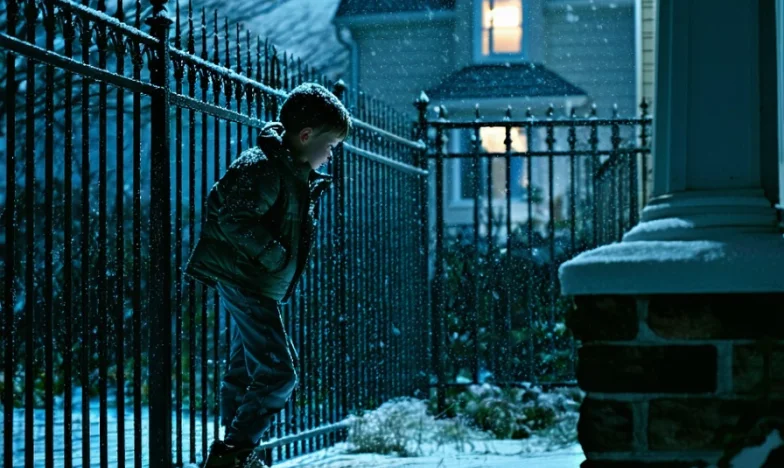
The wind screamed through the empty streets like it wanted to tear the world apart. My fingers were numb, my lips cracked, and every breath burned in my chest. I pressed my back against the stone wall, staring up at the iron fence that separated me from warmth, from safety, from everything I’d ever wanted.
“You can’t do this, Danny,” I whispered to myself. “You’ll get caught. You’ll go to juvie.”
But then I saw her—curled up on the porch of that mansion, shivering so hard her teeth rattled. A girl my age, maybe younger, in a silk nightgown that was already turning stiff with frost. Her hair was tangled around her face, and she looked so small. So alone.
I didn’t think. I just climbed.
—
The snowstorm had hit Connecticut harder than anyone expected. The news called it the worst in decades. But for me, every winter was a fight for survival. I’d been living on the streets since Mom disappeared and Dad got locked up. Shelters were full. Cops didn’t care. People looked away when they saw me.
That night, I’d been sleeping in the alley behind the bakery, wrapped in trash bags and cardboard. The cold woke me up—colder than anything I’d ever felt. That’s when I saw the lights flicker across the street, at the big house on Maple Lane.
I thought about breaking in just for food or a place to sleep. But when I saw her—when I realized she might die out there—I knew I had to do something.
—
The fence tore my jacket and scraped my leg raw. I landed hard on the other side, biting back a cry. The girl didn’t see me until I was right in front of her.
“Hey,” I said softly. “Are you okay?”
She flinched away, eyes wide and wild. “Go away!”
“You’re freezing,” I said. “You’ll die out here. Let me help you.”
She looked at me like she wanted to believe me but didn’t know how.
“My name’s Danny,” I said. “What’s yours?”
She hesitated. “Emily.”
I shrugged off my torn jacket and wrapped it around her shoulders. She was shaking so hard I thought she might break apart.
“Why are you out here?” I asked.
She looked at the door behind her—the huge oak door with brass handles—and then down at her bare feet.
“They locked me out,” she whispered.
—
We sat together on that porch, huddled against the wind, until my teeth started chattering too. I knew we wouldn’t last much longer.
“We have to get inside,” I said.
“It’s locked,” she said. “They don’t want me in there.”
I stared at her, trying to make sense of it. Why would anyone lock a kid out in a storm?
“Who’s inside?” I asked.
She shook her head, tears freezing on her cheeks.
I tried the door anyway—pushed and pulled until my hands hurt. Then I noticed a window around the side, half-open despite the cold.
“Come on,” I said, grabbing her hand.
We squeezed through together, falling into a dark hallway that smelled like lemon polish and old secrets.
—
Inside, everything was silent except for the ticking of a grandfather clock somewhere deep in the house. Emily clung to me like I was her only lifeline.
We crept through rooms bigger than any apartment I’d ever seen—rooms filled with expensive furniture and family portraits that stared down at us with cold eyes.
“Where are your parents?” I asked.
She didn’t answer.
We found a bathroom and ran hot water over our hands until we could feel them again. Emily started to cry—quietly at first, then harder, until she was sobbing into my shoulder.
“They hate me,” she whispered. “They say I ruin everything.”
I didn’t know what to say. My own parents had left me behind too—but at least they hadn’t locked me out in a blizzard.
—
We heard voices then—angry voices echoing down the hallway.
“Where is she? She’s always causing trouble!”
Emily’s face went white. She grabbed my hand and pulled me into a closet just as footsteps thundered past.
Through a crack in the door, I saw a man and woman—her parents, maybe—arguing about money, about Emily, about things I didn’t understand.
“She’s not even ours,” the woman hissed. “Why do we have to keep pretending?”
My heart stopped.
Emily squeezed my hand so tight it hurt.
—
We stayed hidden for what felt like hours. Emily told me everything in whispers—the adoption she’d overheard them talking about, the way they blamed her for their problems, how they threatened to send her away if she ever told anyone.
I told her about my mom disappearing after one too many fights with Dad, about foster homes that never lasted more than a week, about sleeping under bridges and stealing food just to stay alive.
For the first time in years, I felt like someone understood me.
—
Eventually, the house went quiet again. We crept out of our hiding place and found a pantry full of food—more than I’d seen in months. We ate until our stomachs hurt.
Emily smiled for the first time—a real smile that made her eyes shine.
“Thank you for saving me,” she said.
I shrugged, embarrassed. “You saved me too.”
—
But we couldn’t stay hidden forever. In the morning, her parents found us—me dirty and bleeding from my leg, Emily still wearing my jacket.
They called the cops. They screamed at us both—her for sneaking back inside, me for breaking in.
But when the police arrived and saw how cold we were—how scared—we finally told them everything: about being locked out, about being abandoned, about secrets no kid should ever have to keep.
—
The next few weeks were a blur of social workers and courtrooms and questions I didn’t know how to answer. Emily went into foster care; so did I—but this time, we were placed together.
We became each other’s family—the only family we could count on.
Sometimes at night, when the wind howls outside our new home, Emily squeezes my hand and whispers,
“We survived. We’re not alone anymore.”
And even though life is still hard—school is tough, people judge us for where we came from—I know we’ll make it through together.
Because sometimes you have to break into a mansion to find out what really matters: not money or blood or secrets—but love, and hope, and second chances.
Based on a true story.