The House I Was Hired to Clean Became My Home: A Nanny’s Secret Love for a Broken Family

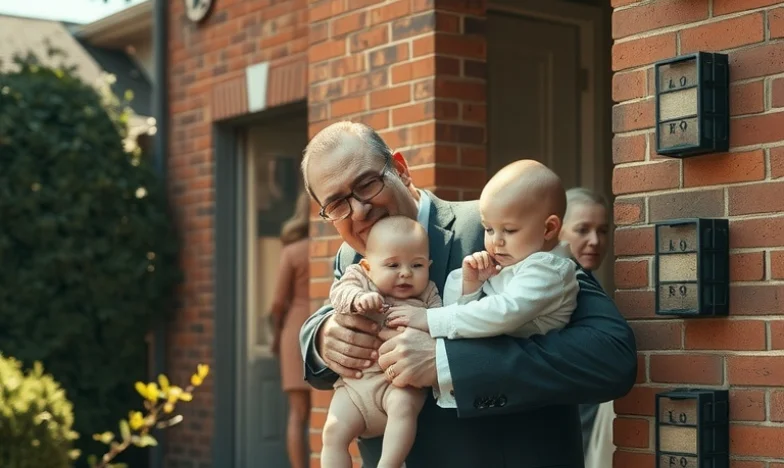
The first time I saw David, he was slumped against the red brick wall in the backyard, his navy suit streaked with dust, his tie hanging loose. In his arms, the twins—Emma and Caleb—were whimpering, their tiny fists clutching at the air. I stood in the doorway, clutching my cleaning caddy, and for a moment, I just watched. He looked so lost, so utterly defeated, that my heart twisted in my chest.
“Mr. Carter?” I called softly, stepping onto the porch. He didn’t look up. The babies’ cries grew louder, desperate. I set my caddy down and hurried over, kneeling beside him. “Let me help.”
He handed me Emma, his hands trembling. “I can’t… I don’t know what I’m doing, Sarah.”
I cradled the baby against my shoulder, rocking her gently. “You’re doing your best. That’s all anyone can ask.”
He let out a shaky breath, eyes red-rimmed. “Their mom always knew what to do. I’m just… I’m just trying to keep us all together.”
That was my first week working for the Carters. I’d answered a Craigslist ad for a housekeeper, not a nanny, but the job description changed the moment I saw those babies and the man who loved them, even if he didn’t know how to show it yet.
—
The house was big, too big for three people, and it echoed with the absence of laughter. Every morning, I’d arrive to find dishes piled in the sink, laundry spilling from baskets, and David already dressed for work, dark circles under his eyes. He’d hand me a list—clean the bathrooms, vacuum the living room, prep bottles for the twins—and then disappear into his home office, shutting the door behind him.
But the twins needed more than clean bottles and folded laundry. They needed someone to hold them, to sing to them, to wipe away their tears. I started staying later, rocking them to sleep when David’s meetings ran long. I learned their cries—Emma’s sharp and insistent, Caleb’s soft and mournful. I learned that David’s silence wasn’t coldness, but grief.
One afternoon, as I was folding tiny onesies in the nursery, David appeared in the doorway. He looked exhausted, but there was a softness in his eyes I hadn’t seen before.
“Sarah, I… I know this isn’t what you signed up for. If you want to quit, I’d understand.”
I shook my head. “I’m not going anywhere. They need me. And so do you.”
He nodded, swallowing hard. “Thank you.”
—
As the months passed, the house began to change. I started baking cookies on Sundays, filling the kitchen with the scent of chocolate and vanilla. I hung the twins’ artwork on the fridge. I planted sunflowers in the backyard, just outside the window where David worked. Slowly, laughter returned—first from the babies, then from David, hesitant at first, then genuine.
We became a team. I’d feed the twins while David read them stories. We’d take walks in the park, pushing the double stroller side by side. Sometimes, after the twins were asleep, we’d sit on the porch, sipping tea in comfortable silence.
One night, as a summer storm rattled the windows, David found me in the kitchen, wiping down the counters. He leaned against the doorway, watching me.
“Sarah, do you ever wish you had your own family?”
I paused, cloth in hand. “Sometimes. But I think… I think I’ve found one here.”
He stepped closer, his voice barely above a whisper. “Me too.”
—
But not everyone was happy with the changes. David’s mother, Evelyn, visited often, her eyes sharp and her words sharper.
“You’re just the help, Sarah. Don’t get too comfortable.”
I bit my tongue, forcing a polite smile. “I’m just doing what’s best for the twins.”
She scoffed. “They need family, not a stranger.”
I wanted to tell her that I loved those babies as if they were my own, that I’d do anything for them. But I kept quiet, knowing my place.
The tension grew. Evelyn began dropping hints to David—suggesting he hire a “proper” nanny, someone with credentials. She questioned my background, my intentions. I saw the doubt flicker in David’s eyes, and it broke my heart.
One evening, after Evelyn had left, David found me packing up my things.
“Are you leaving?” he asked, panic in his voice.
I shook my head, tears stinging my eyes. “I don’t want to cause trouble.”
He reached for my hand. “You’re not. Please, stay. I need you. The twins need you.”
I nodded, unable to speak.
—
The turning point came on a cold November night. Caleb spiked a fever, his tiny body burning with heat. David was frantic, pacing the living room, phone in hand.
“Should we go to the ER? What if it’s serious?”
I took charge, calling the pediatrician, soothing Caleb with cool compresses. I stayed up all night, holding him close, whispering lullabies. David sat beside me, his head in his hands.
“I don’t know what I’d do without you,” he whispered.
In that moment, I realized my feelings had changed. I wasn’t just the help. I was part of this family. I loved David, and I loved those babies.
But I was terrified. What if he didn’t feel the same? What if I lost everything?
—
A week later, as the first snow fell, David asked me to join him for dinner. The twins were asleep, the house quiet.
He poured me a glass of wine, his hands shaking. “Sarah, I need to tell you something.”
I held my breath.
“I’ve been so lost since Emily died. I never thought I’d feel anything again. But you… you brought this house back to life. You brought me back to life.”
Tears filled my eyes. “I love you, David. I love all of you.”
He reached across the table, taking my hand. “Stay. Not as the help. As family.”
I nodded, my heart full.
—
It wasn’t easy. Evelyn fought us every step of the way, insisting I was after David’s money, that I could never replace Emily. The neighbors gossiped. Even some of my own friends questioned my choices.
But I knew the truth. I knew the love I felt for David and the twins was real. I knew I belonged here.
We built a new life together, one day at a time. There were setbacks—tantrums, sleepless nights, doubts—but there was also laughter, warmth, and hope.
Sometimes, late at night, I’d stand in the backyard, looking at the brick wall where I’d first found David, broken and lost. Now, the wall was covered in ivy, and the yard echoed with the sound of children’s laughter.
This house, once just a job, had become my home. This family, once strangers, had become my heart.
And I wouldn’t trade it for anything.
Based on a true story.