The Envelope in the Trash: Betrayal, Power, and the Boy Who Saw the Truth

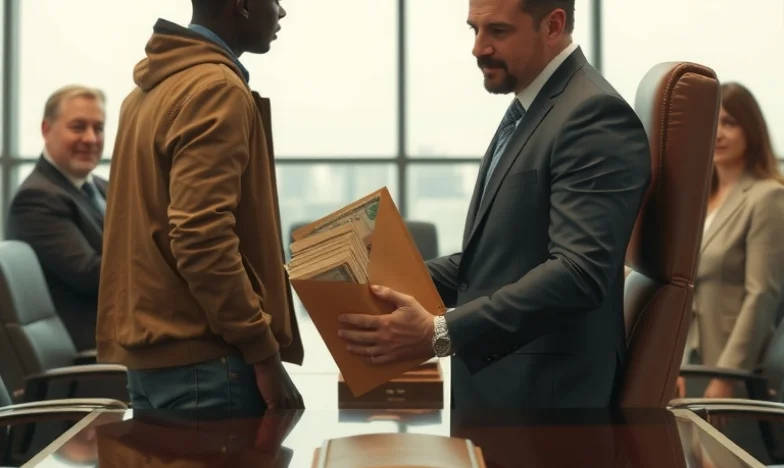
The leather chair groaned under Mr. Carter’s weight as he leaned back, his laughter echoing off the glass walls of the boardroom. “So you’re telling me you found this in the trash and thought you’d play hero?” His voice was sharp, mocking, and every executive at the table avoided my eyes.
I clutched the envelope tighter, my palms sweating. “I just thought—someone might be missing it. There’s a lot of cash inside.”
He smirked. “A street kid with a conscience. That’s a first.”
The silence that followed was suffocating. I could feel my heart pounding in my chest, my cheeks burning with shame and anger. I wanted to run, but my mom’s voice echoed in my head: “Do the right thing, even if it’s hard.”
—
I grew up in Newark, New Jersey, in a cramped apartment with peeling paint and a view of the alley. My mom, Lisa, worked two jobs—waitressing at night, cleaning offices during the day. I was supposed to be at school, but after Dad left, I started skipping to help her out. That’s how I ended up cleaning the offices of Carter & Sons, the biggest real estate firm in the city.
It was supposed to be a quick gig—empty the trash, vacuum the floors, don’t touch anything. But that night, as I was dumping the bins in the executive suite, I saw it: a thick, brown envelope, half-hidden under a pile of shredded paper. I picked it up, curiosity getting the better of me. Inside was a stack of hundred-dollar bills, crisp and new. My hands shook as I counted—ten thousand dollars, maybe more.
I could have walked away. God knows we needed the money. But something about the way it was hidden, the way the cleaning supervisor, Mr. Jenkins, watched me from the hallway, made my skin crawl. I decided to turn it in.
—
The next morning, I asked to see Mr. Carter. The receptionist looked me up and down—my Goodwill jacket, my scuffed sneakers—and wrinkled her nose. “Do you have an appointment?”
“No, but it’s important.”
She sighed and picked up the phone. Minutes later, I was ushered into the boardroom, where a dozen men in tailored suits sat around a gleaming table. Mr. Carter was at the head, his Rolex glinting in the sunlight.
I handed him the envelope. “I found this in the trash.”
He opened it, his eyes narrowing. “Where exactly did you find this?”
“In the executive suite. Last night.”
He glanced at the others. “Anyone missing an envelope?”
No one spoke. The tension was thick, electric. Finally, Mr. Carter laughed, the sound cold and hollow. “Well, isn’t this something. A janitor with a conscience.”
—
After that day, things changed. Mr. Jenkins started watching me more closely. My mom got a call from her boss—her hours were being cut. At home, the fridge was empty more often than not. I tried to talk to her about what happened, but she just shook her head. “Don’t get involved with those people, Danny. They don’t care about us.”
But I couldn’t let it go. I started noticing things—shredded documents in the trash, late-night meetings, envelopes passed between men in the parking lot. One night, I overheard Mr. Jenkins on the phone: “The kid’s a problem. He’s asking questions.”
I knew I was in over my head, but I couldn’t stop. I started taking pictures with my phone, recording conversations. I wanted to believe I was doing the right thing, but fear gnawed at me. What if they found out?
—
The breaking point came when my mom lost her job. She came home in tears, clutching her last paycheck. “They said I was stealing supplies. I never—Danny, I never did that.”
I hugged her, rage boiling inside me. “It’s because of me. I should have kept my mouth shut.”
She pulled away, her eyes fierce. “No. You did the right thing. Don’t let them scare you.”
But I was scared. I started sleeping with a baseball bat under my bed. I stopped going out after dark. At school, kids whispered behind my back—word had gotten out that I was a snitch.
—
One night, I caught Mr. Jenkins in the parking lot, handing an envelope to a man I’d never seen before. I snapped a picture, my hands shaking. The man turned, his eyes meeting mine. He smiled, slow and cruel.
The next day, my phone was gone. My locker was trashed, my backpack slashed open. I knew it was a warning.
I went to the police, but they just shrugged. “You got any proof, kid?”
I showed them the pictures I’d managed to save, but they said it wasn’t enough. “Come back when you have something concrete.”
—
I felt hopeless. My mom was out of work, I was failing school, and the men at Carter & Sons were untouchable. I thought about running away, starting over somewhere new. But then I remembered the look on my mom’s face when she told me not to give up.
So I went back. I started digging deeper, staying late after my cleaning shift, searching for anything that could bring them down. I found ledgers hidden in the supply closet, emails printed and stuffed in drawers. I copied everything, storing it on a flash drive I wore around my neck.
One night, I caught Mr. Carter himself in the act—handing a briefcase to a city official in exchange for a folder of permits. I recorded the whole thing, my heart pounding so loud I thought they’d hear it.
—
I took the evidence to a local reporter, Ms. Thompson. She listened to my story, her eyes wide. “This is huge, Danny. But you know they’ll come after you.”
“I don’t care. They ruined my mom’s life. They can’t get away with it.”
She published the story. The fallout was immediate—FBI raids, arrests, headlines splashed across every paper in the city. Carter & Sons collapsed overnight.
But the victory was bittersweet. My mom and I had to move—too many threats, too many enemies. I lost friends, my school, the only home I’d ever known.
—
Sometimes I wonder if it was worth it. The world is still full of men like Mr. Carter, still full of envelopes hidden in the trash. But I know I did the right thing. I know my mom is proud of me.
And maybe, just maybe, someone else will find the courage to do the same.
Based on a true story.