Sold Like Cattle: The Day My Life Changed in the Smoky Mountains

“You’re not even going to say goodbye?” My voice trembled as I stood in the kitchen, the faded linoleum cool beneath my bare feet. Mom wouldn’t meet my eyes. Dad just shoved a bundle into my arms—two threadbare dresses and a wooden comb, the one Grandma had carved for me when I was little. No hugs. No tears. Just the sound of the old screen door slamming behind me as I stepped out into the thick Tennessee morning, the air heavy with the scent of honeysuckle and something else—something rotten.
They’d sold me. Like cattle. Because I was ‘sterile,’ or so the doctor in town said after a rushed exam and a few whispered words to my father. I was nineteen, and in our little town of Pine Hollow, a woman who couldn’t give her husband children was as good as useless. I’d heard the whispers at church, the way Mrs. Jenkins looked at me with pity, the way my own mother’s hands shook when she braided my hair. But I never thought they’d actually send me away.
The truck that came for me was old, paint peeling, the engine coughing like a dying animal. The man behind the wheel was Sheriff Tomlinson, who wouldn’t look me in the eye either. “It’s for the best, Ellie,” he muttered, as if that made it true. I pressed my face to the window, watching the only home I’d ever known shrink behind me, the porch swing creaking in the wind.
We drove for hours, winding up into the Smoky Mountains, past fields of wildflowers and abandoned barns. Sheriff Tomlinson finally stopped at the edge of a dense forest. “He’s waiting for you,” he said, jerking his thumb toward a narrow path. “Marco. Folks call him the wild man, but he’s good people. Just… different.”
I clutched my bundle and stepped out, heart pounding. The woods swallowed me whole, the path barely visible beneath the ferns. I stumbled over roots, my breath coming in ragged gasps. Then I saw him—Marco. He stood by a cabin, tall and broad-shouldered, with a beard like a bear’s and eyes so blue they seemed to cut through the morning mist. He didn’t smile. He just nodded, as if he’d been expecting me all along.
“Ellie,” he said, his voice deep and rough. “Come inside.”
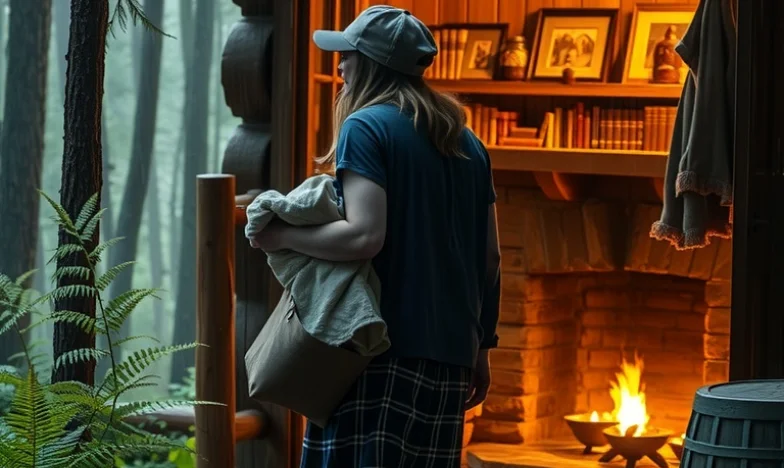
The cabin was small but warm, the walls lined with shelves of books and jars of preserves. A fire crackled in the hearth. Marco handed me a mug of sweet tea, his hands gentle despite their size. “You’re safe here,” he said simply. “No one’s gonna hurt you.”
I wanted to believe him, but the ache in my chest wouldn’t let me. I spent the first night curled on a cot, listening to the wind howl outside, wondering if my parents missed me at all. Marco kept his distance, busying himself with chores, but I caught him watching me sometimes, his gaze softening when he thought I wasn’t looking.
On the third day, I woke to the sound of thunder. Rain lashed the windows, turning the world outside to mud. I tried to help Marco with breakfast, but my hands shook so badly I dropped a plate. He caught it before it hit the floor, his fingers brushing mine. “You don’t have to be afraid,” he said quietly. “I know what they told you. But you’re not broken, Ellie. You’re not less.”
Something in his voice made me look at him—really look. “How do you know?” I whispered. “How can you be sure?”
He hesitated, then reached for a battered medical book on the shelf. “My sister. They said the same thing about her. Turned out, the doctor was wrong. Sometimes folks just want an easy answer for things they don’t understand.”
His words burrowed into me, a seed of hope I didn’t dare water. But that night, as the storm raged, I let myself cry for the first time. Marco sat beside me, silent but steady, his presence a comfort I hadn’t known I needed.
Days turned into weeks. I learned to chop wood, to can peaches, to read the weather in the shape of the clouds. Marco taught me how to fish in the creek, how to listen for the call of the whippoorwill at dusk. Slowly, the ache in my chest eased, replaced by something softer, something like belonging.
One evening, as we sat on the porch watching fireflies dance, Marco turned to me. “You ever think about going back?”
I shook my head. “There’s nothing for me there. Not anymore.”
He was quiet for a long time. “You deserve better, Ellie. You deserve a family who loves you for who you are, not what you can give them.”
I wanted to believe him. But the scars my parents left ran deep.
Then, one morning in late September, I woke up sick. Nausea, headaches, the works. I figured it was just a bug, but Marco looked at me with a strange intensity. “Ellie… when was your last period?”
The question hit me like a slap. I counted back, panic rising. It had been months. But that couldn’t be—could it?
Marco drove me to the clinic in town, his hand steady on mine the whole way. The nurse smiled kindly, running the tests with practiced efficiency. When she came back, her eyes were shining. “Congratulations, Ellie. You’re pregnant.”
The world spun. I couldn’t breathe. Pregnant? But I was supposed to be barren. That’s why they’d sent me away. That’s why my own mother couldn’t even look at me.
Marco hugged me, his arms strong and safe. “See? I told you. Sometimes people just want to believe the worst.”
The news spread through Pine Hollow like wildfire. My parents showed up at the cabin a week later, Mom’s eyes red-rimmed, Dad’s hat twisting in his hands. They wanted me to come home, to forgive them, to let them be part of my child’s life. The anger in me was a living thing, hot and wild. But Marco squeezed my hand, grounding me.
“I’m not coming back,” I told them, my voice steady. “You gave up on me. You believed a lie because it was easier than loving me.”
Mom sobbed, reaching for me, but I stepped back. “I have a family now. One that sees me for who I am.”
Thanksgiving came, and for the first time, I felt grateful—not for what I’d lost, but for what I’d found. Marco and I sat at our little table, the baby kicking inside me, the fire crackling in the hearth. Outside, the mountains stood silent and strong, just like Marco, just like me.
Sometimes I wonder what would have happened if I’d believed the lie. If I’d let their cruelty define me. But I didn’t. I found my own truth, right here in the wild heart of Tennessee.
Do we ever really know what we’re capable of until we’re forced to start over? Or is it the people who believe in us that make all the difference? I’d love to hear your thoughts.