She Whispered, ‘He Promised He Wouldn’t Hurt Me.’ What the Police Dog Found Changed Everything in Our Neighborhood

The morning sun filtered through the blinds, painting stripes across the carpet of my daughter’s room. I was halfway down the stairs when I heard her—soft, broken sobs, the kind that make a parent’s heart freeze.
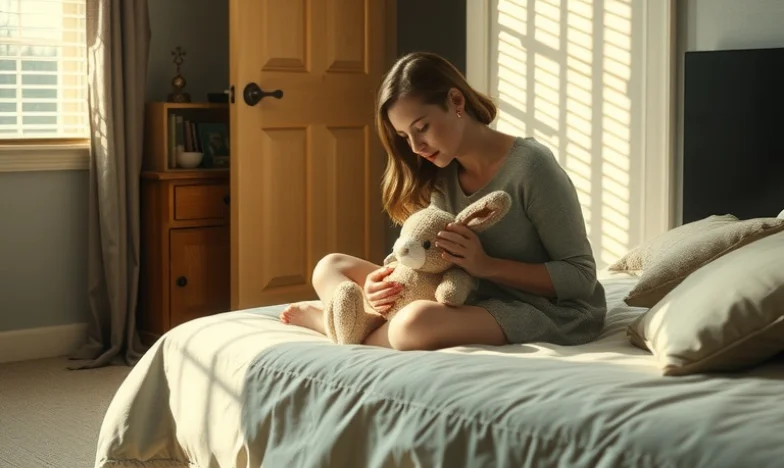
I dropped the dish towel and rushed back up. “Emma? Honey, what’s wrong?” My voice trembled as I pushed open her door. She sat on her bed, clutching her battered stuffed bunny, her knees drawn to her chest. Her eyes were red, her cheeks streaked with tears.
She looked up at me, voice barely a whisper. “He promised he wouldn’t hurt me, Mom.”
The words hit me like a punch. I knelt beside her, trying to keep my voice steady. “Who, sweetheart? What happened?”
She shook her head, burying her face in the bunny’s fur. I wrapped my arms around her, feeling her tiny body shudder. My mind raced—was it a nightmare? A bully at school? Or something worse?
—
Our neighborhood, Willow Creek, was the kind of place where everyone waved from their driveways and kids rode bikes until dusk. We moved here for the safety, the good schools, the sense of community. But that morning, as I held Emma, I realized how little I really knew about the world just beyond our white picket fence.
I called my husband, Mark, at work. He was silent for a long moment after I told him. “I’m coming home,” he said finally. “Don’t let her out of your sight.”
I tried to coax more from Emma, but she just shook her head, eyes wide and haunted. I called her pediatrician, who told me to bring her in right away. The doctor was gentle, asking Emma questions I couldn’t bear to hear. Emma wouldn’t say much, only that “he” had come into her room the night before, and that he’d promised not to hurt her.
The doctor’s face was grave. “I have to call the police,” she said quietly. “This is protocol.”
—
Detective Lisa Harper arrived that afternoon, her badge glinting in the sunlight. She knelt to Emma’s level, her voice soft. “Emma, can you tell me anything about the man who came into your room? Did you see his face?”
Emma shook her head. “He smelled like Daddy’s old jacket. And he had a dog.”
Lisa exchanged a look with me. “A dog? Did he bring the dog into your room?”
Emma nodded, then clammed up again. Lisa promised to help, and left us with a card and a warning: “Keep your doors locked. If you remember anything, call me.”
That night, Mark and I lay awake, listening to every creak and groan of the house. I replayed Emma’s words over and over. Who would do this? Someone we knew? A stranger?
—
The next morning, police cars lined our street. A K9 unit arrived, the German shepherd straining at his leash. Neighbors gathered on their lawns, whispering. The officer explained they were searching for any scent trail, any clue.
Emma clung to me as the dog sniffed around her window, then barked sharply. The handler called out, “He’s got something!”
They followed the dog to the edge of our backyard, where the fence was slightly ajar. There, hidden in the bushes, they found a child’s bracelet—Emma’s, the one she’d lost weeks ago. Next to it, a muddy footprint.
Detective Harper’s face was grim. “This wasn’t random. Whoever did this knew your yard.”
—
The investigation consumed our lives. Emma was terrified to sleep alone. Mark became obsessed, installing cameras, patrolling the yard at night. I felt like I was unraveling, every shadow a threat.
Rumors spread through Willow Creek. Some whispered about the new neighbor, Mr. Thompson, who kept to himself. Others eyed the teenage boys down the block. The sense of safety we’d cherished was gone, replaced by suspicion and fear.
One evening, Emma finally spoke. “He said he was sorry. He said he just wanted to see my bunny.”
I pressed her gently. “Did he hurt you, Emma?”
She shook her head. “He just sat on the floor. He cried.”
—
Detective Harper returned, her notepad full. “Emma, do you remember what the man looked like?”
Emma hesitated, then whispered, “He had a scar on his hand. And he smelled like smoke.”
Harper’s eyes narrowed. “Thank you, Emma. That helps a lot.”
The next day, police arrested Mr. Thompson. He confessed to breaking in, but insisted he never meant to hurt anyone. He’d lost his daughter years ago, he said, and seeing Emma’s bunny in the window had triggered something in him. He brought his dog, hoping to comfort himself. He’d sat on the floor and cried, then left when Emma woke up.
The community was stunned. Some neighbors defended him, citing his grief. Others were furious, demanding harsher punishment. Our family was caught in the middle—relieved Emma wasn’t physically harmed, but shaken by the violation.
—
The weeks that followed were a blur of therapy appointments and neighborhood meetings. Emma slept with the lights on. Mark and I argued constantly—about security, about moving, about how to help Emma heal.
One night, as I tucked Emma in, she looked up at me. “Mom, am I safe now?”
I hugged her tight. “Yes, sweetheart. You’re safe.”
But I wasn’t sure I believed it.
—
The emotional turning point came during a community meeting. Neighbors shouted, blaming each other, demanding answers. I stood up, my voice shaking. “We all want to feel safe. But we can’t let fear turn us against each other. We have to look out for our kids—and for each other.”
There was a long silence. Then Mrs. Ramirez, who lived across the street, nodded. “She’s right. We need to heal.”
Slowly, the anger faded. People began to talk, to listen. We started a neighborhood watch, organized playdates, and checked in on each other. Emma made a new friend, a little girl who’d just moved in. She started to smile again.
—
It’s been a year since that morning. Emma still sleeps with her bunny, but the nightmares have faded. Mark and I are closer, though the scars remain. Our neighborhood is different now—more cautious, but also more connected.
Sometimes I wonder what would have happened if Emma hadn’t spoken up. If the police dog hadn’t found that clue. If we’d let fear win.
But we didn’t. We faced the darkness together, and found a way back to the light.
Based on a true story.