She Grew Weaker Every Hour—And Only Our Nanny Knew Why

The first time I heard Emily’s cry that night, it was barely a whimper—thin, fragile, like a bird caught in a storm. I sat up in bed, heart pounding, straining to hear more. My husband, Mark, rolled over and mumbled, “She’s probably just hungry.” But I knew my daughter’s cries. This was different.
I rushed down the hall, my bare feet cold on the hardwood. Emily, just six months old, lay in her crib, her tiny fists curled, her face pale and damp. Her cry faded as I picked her up. She felt lighter than yesterday. Too light.
“Something’s wrong,” I whispered, rocking her gently. “Something’s really wrong.”
—
The next morning, I called Dr. Harris. He examined Emily, his brow furrowed. “She’s weak,” he said, “but her vitals are stable. Let’s run some tests.”
Days blurred together. Emily grew weaker, almost by the hour. She stopped smiling. She barely cried. Every bottle, every spoonful of food, she pushed away. Mark tried to reassure me, but I saw the fear in his eyes.
Our home—once filled with laughter—became a place of whispers and worry. My mother-in-law, Linda, moved in to help. She hovered, criticizing my every move. “You’re too anxious, Sarah. Babies sense that.”
But I knew it wasn’t me. Something was stealing my daughter from me, and no one could tell me what.
—
We hired a nanny, Maria, when I returned to work after maternity leave. She was quiet, efficient, always on time. Emily seemed to like her. But now, as Emily’s health declined, I started to question everything.
One afternoon, I came home early. Maria was in the kitchen, preparing a bottle. She jumped when she saw me. “Oh! Mrs. Turner, I didn’t hear you come in.”
I watched her hands shake as she screwed the cap on the bottle. “How’s Emily today?” I asked, forcing a smile.
“She’s… tired. Maybe she needs more rest.”
I nodded, but something in her tone made my skin crawl.
—
The doctors ran every test imaginable. Bloodwork, scans, specialists from the city. No answers. “It’s a mystery,” Dr. Harris admitted. “We just don’t know.”
Mark started sleeping in the guest room. He said he needed rest for work, but I knew he was avoiding me. Linda blamed me outright. “You’re her mother. You should know what’s wrong.”
I stopped sleeping. I watched Emily all night, counting her breaths, praying for a miracle.
—
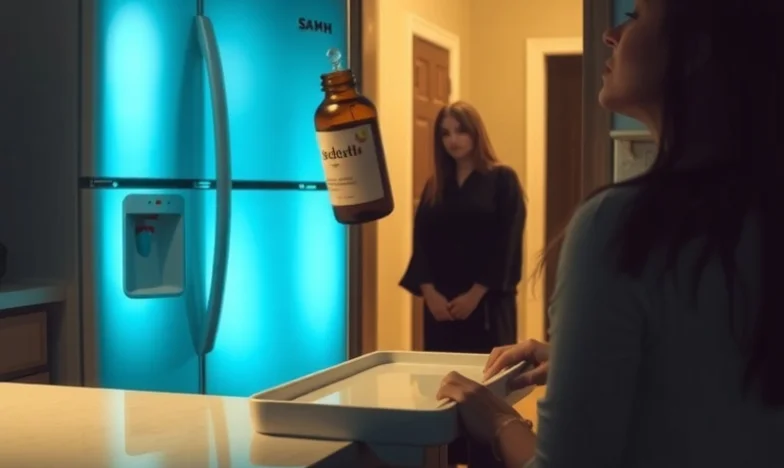
One night, I heard Maria in the kitchen long after midnight. I crept downstairs, careful not to make a sound. She was at the counter, pouring something from a small brown bottle into Emily’s formula.
My heart stopped. “What are you doing?”
Maria spun around, eyes wide. “It’s just vitamins. For her strength.”
I snatched the bottle from her hand. The label was in Spanish, but I recognized the word: sedante. Sedative.
Rage and terror crashed over me. “You’ve been drugging my baby?”
Maria’s face crumpled. “She cried so much. I just wanted her to sleep. I’m sorry, Mrs. Turner. I’m so sorry.”
—
I called 911. The police came. Maria was arrested. The doctors flushed Emily’s system, and slowly, painfully, she began to recover.
Mark and I sat in silence for days. He blamed me for hiring Maria. I blamed him for not being there. Linda moved out, disgusted with us both.
I held Emily every night, sobbing into her soft hair. I had failed her. I had trusted the wrong person. I didn’t know if I could ever forgive myself.
—
Months passed. Emily grew stronger. She learned to laugh again. Mark and I started therapy. We tried to rebuild, but the cracks remained.
Sometimes, late at night, I replay those weeks in my mind. I wonder what would have happened if I hadn’t come home early. If I hadn’t listened to my instincts.
Trust is fragile. Family is fragile. I learned that the hard way.
Would I ever trust someone with my child again? I don’t know.
But I do know this: I will never ignore my instincts again.
Based on a true story.