My Daughter Called: “We’re Leaving Tomorrow. Your Beach House and Car Are Sold. Goodbye.”

The fluorescent lights in Dr. Harris’s waiting room buzzed overhead, making my headache worse. I was scrolling through old photos on my phone—Angela’s graduation, our last Thanksgiving, the beach house in Cape May—when my phone rang. Angela’s name flashed on the screen. I smiled, expecting her usual, “Hey, Mom, how are you?” Instead, her voice was clipped, almost robotic. “Mom, we’re leaving tomorrow for Europe. Your beach house and your car are already sold. We needed the money. Bye.”
I stared at the phone, waiting for her to call back, to say it was a joke, but the line was dead. My heart hammered in my chest. I tried to call her back, but it went straight to voicemail. I sat there, numb, as the nurse called my name. “Mrs. Thompson? The doctor will see you now.”
I barely remember the appointment. Dr. Harris was talking about my cholesterol, but all I could think about was Angela’s voice. My only daughter. The girl I raised after her father died in that car accident when she was ten. The girl I worked double shifts for, so she could go to college. The girl who used to curl up in my lap and whisper, “I love you, Mommy.”
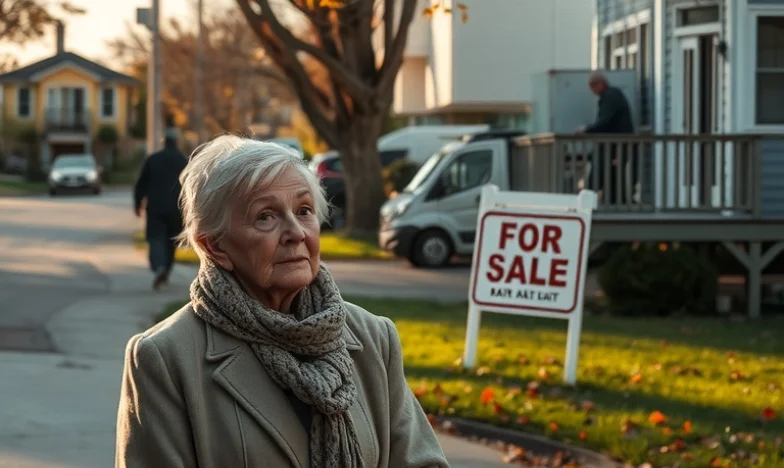
I drove home in a daze, my old Toyota feeling like a coffin. When I pulled into my driveway, I saw the For Sale sign on the lawn of the beach house next door. It hit me then—my own beach house, the one I’d saved for my whole life, was gone. Sold. Without my consent. My hands shook as I unlocked the door. The house felt empty, like Angela had already left.
I called my sister, Linda, in Ohio. “She did what?” Linda’s voice was sharp with disbelief. “She can’t just sell your things, Mary! That’s illegal!”
“I don’t know what to do,” I whispered, tears streaming down my face. “She’s all I have.”
Linda was quiet for a moment. “You need to talk to a lawyer. And you need to talk to Angela. This isn’t right.”
But Angela wouldn’t answer my calls. I tried her husband, Mark, but he texted back: “Angela needs space. We’ll be in touch.”
That night, I sat at the kitchen table, staring at the empty chair across from me. I remembered Christmases with Angela, the way she’d beg to open one present early. I remembered the summer we painted the beach house together, laughing as we got more paint on ourselves than the walls. I remembered the day she told me she was pregnant, how we cried and hugged and planned for the future.
Now, she was gone. And she’d taken everything with her.
The next morning, I drove to the beach house, hoping it was all a mistake. But the locks had been changed, and a moving truck was parked out front. A young couple was carrying boxes inside. I stood on the sidewalk, feeling like a ghost. The woman looked at me, her face kind. “Can I help you?”
I shook my head, unable to speak. I got back in my car and drove to the lawyer’s office. Mr. Jenkins listened as I told him what happened. He frowned, tapping his pen on the desk. “Did you ever give Angela power of attorney?”
I nodded, remembering the day I signed the papers after my heart surgery last year. “Just in case,” Angela had said. “So I can help with bills if you’re in the hospital.”
Mr. Jenkins sighed. “She had the legal right to sell your property. But morally… that’s another story.”
I left his office feeling more alone than ever. I spent the next week in a fog, packing up what little I had left. My car was gone, too—Angela had sold it to a neighbor. I took the bus to the grocery store, feeling old and invisible. At night, I lay awake, replaying every conversation I’d ever had with Angela, searching for clues. Had I missed something? Had I done something to make her hate me?
One afternoon, Linda called. “Come stay with me for a while. You shouldn’t be alone.”
I hesitated, pride warring with desperation. But in the end, I packed a suitcase and took a Greyhound to Ohio. Linda met me at the station, her arms open wide. “We’ll get through this,” she promised.
Thanksgiving came, and Linda’s house was full of laughter and the smell of turkey. Her grandkids ran around the table, and for a moment, I felt almost normal. But when Linda’s daughter hugged her, I felt a pang of jealousy so sharp it took my breath away. I missed Angela. I missed my old life.
On Christmas Eve, I got a postcard from Paris. Angela’s handwriting was neat, impersonal. “Hope you’re well. Europe is beautiful. Take care.” No apology. No explanation.
Linda tried to cheer me up. “Maybe she’ll come around. Maybe she just needed a fresh start.”
But I knew better. Something had broken between us, something I wasn’t sure could ever be fixed.
Months passed. I found a part-time job at the library, shelving books and helping kids with their homework. It wasn’t much, but it gave me a reason to get up in the morning. I made friends with the other librarians, and sometimes we’d go out for coffee after work. I started to feel like myself again, bit by bit.
But every night, I checked my phone, hoping for a message from Angela. I watched her life unfold on Facebook—photos of her in Rome, London, Prague. Smiling with Mark, drinking wine on a balcony. She looked happy. I wondered if she ever thought about me.
One day, I got a call from Mark. His voice was strained. “Mary, Angela’s in the hospital. She had a breakdown. She’s asking for you.”
I flew to Paris the next day, my heart pounding with fear and hope. When I walked into the hospital room, Angela looked so small, so fragile. She started to cry when she saw me. “I’m sorry, Mom. I didn’t know what else to do. We were drowning in debt. I thought if we left, started over, it would fix everything.”
I held her hand, my anger melting into sadness. “You should have told me. We could have figured it out together.”
She nodded, tears streaming down her face. “I was scared. I didn’t want you to see me fail.”
We talked for hours, picking through the wreckage of our relationship. It wasn’t easy. There were things I couldn’t forgive, not yet. But as I sat by her bed, I realized that love isn’t always neat or fair. Sometimes it’s messy and painful and full of mistakes.
When I returned to Ohio, I felt lighter. Angela and I talked every week, rebuilding trust one conversation at a time. I still missed my beach house, my car, my old life. But I had something better—a second chance with my daughter.
Now, when I sit at the kitchen table, I don’t see an empty chair. I see hope. I see forgiveness. I see the possibility of healing, even after the deepest wounds.
Sometimes I wonder—how do we forgive the people who hurt us most? And how do we find the strength to start over, when everything we’ve built is gone? Maybe that’s what being a family is all about.