Letters from the Shadows: Secrets Beneath Grandpa’s Cellar in Ohio

“You don’t have to go down there, Emily. Some things are better left alone.”
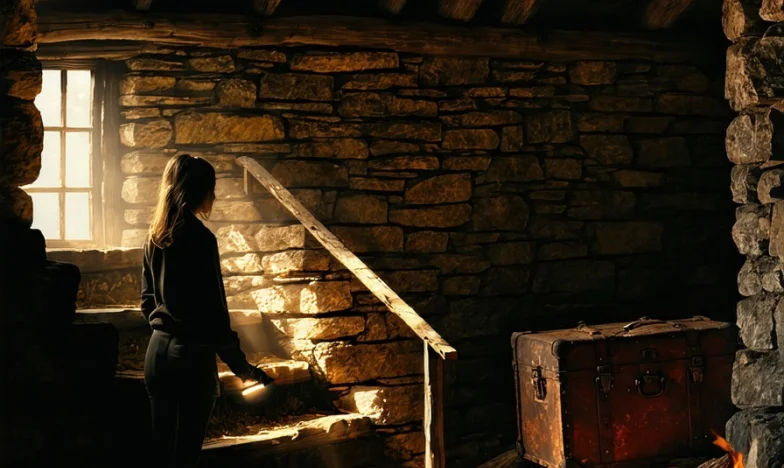
My mother’s voice echoed from the kitchen, brittle and sharp as the November wind rattling the windows of Grandpa’s old farmhouse. I stood at the top of the basement stairs, flashlight trembling in my hand, heart pounding so loud I thought she might hear it. The house smelled of dust and old wood, and beneath it all, a sour tang of secrets.
I was twenty-eight, newly divorced, and had just inherited this crumbling piece of rural Ohio after Grandpa passed away last spring. Thanksgiving was a week away, and the family expected me to host. But I couldn’t shake the feeling that something was waiting for me in that basement—something more than just boxes of canning jars and rusty tools.
“Mom,” I called back, “I need to find the breaker box. The lights keep flickering.”
She didn’t answer. I knew she hated this house, hated the memories it held. But I needed answers. My life had unraveled—my marriage gone, my job on hold—and this house was all I had left. Maybe if I understood Grandpa better, I could understand myself.
The stairs creaked under my weight. The flashlight beam danced across stone walls slick with moisture. At the bottom, I found the breaker box—and something else: a battered trunk wedged behind a pile of firewood.
I knelt, heart racing. The lock was rusted, but after a few tugs it snapped open. Inside were stacks of yellowed envelopes tied with twine, each addressed in Grandpa’s careful script: “To My Emily.”
I sat cross-legged on the cold concrete floor and opened the first letter. Grandpa’s handwriting wavered across the page:
“If you’re reading this, Em, then you’ve found what I never had the courage to say out loud. There are things you need to know about our family—about me, about your mother.”
My breath caught. I read on, devouring letter after letter as dust motes danced in the flashlight’s beam. Grandpa wrote about his childhood during the Great Depression, about losing his brother in Vietnam, about a secret love he’d carried for decades—a woman named Linda who wasn’t my grandmother.
But it was the letters about my mother that shook me most. Grandpa confessed to sending her away at sixteen when she got pregnant—me—with a boy from town no one approved of. He wrote about his shame, his regret, and how he’d lied to everyone, telling them she’d gone to live with an aunt in Cleveland for school.
I pressed my hand to my mouth. All my life, Mom had been distant, brittle—a woman made of glass and sharp edges. Now I understood why.
Upstairs, I heard her footsteps pacing. I climbed back up, clutching the letters to my chest.
She was standing by the window, arms folded tight. “You found them, didn’t you?”
I nodded. “Why didn’t you ever tell me?”
Her eyes glistened with unshed tears. “Because it hurt too much. Because your grandfather made me promise never to speak of it.”
We stood in silence as dusk fell outside, painting the fields gold and gray.
That night, as wind howled around the house and branches scraped the roof like bony fingers, I read more letters by lamplight. Grandpa wrote about his guilt—how he’d tried to make amends by leaving me the house, hoping I’d find these letters and forgive him.
The next morning, my brother Jake arrived early to help fix up the place for Thanksgiving. He found me at the kitchen table surrounded by letters.
“What’s all this?” he asked.
“Family history,” I said quietly.
He picked up a letter and scanned it. His jaw tightened. “So it’s true? Mom was sent away because of us?”
I nodded. “We’ve been living a lie.”
Jake slammed his fist on the table. “He had no right! No right to decide our lives like that.”
Mom walked in then, her face pale but resolute. “He thought he was protecting us,” she said softly. “But secrets rot from the inside.”
We spent that day arguing—about Grandpa’s choices, about Mom’s silence, about whether we could ever forgive him or each other. The house felt colder than ever.
But as Thanksgiving approached and relatives began to arrive—Aunt Susan with her loud laugh and cranberry sauce; Uncle Mike with his endless stories—I realized something: every family has its shadows. Ours just happened to be written down in ink and hidden in a basement.
On Thanksgiving morning, I set the table with Grandma’s china and lit candles in every window. The house filled with laughter and the smell of roasting turkey. For the first time in years, Mom sat beside me at dinner, her hand resting on mine.
After dessert, I stood up and cleared my throat. “There are things we need to talk about,” I said.
The room fell silent as I read aloud one of Grandpa’s letters—the one where he begged for forgiveness.
Tears slid down Mom’s cheeks as Jake squeezed her shoulder. Aunt Susan sniffled into her napkin.
“We can’t change what happened,” I said finally. “But maybe we can start being honest—with ourselves and each other.”
That night, after everyone left and the house was quiet again, Mom hugged me for the first time in years.
“I’m sorry,” she whispered into my hair.
“So am I,” I said.
As snow began to fall outside, blanketing the fields in white silence, I wondered if forgiveness was possible—not just for Grandpa or Mom, but for myself too.
Maybe that’s what being family means: carrying each other’s burdens through darkness into light.
Do we ever really know our parents? Or are we all just piecing together stories from what’s left behind?