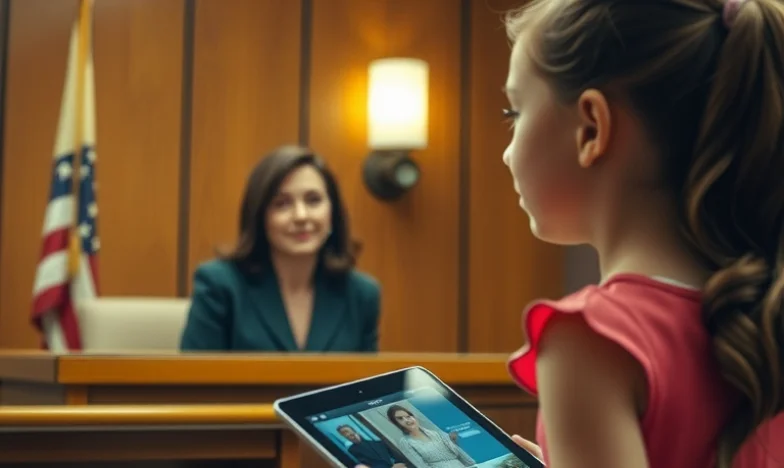
In My Divorce Hearing, My Daughter Played a Video—No One Was Prepared for What It Revealed

“You’re not fit to be a mother, Emily. You never were.”
Mark’s words echoed through the sterile courtroom, bouncing off the wood-paneled walls and settling like a weight in my chest. My hands trembled as I gripped the edge of the table, feeling the eyes of the judge, the attorneys, and—most painfully—my daughter Clara, watching me from the front row.
I wanted to scream, to defend myself, but my voice caught in my throat. Mark’s attorney, a sharp woman in a navy suit, slid a stack of papers across the table. “We’re seeking full custody of Clara, as well as the family home and assets. Mrs. Turner has demonstrated a pattern of neglect and emotional instability.”
I looked at Clara, her small hands folded in her lap, her brown eyes wide and uncertain. I wondered if she believed any of this. If she thought I was the monster Mark painted me to be.
—
The weeks leading up to the hearing had been a blur of sleepless nights and whispered arguments. Mark and I had once been happy, or at least I thought we were. But somewhere between his late nights at the office and my exhaustion from juggling work and motherhood, we’d lost each other.
He started coming home later, smelling of expensive cologne and bourbon. I started sleeping on the couch, too tired to fight. The love that once filled our home had curdled into resentment and silence.
When Mark filed for divorce, he didn’t just want to end our marriage—he wanted to erase me from Clara’s life. He claimed I was unstable, that I yelled too much, that I couldn’t provide a safe environment for our daughter. He hired the best lawyer in town, and suddenly, I was fighting for my child, my home, my dignity.
The courtroom was cold, the fluorescent lights buzzing overhead. My attorney, Mr. Harris, tried to reassure me. “Just tell the truth, Emily. The judge will see through his tactics.”
But Mark was charming, articulate. He told the judge about my panic attacks, my missed PTA meetings, the time I forgot to pick Clara up from ballet because I was stuck at work. He made me sound like a stranger to my own child.
I felt myself shrinking with every accusation, every sideways glance from the gallery. I wanted to disappear.
—
Then, as Mark’s attorney finished her closing argument, Clara stood up. She was so small, her pink dress hanging off her shoulders, her hair pulled back in a messy ponytail. She clutched a tablet in her hands.
“Your Honor,” she said, her voice trembling but clear. “Can I show you something?”
The judge looked surprised. “Clara, do you want to say something?”
She nodded, glancing at me for reassurance. I nodded back, tears stinging my eyes.
Clara walked to the front of the courtroom and handed the tablet to the bailiff. He connected it to the screen. The video began to play.
—
The footage was shaky, filmed from Clara’s perspective. It showed our kitchen, the morning sun streaming through the window. I was making pancakes, humming to myself. Clara’s giggle echoed as I flipped a pancake too high and it landed on the floor. We both laughed.
Then, the video cut to another scene. Mark was in the living room, shouting into his phone. Clara’s voice whispered, “Daddy’s mad again.”
He slammed the phone down, cursing under his breath. Clara’s camera lingered on his face—red, angry, unfamiliar.
The next clip showed me sitting on Clara’s bed, reading her favorite story. She snuggled into my side, her head on my shoulder. I kissed her forehead and whispered, “I love you, baby.”
The final scene was the hardest to watch. Mark was yelling at me, his voice harsh and cruel. Clara’s hand shook as she filmed from behind the door. I was crying, begging him to stop. Clara’s whisper was barely audible: “Please don’t fight.”
—
When the video ended, the courtroom was silent. Mark’s face was pale, his jaw clenched. The judge cleared her throat, her eyes glistening.
“Thank you, Clara,” she said softly. “That was very brave.”
Mark’s attorney tried to object, but the judge held up her hand. “I’ve seen enough.”
I looked at Clara, my heart breaking and swelling at the same time. She had shown the truth—the messy, complicated, painful truth. Not just about Mark, but about me, too. I wasn’t perfect. I’d made mistakes. But I loved my daughter with everything I had.
The judge turned to me. “Mrs. Turner, do you have anything to say?”
I stood, my legs shaking. “I’m not a perfect mother. I’ve struggled. I’ve failed. But I love Clara more than anything in this world. I want what’s best for her, even if that means letting her go.”
My voice broke. “But I hope you see that I’m trying. That I’m here. That I won’t give up on her.”
—
The judge took a long pause before speaking. “This court finds that both parents have made mistakes. But it’s clear to me that Mrs. Turner is a loving, devoted mother. I am awarding joint custody, with primary residence to Mrs. Turner. Mr. Turner, you will have visitation rights.”
Mark’s face twisted in anger, but I barely noticed. Clara ran to me, throwing her arms around my waist. I knelt down, holding her tight, sobbing into her hair.
Outside the courtroom, Mark stopped me. “You set me up. You used her against me.”
I shook my head. “I didn’t know about the video, Mark. Clara just wanted to tell the truth.”
He looked at me, something like regret flickering in his eyes. “Maybe we both lost our way.”
I nodded. “Maybe we did.”
—
That night, Clara and I sat on the porch, watching the fireflies dance in the humid summer air. She leaned against me, her small hand in mine.
“Are we going to be okay, Mommy?”
I squeezed her hand. “We’re going to be okay, baby. We have each other.”
I thought about the video, about the pain and the love it revealed. About the ways we hurt each other, even when we don’t mean to. About the courage it takes to tell the truth, even when it’s hard.
I don’t know what the future holds. But I know that, whatever happens, I’ll keep fighting for my daughter. For us.
Based on a true story.