He Left Me With Five Children—30 Years Later, The Truth Changed Everything

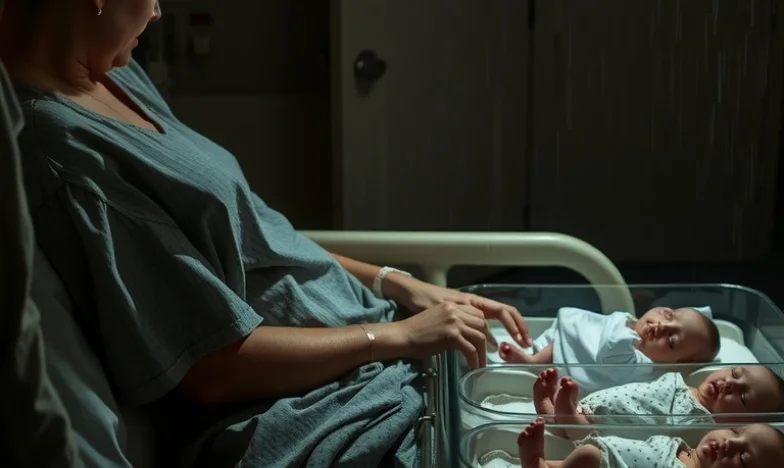
The rain hammered the windows as I rocked my babies, five tiny bundles lined up in bassinets beside my hospital bed. My body ached, my mind spun, but I couldn’t stop staring at their perfect faces. My husband, Marcus, stood by the door, his jaw clenched, eyes darting between me and the children.
“Marcus, please,” I whispered, my voice raw from exhaustion and fear. “Don’t go. I can’t do this alone.”
He shook his head, tears glistening in his eyes. “I’m sorry, Lisa. I just… I can’t.”
He turned and left. The door clicked shut, and with it, the life I’d imagined vanished.
—
I was twenty-four, living in a cramped apartment in Detroit, and suddenly a single mother to five beautiful, brown-skinned babies. The nurses whispered, the neighbors stared. My own mother, Ruth, flew in from Ohio, her face tight with worry.
“Lisa, honey, you have to be strong now. For them.”
I nodded, but inside, I was screaming. How could Marcus leave us? We’d dreamed of a family, but five at once? I replayed every conversation, every argument, searching for clues. Was it the stress? The money? Or something deeper?
—
The first years blurred together in a haze of diapers, midnight feedings, and desperate prayers. I worked two jobs—waitressing at a diner by day, cleaning offices by night. My mother helped when she could, but mostly, it was just me and the kids: Michael, Maya, Jordan, Olivia, and Isaiah.
People talked. Some said Marcus had run off because he couldn’t handle the responsibility. Others whispered uglier things, questioning the children’s paternity because of their dark skin. I ignored them, but the words stung.
One night, after a long shift, I found Maya crying in her room.
“Why don’t we have a daddy?” she asked, her big brown eyes searching mine.
I pulled her close. “Your daddy loved you very much. Sometimes grown-ups make mistakes. But I promise, I’ll always be here.”
—
As the kids grew, so did the challenges. Michael got into fights at school, angry at a world that seemed to judge him before he spoke. Olivia became quiet, retreating into books. Jordan and Isaiah clung to each other, while Maya tried to keep the peace.
Money was always tight. I skipped meals so they could eat. I patched their clothes, begged for extra shifts, and prayed for a miracle. Every birthday, every Christmas, I hoped Marcus would call, would send a card, would show he cared. But the phone never rang.
—
Years passed. The kids graduated high school, some with honors, some by the skin of their teeth. Michael joined the Army. Maya got a scholarship to Howard. Olivia stayed close, helping me at home. Jordan and Isaiah found work at a local garage.
Still, the shadow of Marcus lingered. The kids asked less often, but I saw the longing in their eyes. I wondered, too. Where was he? Did he ever think of us?
—
Then, one summer afternoon, thirty years after that night in the hospital, my phone rang. The number was unfamiliar.
“Hello?”
A deep, hesitant voice answered. “Lisa? It’s Marcus.”
My heart stopped. For a moment, I couldn’t breathe.
“Marcus? After all these years?”
He sighed. “I know I have no right to call. But there’s something you need to know. About the kids. About why I left.”
—
We met at a coffee shop downtown. He looked older, grayer, but the pain in his eyes was the same.
“I was scared,” he began. “But not of being a father. I was scared because… I found out I was adopted. My birth parents were white. When the babies were born, and they were all Black, I panicked. I thought you’d cheated. I couldn’t face it.”
I stared at him, shock and anger warring inside me. “You left because you thought I cheated? Marcus, I never—”
He shook his head. “I know. I got a DNA test last year. Turns out, I’m biracial. My birth mother was white, but my father was Black. I never knew. I’m so sorry, Lisa. I let my own confusion and shame ruin everything.”
Tears streamed down my face. Thirty years of pain, of struggle, of unanswered questions—all because of a secret he didn’t even know he carried.
—
We sat in silence, the weight of the years between us. Finally, I spoke.
“You missed their whole lives, Marcus. You missed everything.”
He nodded, tears in his eyes. “I know. I can’t change the past. But I want to try. If you’ll let me.”
—
Telling the kids was harder than I imagined. Some were angry. Some cried. Some refused to see him. But slowly, over months, Marcus tried to make amends. He came to family dinners, listened to their stories, apologized over and over.
It wasn’t perfect. The scars ran deep. But for the first time, we talked openly about race, about identity, about forgiveness. We learned that secrets—no matter how well-intentioned—can destroy families. And that healing, though slow, is possible.
—
Sometimes I wonder what our lives would have been like if Marcus had stayed. If he’d known the truth from the start. But I also know that my children are strong, resilient, and full of love—because we survived together.
Now, when I look at my family, I see not just the pain of the past, but the hope of the future. And I ask myself: How many other families are living with secrets that could change everything?
Based on a true story.