He Left Me Everything, But Never Called Me His Daughter: The Day My Family Turned Against Me

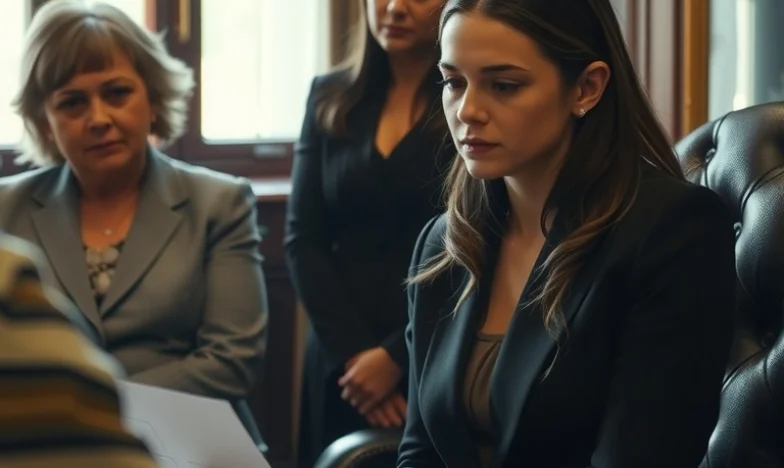
The lawyer’s voice trembled as he read the will, but it was nothing compared to the tremor in my hands. My mother’s eyes were fixed on me, cold and sharp, while my half-sister, Emily, sat rigid, her jaw clenched so tight I thought she might shatter her own teeth.
I never expected to be here—sitting in a mahogany-paneled office in downtown Chicago, surrounded by people who barely tolerated me. My stepfather, Richard, had died two weeks ago. I’d spent the funeral standing alone in the back pew, watching my mother sob into Emily’s shoulder. No one had looked for me. No one had asked if I was okay.
Now, as the lawyer cleared his throat and read the numbers—”six hundred forty thousand dollars to my stepdaughter, Jessica Miller”—the room went silent. My mother’s face went white. Emily gasped, then let out a strangled laugh.
“That’s not possible,” my mother spat. “There must be a mistake.”
The lawyer shook his head. “It’s all here in writing. Jessica receives the estate. You and Emily receive five thousand dollars each.”
I wanted to disappear. I wanted to run out of that office and never look back. But something kept me rooted to the chair—the same invisible force that had kept me in that house for eighteen years, hoping for a scrap of love.
—
Growing up, I was always the outsider. My real dad left when I was four. Mom remarried Richard when I was six, and Emily was born a year later. From then on, it was like I’d become a ghost in my own home.
Richard never called me his daughter. He called me “Jess”—never “sweetheart,” never “honey,” just Jess. He’d pat Emily on the head and call her “princess,” but for me? A nod at dinner, maybe a “good job” if I brought home straight As.
I tried so hard to win him over. I joined the soccer team because he liked sports. I learned to cook because he loved homemade meals. Nothing worked. Mom told me to stop trying so hard—”He’s not your real dad anyway,” she’d say when she thought I couldn’t hear.
Emily was everything I wasn’t—blonde, bubbly, always laughing. She got away with everything. When she crashed Mom’s car at sixteen, Richard bought her a new one. When I got into Northwestern on a scholarship, they barely said congratulations.
I moved out at eighteen and never looked back. I built a life for myself—bartending at night, studying during the day, scraping by on student loans and hope. Richard never called. Mom sent Christmas cards with Emily’s graduation photos tucked inside.
So when Richard died suddenly—a heart attack at sixty-two—I didn’t expect anything. I went to the funeral out of obligation, not love.
—
Now, sitting in that office, I felt like I was watching someone else’s life unfold.
“You must have manipulated him,” Emily hissed at me after the reading. “You were never even his real daughter!”
“Emily!” Mom snapped, but her eyes were just as accusing.
“I didn’t do anything,” I whispered. “I haven’t spoken to him in years.”
The lawyer handed me an envelope—Richard’s letter to me. My hands shook as I opened it.
“Jess,
I know I was never the father you needed. I didn’t know how to love you the way you deserved. You were always so strong—so independent—it scared me sometimes. I thought you didn’t need me.
I want you to have this money because you earned it by surviving us. Use it to build the life you deserve.
I’m sorry for everything I couldn’t be.
Richard”
Tears blurred the words. For the first time in years, I cried for him—not for what he gave me now, but for what he never gave me when he was alive.
—
The days after the will reading were a blur of angry phone calls and bitter texts from my mother and Emily.
“You’re stealing from us!” Mom screamed over voicemail. “That money should be ours!”
Emily posted on Facebook: “Some people will do anything for money—even betray their own family.” Her friends commented with angry emojis and thinly veiled threats.
I stopped answering my phone. My apartment felt smaller every day, like the walls were closing in with every accusation.
I tried to remember Richard’s letter—to hold onto those words as proof that maybe, just maybe, he’d seen me after all.
But guilt gnawed at me. Was it right for me to keep the money? Should I give some to Mom and Emily? Would it ever be enough?
One night, Mom showed up at my door unannounced. She looked tired—older than I remembered.
“Jessica,” she said quietly, “please… we need that money. Emily’s student loans are crushing us. The house is mortgaged to the hilt.”
I wanted to scream—where was this desperation when I needed help? Where was this concern when I was eating ramen noodles for weeks at a time?
But all I said was, “I’m sorry, Mom. It’s not that simple.”
She glared at me like she didn’t recognize me anymore.
—
Weeks passed. The money sat untouched in my account—a number on a screen that felt more like a curse than a blessing.
Friends told me to take a vacation or buy a new car—”You deserve it!” they said—but every time I tried to spend even a dollar, guilt twisted in my stomach.
One afternoon, Emily cornered me outside my apartment building.
“You think you’re better than us now?” she spat.
“No,” I said quietly. “I just want peace.”
She laughed bitterly. “You’ll never have it—not after this.”
Her words haunted me for weeks.
—
The emotional turning point came late one night as I sat alone with Richard’s letter spread out on my kitchen table.
I realized that no amount of money could fix what was broken between us—not between me and Richard, not between me and my mother or Emily.
But maybe… maybe it could help someone else avoid what happened to us.
I made a decision: half of the inheritance would go into a scholarship fund for kids like me—kids who felt invisible in their own homes, who needed a chance to build something better.
The rest? Enough for a down payment on a small condo—a place that would finally be mine.
When I told Mom and Emily about the scholarship fund, they didn’t understand at first.
“You’re giving it away?” Mom asked incredulously.
“Not all of it,” I said gently. “But enough to make a difference—for someone who needs it more than we do.”
Emily stormed out of the room without another word.
Mom just stared at me—maybe for the first time really seeing me as more than just Richard’s stepdaughter.
—
It’s been six months now since that day in the lawyer’s office.
Mom and Emily still don’t speak to me much—but sometimes Mom sends short texts: “Hope you’re well.” It’s not much, but it’s something.
The scholarship fund has already helped two kids get into college—kids who remind me so much of myself that it hurts sometimes to read their stories.
I still think about Richard—about all the things we never said and all the love we never shared.
But maybe forgiveness isn’t about forgetting what happened—it’s about finding a way forward anyway.
Would you have kept the money? Or tried to fix what can’t be fixed?
Based on a true story.