Can I Keep Your Leftovers, Ma’am? A Rainy Night, a Millionaire, and the Truth About Dignity in America

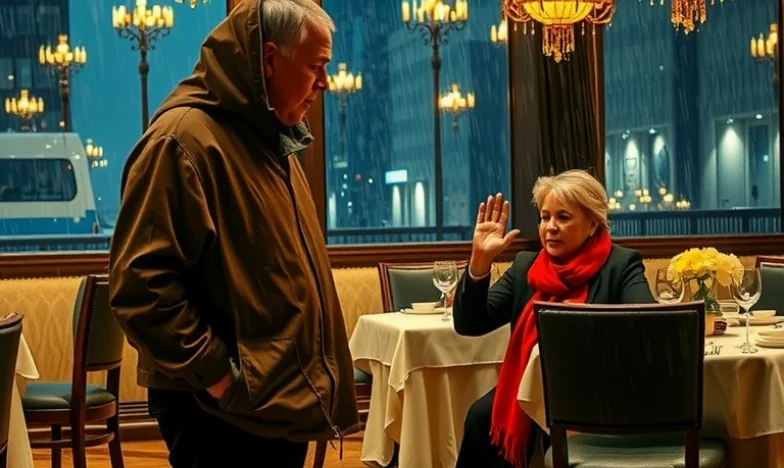
“Ma’am… could I maybe have what you’re not going to finish?” My voice cracked, barely louder than the clatter of forks and the low hum of jazz. The room froze. It was Thanksgiving night, and outside, Chicago’s wind howled, rattling the windows of The Lakeview Grille—a place where the napkins are linen and the wine list is longer than my resume. I stood there, soaked to the bone, my thrift-store jacket dripping onto the marble floor. Every eye in the room turned to me, some wide with shock, others narrowed in disgust.
A man in a navy suit snickered, nudging his wife. “Did you hear that, honey? He wants your scraps.” Laughter rippled through the tables, bouncing off the crystal and silver. I felt my face burn. I wanted to run, but hunger kept my feet planted. I hadn’t eaten since yesterday morning, and the smell of roasted turkey and garlic mashed potatoes was torture.
The woman I’d addressed was stunning—maybe late forties, with silver-streaked hair and a red cashmere scarf. She looked at me, her blue eyes sharp, and for a second, I thought she’d join the laughter. Instead, she raised her hand, and the room fell silent. “That’s enough,” she said, her voice calm but commanding. “You should be ashamed.”
She turned to me. “What’s your name?”
“Eli,” I mumbled, staring at my shoes.
“Well, Eli, would you like to join me for dinner?”
The laughter died. You could hear the rain pounding outside. I hesitated, but she smiled, warm and genuine. “Please. Sit.”
I slid into the booth across from her, my heart pounding. The waiter, red-faced, hurried over. “Ma’am, is everything alright?”
She didn’t look at him. “Bring my friend here a plate. And a towel.”
He scurried off. I tried to speak, but she waved me off. “Eat first. Talk later.”
I ate like a man starved—because I was. She watched me, not with pity, but with curiosity. When I finally slowed, she asked, “How did you end up here?”
I swallowed hard. “Lost my job last year. My mom got sick—cancer. I tried to take care of her, but the bills…” I trailed off. “She passed in July. I lost the apartment in August. Been on the street since.”
She nodded, her eyes softening. “I’m sorry. That’s a lot for anyone.”
I shrugged. “It’s life, I guess.”
She leaned in. “No, Eli. That’s not how life should be. Not here.”
I looked around at the people pretending not to stare. “Most folks don’t see it that way.”
She smiled, but there was sadness in it. “Most folks are wrong.”
We talked for hours. She told me her name—Margaret Sinclair. She’d grown up poor in Detroit, worked her way through college, started a tech company, and sold it for millions. “But money doesn’t fix everything,” she said. “My husband left. My son won’t speak to me. Sometimes I wonder if I traded too much for all this.” She gestured at the restaurant, the city lights beyond the window.
I told her about my mom, about the Thanksgiving dinners we used to have—just the two of us, watching the parade on TV, laughing at the floats. I told her about the job I lost, the friends who disappeared when things got hard. I told her how invisible I felt, walking the streets, how people looked through me like I was a ghost.
She listened. Really listened. When the check came, she paid without a word. Then she handed me a business card. “Come by my office tomorrow. I can’t promise much, but I can promise a hot meal and a shower. Maybe more.”
I stared at the card, not sure if I should believe her. She saw my doubt. “You have nothing to lose, Eli. Except maybe your pride. But I think you lost that a long time ago.”
I laughed, surprised at myself. “Yeah. I guess I did.”
She stood, gathering her things. “Happy Thanksgiving, Eli.”
“Happy Thanksgiving, ma’am.”
I left the restaurant with a full belly and a strange sense of hope. I spent the night at the shelter, clutching her card like a lifeline. The next morning, I showed up at her office—a glass tower on Michigan Avenue. The receptionist looked at me like I was crazy, but Margaret came out herself, smiling. She took me to the staff kitchen, handed me a plate of eggs and toast, and sat with me while I ate.
Over the next few weeks, she helped me get back on my feet. She found me a job in the mailroom, helped me get an apartment, even paid for a new suit so I could interview for better positions. She never treated me like a charity case. She treated me like a person.
But not everyone was happy about it. Some of her employees whispered behind my back. One day, I overheard a manager say, “Why’s she wasting time on that bum? He’ll just end up back on the street.”
It stung, but Margaret shut it down. “Everyone deserves a second chance,” she told them. “Remember that.”
Christmas came, and she invited me to her house. It was huge, decorated with lights and garlands, but it felt empty. Her son, David, showed up late, barely speaking to her. After dinner, I found him in the kitchen, staring out at the snow.
“Your mom’s a good person,” I said.
He snorted. “You don’t know her.”
“Maybe not. But I know what she did for me.”
He looked at me, his eyes hard. “She’s always trying to fix things. Some things can’t be fixed.”
I wanted to argue, but I saw the pain in his face. I remembered my own anger, my own losses. “Maybe not. But sometimes trying is enough.”
He didn’t answer, but when we sat down for dessert, he smiled at his mom for the first time all night.
Months passed. I worked hard, moved up to a better job. Margaret and I stayed close. She told me once, “You saved me as much as I saved you.”
I never forgot that night in the restaurant—the laughter, the shame, the kindness that followed. Sometimes, when I see someone on the street, I remember how it felt to be invisible. I try to look them in the eye, to see them.
Now, every Thanksgiving, I volunteer at the shelter. I bring extra food, sit and listen to stories. I tell them about Margaret, about second chances. About how a single moment can change everything.
I still wonder, though—why is it so easy for people to laugh at someone’s pain? Why do we forget that dignity is a right, not a privilege? Maybe if more people remembered that, the world would be a little kinder. What do you think? Would you have laughed—or would you have offered a seat?