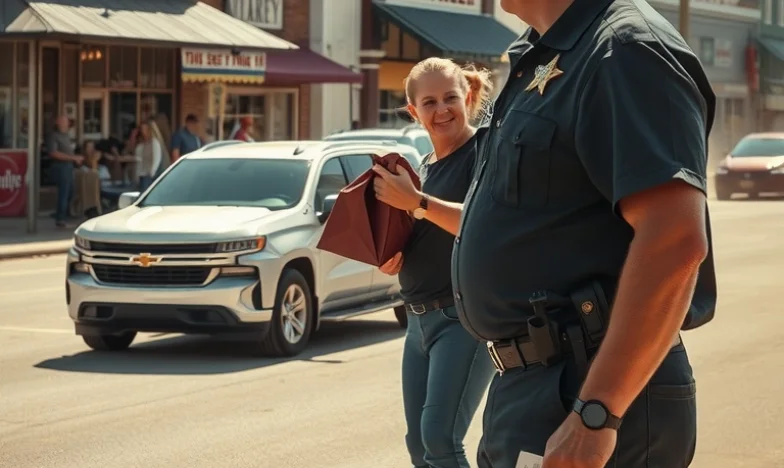
A Silver Truck on Main Street: The Day I Saw Jenny Again

The silver Chevy truck crawled down Main Street, its tires crunching over the gravel as I rolled past the faded sign that read, “Welcome to Willow Creek, Home of the Eagles.” I hadn’t been back in over a decade, not since Mom’s funeral, and the town looked both smaller and more tired than I remembered. The Fourth of July banners still hung from the lampposts, even though it was already August, and the old diner where we used to skip school was now a vape shop. I was just passing through, or so I told myself, but the truth was, I needed to see if anything here could still feel like home.
I was about to turn onto Maple Avenue when I saw her—Jenny Harper, my best friend from high school, the girl who once dared me to jump off the old railroad bridge into the river. She was standing outside the Dollar General, her arms full of groceries, her hair pulled back in a messy ponytail. Next to her was a man I didn’t recognize, tall, broad-shouldered, with a face that looked like it had never learned to smile. He was yelling, his voice carrying across the parking lot, sharp and mean. “How many times do I have to tell you, Jenny? You can’t do anything right!” he barked, grabbing her arm so hard I could see the white of his knuckles from across the street.
I slammed on the brakes, my heart pounding. For a second, I was sixteen again, watching Jenny stand up to bullies twice her size, never backing down. But now, she looked small, her eyes darting around, searching for an escape. The man jerked her closer, and I saw her wince. People walked by, pretending not to notice, their faces set in that familiar small-town mask of polite indifference. I felt a surge of anger—no, fury—rise up in me. I threw the truck into park and got out, my boots hitting the pavement harder than I intended.
“Hey!” I shouted, my voice echoing off the brick walls. The man turned, his eyes narrowing. Jenny’s gaze flicked to mine, and for a split second, I saw a flash of recognition—then fear. “Mind your own business,” the man growled, but his grip loosened just a little. I walked closer, my hands shaking, but I kept my voice steady. “Let her go. Now.”
He sneered, but I could see the uncertainty in his eyes. “Who the hell are you?” he spat. I didn’t answer. Instead, I looked at Jenny, really looked at her, and saw the bruises she tried to hide with makeup, the way her shoulders curled inward. “Jenny, you okay?” I asked softly. She nodded, but her eyes were glassy, her lips pressed tight.
The man stepped between us, puffing up like a rooster. “She’s my wife. This is none of your damn business.” I took a deep breath, remembering every fight I’d ever backed down from, every time I’d let someone else take the fall. Not today. I reached into my back pocket and pulled out my old sheriff’s badge—the one Dad left me before he died. I hadn’t worn it in years, but I kept it with me, a reminder of who I wanted to be. I held it up, just enough for him to see. “You sure about that?” I said quietly.
His face went pale, the bravado draining out of him in an instant. He let go of Jenny’s arm like it was on fire, stumbling back a step. “I—I didn’t mean nothing by it,” he stammered, glancing around as if looking for an escape. The silence was heavy, the kind that makes your ears ring. Jenny looked at me, her eyes wide, and for the first time, I saw a flicker of hope.
“Go home,” I told him, my voice low. “And if I ever see you lay a hand on her again, you’ll answer to me—and the law.” He nodded, backing away, his hands raised. He got into his beat-up Ford and peeled out of the parking lot, leaving a trail of dust and shame behind him.
Jenny stood there, shaking, her groceries scattered on the ground. I knelt down, picking up a box of cereal and a bruised apple. “You okay?” I asked again, softer this time. She nodded, tears streaming down her face. “I didn’t know what to do,” she whispered. “He’s not always like that.”
I wanted to tell her that was a lie, that men like him were always like that, but I bit my tongue. Instead, I put my arm around her, feeling her tremble. “You don’t have to go back,” I said. “You can come with me.”
She shook her head. “I can’t. He’ll find me. He always does.”
We sat there on the curb, the sun beating down, the world moving on around us. I remembered all the times we’d sat here as kids, dreaming about leaving this place, about making something of ourselves. Now, it felt like nothing had changed, except we were older and more broken.
“You remember that summer we built the treehouse in your backyard?” I asked, trying to make her smile. She laughed, a shaky sound. “Yeah. You fell out of it and broke your arm.”
“You signed my cast, ‘Best friends forever.’”
She wiped her eyes. “I meant it.”
I squeezed her hand. “So did I.”
We sat in silence for a while, watching the clouds drift by. Eventually, I helped her gather her groceries and walked her home, keeping an eye out for the Ford. Her house was small, paint peeling from the porch, the yard overgrown. I wanted to tell her to pack a bag, to leave with me right then and there, but I knew it wasn’t that simple. Abuse isn’t just bruises and broken bones—it’s fear, it’s shame, it’s the voice in your head that tells you you’re not worth saving.
That night, I lay in the guest room at my aunt’s house, staring at the ceiling fan spin. I thought about Jenny, about all the women like her, trapped by love turned sour. I thought about my dad, about the badge he wore, about the promise I made to him to always do the right thing, even when it was hard. I wondered if I’d done enough, if I could have done more.
The next morning, I drove by Jenny’s house. Her husband’s truck was gone. She was sitting on the porch, a suitcase at her feet. She looked up as I pulled in, her face set with determination. “I’m ready,” she said simply.
We loaded her things into the truck and drove away, leaving Willow Creek behind us. As we crossed the county line, she reached over and squeezed my hand. “Thank you,” she whispered. “For not looking away.”
I smiled, tears prickling my eyes. “You don’t ever have to thank me for that.”
Sometimes, the hardest thing in the world is to stand up for someone you love. Sometimes, all it takes is a silent gesture—a badge, a look, a hand held out in the dark—to change the course of a life.
Now, as I look back on that day, I wonder: How many of us walk past someone in pain, too afraid or too busy to help? What would happen if we all chose to see, to act, to care? Would the world be a little kinder, a little safer, for people like Jenny?
Have you ever been in a moment where you had to choose between silence and action? What did you do? Would you do it again?