A New Car, a New Life: The Night Everything Changed

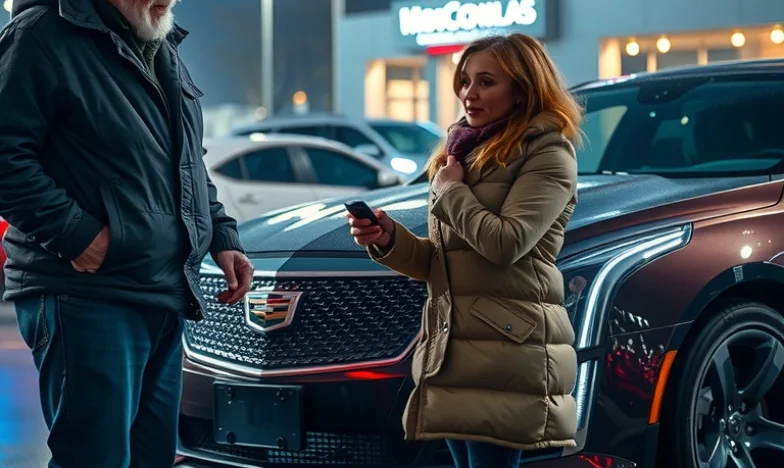
“Get out of here! Pregnant women bring bad luck to new cars!” The old man’s voice cut through the crisp November air like a rusty blade. I slammed the door of my brand-new Cadillac, the keys still warm in my hand, and stared in disbelief at the scene unfolding in the dealership parking lot. My wife, Emily, six months pregnant and glowing with the anticipation of our first child, stood frozen on the sidewalk, her hands trembling as she cradled her belly. Her blue eyes, usually so full of laughter, were wide with shock and hurt.
It was supposed to be a celebration. I’d worked overtime for months at the law firm, skipping family dinners and missing Sunday football with my dad, all to afford this car—a symbol of the life I wanted for us. Emily had spent the whole day humming Christmas songs, teasing me about my obsession with leather interiors and heated seats. We’d planned to drive straight to her parents’ house in the suburbs for an early Thanksgiving dinner, the first one since her mom’s cancer went into remission. Instead, we were standing in the cold, the glow of the dealership’s neon sign flickering above us, as a stranger’s words hung in the air like a curse.
The old man, a wiry mechanic with grease-stained hands and a faded John Deere cap, glared at Emily as if she’d spat on the hood. “I’m serious, son. My daddy always said, never let a pregnant woman near a new car. Brings nothing but trouble.”
I felt my fists clench. “That’s ridiculous. It’s 2023, not 1923.”
But Emily’s voice was barely a whisper. “Jon, maybe we should just go.”
I turned to her, my anger dissolving into helplessness. “Em, you didn’t do anything wrong. He’s just—”
She shook her head, tears glistening on her cheeks. “Let’s just go.”
We drove in silence, the city lights blurring past. I kept glancing at her, searching for the right words, but my mind was a storm. How could a stranger’s superstition cut so deep? Why did I feel like I’d failed her, failed us?
At her parents’ house, the warmth of turkey and cinnamon candles did little to thaw the chill between us. Her mom, Susan, hugged Emily tight, whispering, “You okay, honey?”
Emily forced a smile. “Just tired, Mom.”
Her dad, Frank, clapped me on the back. “Heard you got yourself a new ride, Jon! Let’s take a look after dinner.”
I nodded, but my heart wasn’t in it. The meal was a blur of laughter and clinking glasses, but Emily barely touched her food. I caught her staring out the window, lost in thought. After dessert, I found her in the guest room, sitting on the edge of the bed, her hands folded over her belly.
“Em,” I said softly, “don’t let that guy get to you. He’s just some crank.”
She looked up, her eyes red. “It’s not just him, Jon. Ever since I got pregnant, it’s like the world’s changed. People stare, they judge. At the grocery store, at work… I feel like I’m not myself anymore. Like I’m just… someone’s mom.”
I sat beside her, guilt gnawing at me. “I’m sorry. I should’ve said something. I should’ve—”
She squeezed my hand. “It’s not your fault. I just… I wanted tonight to be special. For us.”
We sat in silence, the muffled sounds of her family downstairs drifting up like a distant memory. I thought about the car, gleaming in the driveway, and how empty it felt now. Was this what success looked like? A shiny car and a wife in tears?
The next morning, I woke to the sound of Emily’s voice in the kitchen. She was laughing with her mom, her hands moving animatedly as she told a story about our first date. For a moment, I let myself believe everything was back to normal. But when we got in the car to drive home, she hesitated before buckling her seatbelt.
“Do you think he was right?” she asked quietly. “About the bad luck?”
I shook my head. “No. But I think… maybe we let people’s words get to us more than we should.”
She nodded, but I could see the doubt lingering in her eyes.
That week, the car became a symbol of everything we weren’t saying. I drove it to work, to the grocery store, but every time Emily got in, there was a tension between us. One night, after a particularly rough day at the office, I came home to find her crying in the nursery, surrounded by unopened boxes of baby clothes.
“I’m scared, Jon,” she admitted. “What if something goes wrong? What if I’m not ready?”
I knelt beside her, my own fears bubbling to the surface. “I’m scared too. But we’re in this together. No superstition, no stranger, is going to change that.”
We held each other, the weight of our worries pressing down, but also binding us closer. In the weeks that followed, we started talking more—about our fears, our hopes, the future we wanted for our child. We decorated the nursery together, argued over paint colors, laughed about baby names. The car, once a source of pride and then of pain, became just a car again—a way to get from one place to another, not a measure of our worth.
On Christmas Eve, as snow fell softly outside, Emily went into labor. The drive to the hospital was a blur of red lights and prayers, but when I held our daughter for the first time, all the fear and superstition melted away. She was perfect—tiny fingers, a shock of dark hair, and lungs strong enough to wake the whole maternity ward.
As I watched Emily cradle our daughter, I realized that life is full of moments that threaten to break us. But it’s how we face them—together—that defines who we are. The old man’s words were just that: words. Our family was stronger than any curse, any fear.
Now, every time I see that Cadillac in the driveway, I remember not the night of hurt, but the journey that brought us here. I wonder—how many of us let other people’s fears shape our lives? And what would happen if we chose, just once, to believe in ourselves instead?