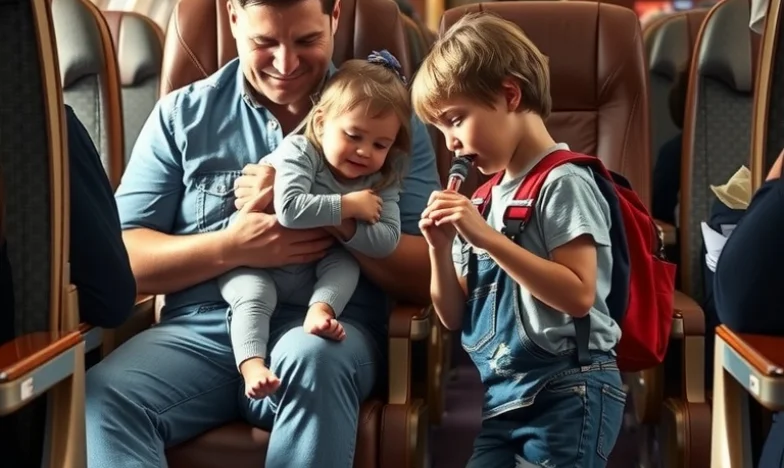
A Millionaire’s Child Cried Uncontrollably on the Plane—Until a Poor Boy Did Something Unexpected

The engine’s hum was nothing compared to the piercing wail of my daughter, Emma. We were barely thirty minutes into our flight from JFK to LAX, and already, her cries had turned the plush first-class cabin into a war zone of glares and whispered complaints. I cradled her in my arms, bouncing her gently, desperate for her to calm down. “Shhh, baby, please,” I whispered, my voice trembling with exhaustion and embarrassment.
A woman in a navy pantsuit leaned over the aisle, her lips pressed into a thin line. “Sir, could you do something about your child?” she hissed, not bothering to hide her annoyance. I felt my face flush. I was used to boardroom confrontations, not this kind of public scrutiny. Emma’s mother had left us two years ago, and since then, I’d thrown myself into work, building my tech company from the ground up. But no amount of money or success could help me now, as my daughter’s cries echoed off the polished wood and leather.
The flight attendant, a young man named Tyler, knelt beside me. “Can I get you anything, Mr. Walker? Warm milk? A blanket?”
I shook my head. “She’s teething. Nothing helps.”
Emma’s tiny fists beat against my chest. I caught a glimpse of her red, tear-streaked face and felt a pang of helplessness. Around us, the other passengers—businessmen, celebrities, a retired senator—shifted uncomfortably. I could almost hear their thoughts: Why is that kid in first class? Why can’t he control her?
I tried everything. Her favorite stuffed bunny. Her pacifier. Even the iPad with her favorite cartoons. Nothing worked. The minutes crawled by. My hands shook as I rocked her, my mind racing with guilt and frustration. I thought of my own father, a steelworker in Pittsburgh, who’d raised me with a firm hand and little patience for weakness. Would he have judged me, too?
Suddenly, a commotion erupted in the aisle. A boy, maybe ten years old, was making his way up from economy, clutching a battered backpack. His jeans were patched at the knees, and his sneakers looked like they’d seen a hundred playgrounds. A flight attendant tried to stop him, but he slipped past, his eyes fixed on Emma.
“Hey,” he said, his voice soft but confident. “Can I try?”
I blinked, startled. “Try what?”
He knelt beside me, meeting Emma’s gaze. “My little sister used to cry like that. Sometimes music helps.” He unzipped his backpack and pulled out a battered harmonica. “Mind if I play?”
I hesitated, but at that point, I was willing to try anything. “Go ahead.”
He put the harmonica to his lips and played a gentle, lilting tune—something old and sweet, like a lullaby from another time. The sound was soft, almost magical. Emma’s cries faltered, then faded. Her eyes widened, transfixed by the music. For the first time in an hour, she was silent.
The cabin seemed to exhale. The woman in the pantsuit looked away, embarrassed. Tyler gave the boy a thumbs-up. I felt tears prick my eyes—tears of relief, gratitude, and something else I couldn’t name.
“Thank you,” I whispered. “What’s your name?”
“Lucas,” he said, flashing a shy smile. “I’m flying to see my grandma. My mom saved up for months to buy the ticket.”
I looked at his clothes, his backpack, the way he glanced longingly at the first-class snacks. I realized he had nothing, and yet he’d given us everything in that moment.
“Would you like to sit with us for a while?” I asked. “Emma seems to like you.”
He nodded eagerly, settling into the empty seat beside us. He played another song, and Emma giggled, reaching for his harmonica. Lucas let her touch it, showing her how to blow gently to make a sound. The two of them laughed together, and for the first time in a long time, I felt a weight lift from my chest.
As the hours passed, Lucas told me about his life in Detroit. His mom worked two jobs, and he watched his little sister after school. He loved music, but lessons were too expensive, so he taught himself on the harmonica his uncle gave him. He spoke with a quiet dignity that humbled me. I thought about the world I’d built for Emma—private schools, nannies, every advantage money could buy. But Lucas had something I couldn’t give her: resilience, kindness, the ability to find joy in the smallest things.
When the flight attendant came by with dinner, I asked for an extra meal for Lucas. He hesitated, glancing at me. “Are you sure?”
“Absolutely,” I said. “You’re our guest.”
He grinned, tearing into the bread roll like it was the best thing he’d ever tasted. Emma watched him, mimicking his every move. I realized she’d been lonely, too—surrounded by adults, but missing the simple companionship of another child.
As we began our descent into Los Angeles, Lucas packed up his harmonica. “Thank you for letting me help,” he said. “Most people don’t want to talk to kids like me.”
I shook my head, ashamed. “You helped us more than you know. If you ever need anything—”
He smiled. “Just take care of your little girl. That’s all.”
We landed, and Lucas disappeared into the crowd, his backpack slung over one shoulder. I watched him go, feeling a strange ache in my chest. I hugged Emma tight, whispering a silent promise to do better—for her, for myself, for kids like Lucas.
That night, as I tucked Emma into bed in our sprawling Beverly Hills home, I thought about the boy with the harmonica. I realized that all the money in the world couldn’t buy what he’d given us: a moment of peace, a lesson in humility, a reminder that kindness can come from the most unexpected places.
Sometimes I wonder—how many Lucases do we pass by every day, too busy or too proud to notice? What would happen if we listened, even for a moment, to the music they carry inside them?