Thanksgiving at the Breaking Point: A Story of Forgiveness, Family, and Finding Myself

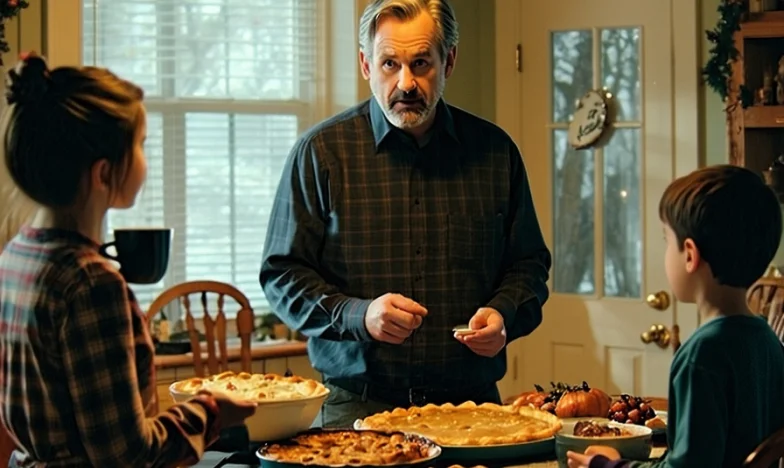
“You’re not welcome here, David. Not after all these years.” My mother’s voice cut through the kitchen like a knife through cold butter. The scent of roasting turkey and cinnamon rolls hung heavy in the air, but the warmth was gone, replaced by a chill that settled deep in my bones.
I stood frozen by the sink, clutching a chipped mug of coffee, watching my father—my father—stand awkwardly in the doorway. He looked older than I remembered: hair grayer, shoulders stooped, eyes rimmed red. The last time I’d seen him was twelve years ago, when he left us in this same house on a rainy November morning. I was ten then, and I’d cried so hard I thought my heart would burst.
Now I was twenty-two, home from college for Thanksgiving break, and the world felt upside down.
“Emily,” he said softly, his voice trembling. “I just wanted to see you. Just for a minute.”
My mother’s hands shook as she wiped them on her apron. “You don’t get to just show up. Not after everything.”
I wanted to scream, to run, to disappear into the snow that was starting to fall outside. Instead, I set my mug down and forced myself to speak. “Mom… maybe we should let him talk.”
She turned to me, her eyes blazing. “After all he’s done? After he left us with nothing?”
Dad flinched. “I know I messed up. I know I don’t deserve forgiveness. But please… just let me explain.”
The silence stretched between us like a taut wire. Finally, Mom stormed out of the kitchen, slamming the door behind her. Dad and I stood there, surrounded by half-prepared pies and mashed potatoes, the air thick with everything unsaid.
He looked at me, tears glistening in his eyes. “I’m sorry, Em. I’m so sorry.”
I wanted to hate him. I wanted to tell him he had no right to come back now, after missing birthdays and graduations and every Christmas morning. But all I could think about was the little girl who used to wait by the window for him to come home.
“Why now?” I whispered. “Why today?”
He swallowed hard. “Because I got sick last year. Real sick. And when I thought I might die… all I could think about was you and your mom. How much I missed you both. How much I’d thrown away.”
I stared at him, searching for the man I remembered—the one who used to lift me onto his shoulders at county fairs, who taught me how to ride a bike on the cracked driveway out back.
“I don’t know if we can ever forgive you,” I said quietly.
He nodded. “I know. But I had to try.”
The front door banged open and my younger brother, Jake, burst in from football practice, cheeks red from the cold. He stopped short when he saw Dad.
“Dad?” His voice cracked on the word.
Dad smiled weakly. “Hey, buddy.”
Jake dropped his duffel bag and ran to him, hugging him so hard it looked like he might never let go.
I watched them, my heart twisting with jealousy and relief and anger all tangled together.
That night, after everyone had gone to bed—Mom in her room with the door locked; Jake asleep with Dad’s old baseball cap clutched in his hands—I sat alone at the kitchen table, staring at the half-eaten pumpkin pie.
Dad came in quietly and sat across from me.
“I know you have questions,” he said softly.
I nodded. “Why did you leave?”
He sighed, rubbing his temples. “I was scared. Your mom and I… we fought all the time about money, about everything. I felt like a failure. And then I met someone else—a woman from work. It was stupid and selfish and I regret it every day.”
The words hung between us like smoke.
“I hated you for so long,” I whispered.
He nodded again. “You had every right.”
We sat in silence for a long time.
“Do you think Mom will ever forgive you?”
He shook his head slowly. “I don’t know. But I hope someday she can find peace.”
The next morning was Thanksgiving Day. The house filled with relatives—my aunt Susan with her loud laugh; Uncle Mike with his endless dad jokes; cousins running wild through the living room. No one knew what to say when they saw Dad sitting at the table, carving turkey like he’d never left.
Mom kept her distance, her face tight with pain.
After dinner, as everyone gathered around the fireplace for pie and football on TV, Dad stood up and cleared his throat.
“I know this is awkward,” he began, voice shaking. “But I want to say something.”
The room fell silent.
“I made mistakes—big ones—and I hurt this family more than I can ever say. But being here today… it means everything to me. If you can find it in your hearts to forgive me someday, I’ll spend every day trying to earn it.”
No one spoke for a long moment.
Then Aunt Susan stood up and hugged him tight.
One by one, people came over—some hugged him; some just nodded; some walked away without a word.
Later that night, after everyone had gone home and Jake had fallen asleep on the couch with a plate of pie balanced on his chest, Mom sat down next to me at the kitchen table.
“I don’t know if I can ever trust him again,” she said quietly.
“I know,” I replied. “But maybe we can try.”
She squeezed my hand and for the first time in years, we both cried together—not out of anger or grief, but out of hope.
My dad didn’t move back in that night or even that year. But he started coming around more—birthdays, graduations, Sunday dinners when Mom felt strong enough to invite him.
It wasn’t perfect—some wounds never fully heal—but we learned that forgiveness isn’t about forgetting; it’s about choosing to move forward together.
Now, every Thanksgiving when we gather around that old oak table in our Ohio kitchen, we remember that sometimes family is about more than blood—it’s about second chances and the courage to forgive.
Do you think everyone deserves a second chance? Or are some wounds too deep to heal? What would you do if someone you loved came back after years away?