He Gave Me His Last Sandwich: The Day My Fortune Changed Forever

“Ma’am, are you okay?”
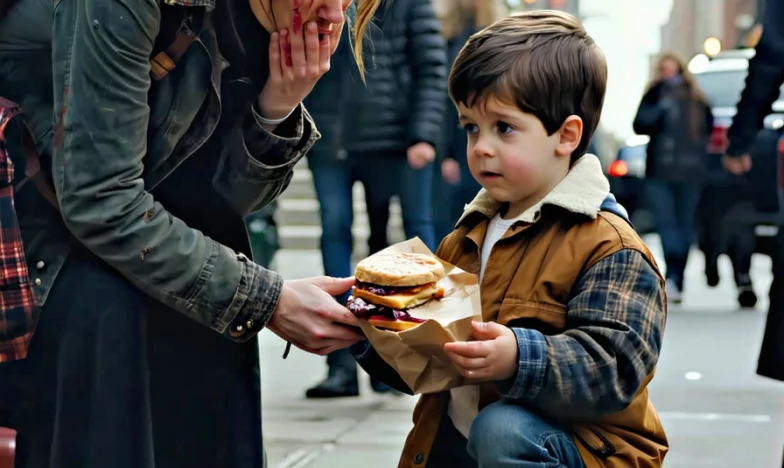
The voice was small, hesitant, and it cut through the November wind like a lifeline. I looked up from my trembling hands, mascara streaking my cheeks, and saw a boy—maybe ten, maybe younger—standing in front of me. His jacket was two sizes too big, patched at the elbows, and he clutched a battered backpack to his chest.
I tried to answer, but my throat was tight. The world spun around me: the honking cabs, the Christmas lights strung across Tremont Street, the laughter of families heading home for Thanksgiving. I was alone on the sidewalk, my phone buzzing with messages I couldn’t bear to read.
He knelt beside me, unzipping his backpack. “You look hungry. You can have this.”
He held out a peanut butter and jelly sandwich, wrapped in wax paper. It was lopsided and squished, but it was all he had. I stared at it, then at him. “Why are you giving this to me?”
He shrugged. “You’re sad. My mom used to say, ‘When you see someone hurting, you help.’”
I took the sandwich with shaking hands. “Thank you,” I whispered. “What’s your name?”
“Tyler,” he said. “What’s yours?”
I hesitated. For years, my name—Emily Carter—had been printed on Forbes lists and business cards, whispered in boardrooms and splashed across glossy magazines. But here, on this curb, it felt meaningless.
“Emily.”
He grinned. “Nice to meet you.”
I watched him walk away, his sneakers flapping against the pavement. I wanted to call after him—to ask where he was going, if he had somewhere warm to sleep—but the words stuck in my throat.
I sat there for a long time, clutching that sandwich. My phone buzzed again: ‘Mom, please come home for Thanksgiving. We miss you.’
I hadn’t seen my family in three years—not since Dad’s funeral. Not since the fight with my brother over the will, the screaming match that ended with slammed doors and broken hearts. I’d thrown myself into work, building Carter Innovations into a tech empire worth billions. But no amount of money could fill the ache in my chest.
That morning, I’d closed a deal that should have made me ecstatic. Instead, I’d walked out of my office and kept walking until I found myself here—on this cold sidewalk, sobbing like a child.
I unwrapped Tyler’s sandwich and took a bite. It tasted like childhood summers and after-school snacks; it tasted like kindness.
The next day was Thanksgiving. I woke up in my penthouse apartment with its floor-to-ceiling windows and panoramic view of the city—and felt nothing but emptiness. The fridge was stocked with catered meals; the dining table set for one.
I thought about Tyler all morning. Where did he go? Did he have anyone to share Thanksgiving with? Or was he just another invisible kid lost in the city?
By noon, I couldn’t stand it anymore. I packed up leftovers and drove downtown, searching for him on every corner. The city was quieter than usual—most people were home with their families—but I finally spotted him near Boston Common, sitting on a bench with two other kids.
“Tyler!” I called.
He looked up, surprised. “Hey! You found me.”
I sat beside him and handed over the bag of food. “Happy Thanksgiving.”
He grinned and tore into the turkey sandwich like it was gold. The other kids—his sister Mia and their friend Jordan—joined in.
We talked for hours. Tyler told me about his mom—how she’d died two years ago from cancer—and how he and Mia bounced between shelters and foster homes. He told me about his dreams: to be a firefighter, to have a dog, to eat pizza every Friday night.
I listened, really listened, for the first time in years.
As dusk fell and the city lit up with holiday lights, I realized something: Tyler had given me more than a sandwich. He’d given me perspective—a reminder that love and connection mattered more than any fortune.
That night, I called my brother for the first time since Dad died.
“Emily?” His voice cracked with disbelief.
“Yeah,” I whispered. “I’m sorry.”
There was silence—a long, aching silence—before he said, “Come home.”
I did. The next day, I drove to our old house in Newton. Mom hugged me so tight I thought my ribs would break; my brother cried for the first time since we were kids.
We talked for hours—about Dad, about our mistakes, about forgiveness. We laughed over burnt pies and argued about football like nothing had changed.
But everything had changed.
A week later, I started volunteering at a shelter downtown—the same one where Tyler and Mia sometimes stayed. I helped them find a permanent foster family; I set up a scholarship fund in their mom’s name.
My company thrived—but now I measured success by lives changed, not dollars earned.
Sometimes I still think about that day on Tremont Street—the day a little boy with nothing gave me everything.
Is it possible that true wealth isn’t what we keep for ourselves—but what we give away? What would you do if someone offered you their last sandwich?