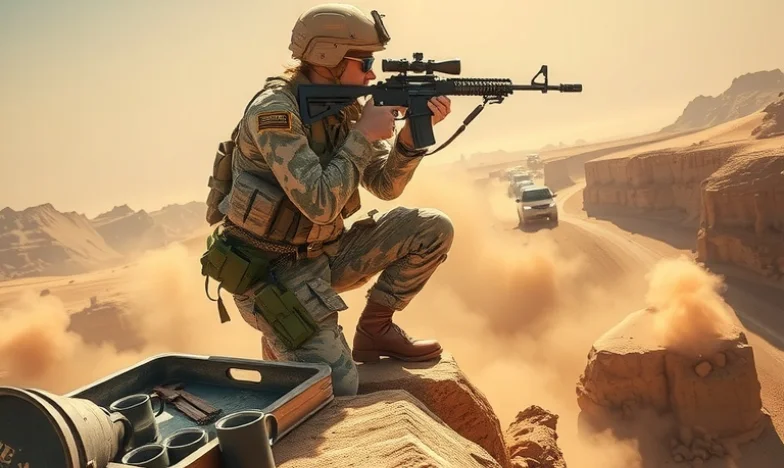
They Thought I Was Just the ‘Coffee Girl.’ They Laughed When I Got Promoted. They Never Knew: I Saved Their General’s Life with One Shot.

“You want cream or sugar, Sergeant Miller?” I asked, balancing the tray with three mugs, my hands trembling just enough for him to notice. He didn’t look up from his phone. “Just black, thanks, coffee girl.” The others snickered. I forced a smile, set the mugs down, and walked away, the laughter echoing behind me like a slap. I was Specialist Emily Carter, 27, from Topeka, Kansas, and I’d been in-country for six months. But to them, I was still the girl who fetched their coffee, the one who didn’t belong in the sniper nest, the one who’d never see real action.
It was July 4th, and the base was a furnace. The desert sun pressed down on us like a punishment, the air thick with dust and the smell of burnt oil. I missed home—missed my mom’s apple pie, the fireworks over Lake Shawnee, the way my dad would salute the flag with tears in his eyes. Here, the only fireworks were mortars, and the only tears were the ones you hid in the shower.
That morning, the tension was different. We’d gotten word: General Thompson was coming through the sector, and intel said there was a credible threat. Thirteen of the best snipers in the division were assigned to overwatch. I was told to stay in the back, monitor comms, and—of course—keep the coffee flowing.
“Don’t worry, Carter,” Sergeant Miller said, grinning as he checked his scope. “We’ll handle the real work.”
I bit my tongue. I’d qualified top of my class at Fort Benning. I’d spent hours on the range, learned to control my breathing, to squeeze the trigger so gently it felt like a secret. But none of that mattered here. Here, I was just the girl with the tray.
The convoy rolled in at 1400 hours. The world went silent, the kind of silence that makes your skin crawl. I watched through binoculars as the Humvees kicked up clouds of dust, the general’s vehicle at the center. My radio crackled. “All units, eyes up. Possible hostile on the ridge.”
I scanned the horizon. There—a glint of metal, just for a second. “Contact, 11 o’clock, 800 meters,” I said into the mic. No one responded. Maybe they didn’t hear me. Maybe they didn’t care.
Then it happened. Thirteen shots, almost simultaneous, thundered across the valley. Thirteen puffs of dust, wide of the mark. The target—a man in desert robes, RPG on his shoulder—was still standing. My heart hammered. I could see him lining up the shot, aiming right at the general’s Humvee.
I didn’t think. I dropped the tray, grabbed my rifle, and sprinted to the edge of the nest. Miller’s voice barked in my ear, “Carter, what the hell are you doing?”
I ignored him. I dropped to my stomach, lined up my scope, and found the target. The world narrowed to the crosshairs, the rise and fall of my breath, the sweat stinging my eyes. I remembered my dad’s words: “You only get one shot, Em. Make it count.”
I squeezed the trigger. The rifle kicked against my shoulder. The man on the ridge dropped, the RPG clattering to the rocks. For a moment, everything was still. Then the radio exploded with chatter.
“Target down! Target down! Who took the shot?”
Miller stared at me, his mouth open. “Was that you?”
I nodded, my hands shaking. “Yeah. It was me.”
The general’s convoy made it through. No casualties. The brass came down to congratulate the team. Miller tried to take credit, but the spotter’s log told the truth. The shot was mine. The general shook my hand, his grip strong, his eyes searching. “You saved my life, Specialist. Thank you.”
That night, the guys were quiet. No jokes, no laughter. I sat alone in the mess, picking at my dinner. My phone buzzed—a text from my mom back home. “Happy Fourth, Em. We’re so proud of you. Stay safe.” I wanted to tell her everything, but I couldn’t. Not yet.
A week later, the promotion orders came through. I was now Sergeant Carter. Some of the guys congratulated me, but most just looked away. Miller wouldn’t meet my eyes. I overheard him in the barracks, telling the others, “She got lucky. That’s all.”
But it wasn’t luck. It was years of training, of being underestimated, of fighting for every inch. It was every time I’d been told I wasn’t good enough, every time I’d been laughed at or ignored. It was the memory of my dad, gone now, who’d taught me to shoot cans off the fence in our backyard, who’d told me I could do anything if I worked hard enough.
The next mission came fast. We were sent to clear a compound on the outskirts of Fallujah. The intel was bad, the enemy was dug in, and we lost two men before we even got inside. I led my team through the chaos, my voice steady on the radio, my hands sure on the rifle. When it was over, we’d taken the objective with no further losses. The guys started to look at me differently—not with respect, exactly, but with something closer to acceptance.
But the cost was high. I started having nightmares—flashes of the man on the ridge, the look in his eyes before I pulled the trigger. I stopped calling home as much. My mom worried. “You sound so far away, Em,” she said. “Are you okay?”
“I’m fine, Mom. Just tired.”
The holidays came and went. Thanksgiving in the mess hall, turkey out of a can, football on a tiny TV. Christmas was worse. I got a care package from home—cookies, socks, a card from my little sister. I cried in the supply closet, where no one could see.
One night, Miller found me on the roof, staring at the stars. He sat down next to me, silent for a long time. Finally, he said, “I was wrong about you, Carter.”
I looked at him, surprised. “What changed?”
He shrugged. “You saved my ass more than once. And the general’s. That counts for something.”
We sat in silence, the desert wind cold against our faces. I thought about all the things I’d lost—my innocence, my sense of safety, the easy laughter of home. But I’d gained something, too. I’d proven myself, not just to them, but to me.
When my tour ended, I flew home to Kansas. My mom met me at the airport, tears streaming down her face. My little sister hugged me so hard I thought I’d break. My dad’s old flag hung in the living room, a reminder of everything we’d sacrificed.
Sometimes, late at night, I think about that day in the desert—the heat, the silence, the weight of the rifle in my hands. I wonder if the guys ever tell the story, if they remember the girl who brought their coffee, who took the shot they couldn’t.
I look in the mirror and ask myself: Would I do it all again, knowing what I know now? And if I would—what does that say about me?
What would you have done, if you were in my boots?