The system is not built for people like Leonard

I was coming out of the Save-a-Lot on Colfax with a twelve-pack of paper towels and a rotisserie chicken that was still warm against my arm. He was sitting on the low brick wall near the cart return, not asking anybody for anything, just watching the traffic. He had on a button-down shirt that might have been light blue once, and his hands were folded in his lap like he was waiting for a bus that wasn’t coming.
I almost walked past. Everybody does. But he looked at the chicken and said, “That smells like Sunday,” and something about the way he said it made me stop.
His name was Leonard. Leonard Marsh. He told me right away, like he needed me to know he wasn’t always out here. “I taught eighth-grade social studies for nineteen years,” he said. “Jefferson Middle. Over on Wabash.”
I said, “I had a cousin went to Jefferson.”
He nodded like that meant something.
I gave him the chicken. He didn’t grab it. He waited until I held it out twice, then took it and set it on the wall beside him like it was a library book. We talked for maybe ten minutes. He told me he’d been sleeping at the men’s shelter on Park Avenue but lost his bed because he missed curfew. He said it matter-of-fact, the way you’d say you missed a dentist appointment.
I’m fifty-six. I work as a billing clerk for a plumbing supply company. I’ve been divorced since 2011. My daughter lives in Phoenix with her husband and my two grandsons. I’m not the kind of person who brings home strays. But I gave Leonard my phone number, which I have never done before in my life, and I told him to call me if he wanted help getting into a program.
He called three days later from a pay phone outside a laundromat.
The first thing I did was look up his teaching license. It was all public record. Leonard Marsh, social studies, certificate expired. Then I found the news article from 2016. Arrested for possession, suspended, then fired after he didn’t show up for a hearing. There was a photo of him outside the school board building, thinner than he is now, not looking at the camera.
I didn’t tell him I found it. I just started making calls.
The system is not built for people like Leonard. He’s sixty-one years old. He doesn’t have a phone. He doesn’t have an address. He has a social security card but no birth certificate. Every place I called wanted something he didn’t have. A referral. An ID. A mailing address. One woman at a housing agency actually said, “Ma’am, he needs to come in person,” and I said, “He can come in person, he just can’t receive mail,” and she said, “Well, that’s the process.”
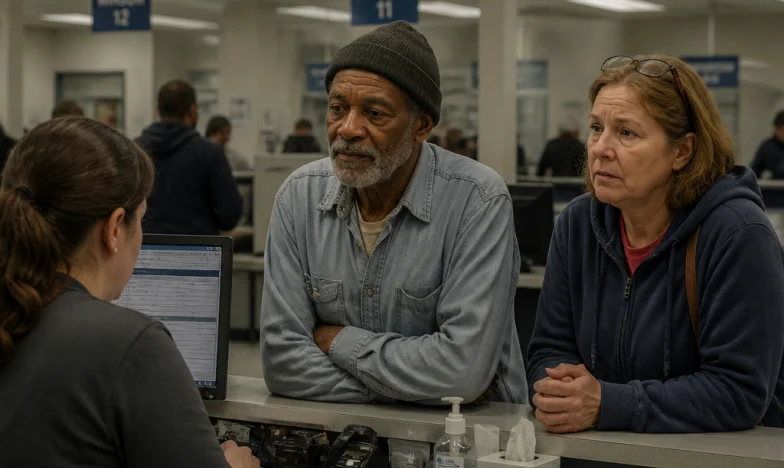
I took a half day off work and drove him to the DMV. We waited two hours. He needed a birth certificate to get a state ID, and he needed a state ID to request a birth certificate. The clerk was young, maybe twenty-five, and she kept looking at her screen instead of at us. Finally she said, “There’s a form he can fill out. It’ll take six to eight weeks.”
Leonard just nodded. He was used to waiting.
His son found out I was helping him. His name is Marcus. He’s thirty-four, works in IT, lives in a condo in Glendale. He called me from a blocked number and said, “I don’t know who you are, but my father is not your project. He burned every bridge he had. You need to step back.”
I said, “I’m not trying to be his family. I’m just trying to help him get a bed.”
Marcus said, “He had a bed. He had a house. He had a wife. He chose the other thing.”
Then he hung up.
I didn’t blame him. I still don’t. But I kept going.
I found a church on the south side that runs a winter shelter. They didn’t require an ID, just a name and a breathalyzer. Leonard passed. He started staying there in November. I’d pick him up on Saturday mornings and we’d go to the library so he could use the computers. He applied for jobs at a hardware store, a warehouse, a car wash. Nobody called back. He had a nineteen-year gap in his employment history and a felony on his record.
One Saturday he said, “You know what I miss most? The first day of school. The kids would come in and I’d have the desks arranged in a circle. They hated that. They wanted rows. But I wanted them to see each other.”
I said, “You could tutor.”
He shook his head. “Felony. Nobody’s letting me near kids.”
In January, the church shelter closed for the season. Leonard moved into a tent behind a strip mall. I brought him a sleeping bag from Walmart and a pack of hand warmers. He said thank you and then he said, “You don’t have to keep doing this.”
I said, “I know.”
In March, a caseworker from a nonprofit finally called me back. She said there was a transitional housing program for older men, but it required a referral from a social service agency. I called the agency. They said they needed proof of homelessness. I called the church. They faxed a letter. The fax didn’t go through. I called again. They faxed it again. It went through.
Leonard moved into a room in a converted motel on East Colfax in April. It’s not much. A bed, a dresser, a microwave. But it has a door that locks and a mailbox with his name on it.
He got a job in May. Night stocker at a grocery store. He works eleven to seven, four nights a week. He told me he likes it because it’s quiet and he can listen to audiobooks on his headphones. He’s reading a biography of John Adams.
Marcus still won’t speak to him. Leonard calls him every Sunday and leaves a voicemail. He told me he doesn’t expect Marcus to pick up. He just wants him to know the number still works.
Last week, Leonard and I were sitting on a bench outside the library. He had a cup of coffee from the gas station and I had a bottle of water. He said, “I used to think I’d die out here. Not in a dramatic way. Just one day, and nobody would know for a while.”
I didn’t say anything.
He said, “I don’t think that anymore.”
I said, “Good.”
He took a sip of his coffee. “Marcus might never come around. I know that. But I’m still his father. Even if he doesn’t want me to be.”
We sat there for a while. The traffic went by. The sun came through the trees. It wasn’t a happy ending. But it was an ending that could keep going.