Hidden Truth: A Mother’s Unblinking Vigil

“Naomi, you’re being paranoid.”
My husband, Mark, stood in the kitchen, arms folded, his voice low but edged with frustration. I clutched the baby monitor, my knuckles white, listening to the faint sounds of my daughter Ruby’s cries from the nursery upstairs. The new nanny, Jessica, had only been with us a week, but something in my gut twisted every time I left Ruby alone with her.
“I just… I don’t know, Mark. She’s so distant. I feel like she’s hiding something.”
He sighed, running a hand through his hair. “We checked her references. She came highly recommended. You need to rest, Naomi. You can’t do this all alone.”
He was right. I was exhausted—physically, emotionally, spiritually. Ruby was only three months old, and the postpartum fog still clung to me like a heavy blanket. But the unease wouldn’t leave. Every time Jessica smiled, it felt forced. Every time she held Ruby, I watched her hands, her eyes, her every move.
—
I tried to ignore it. I tried to sleep, to trust, to let go. But the anxiety gnawed at me, night and day. I found myself inventing errands just to come home early, hoping to catch Jessica in some act I couldn’t quite name. Each time, the house was spotless, Ruby was fed and changed, and Jessica greeted me with that same polite, unreadable smile.
One night, after another argument with Mark, I sat alone in the living room, scrolling through parenting forums. Stories of hidden abuse, neglect, and betrayal leapt from the screen. My heart pounded. I ordered two small cameras online, the kind you could hide in a teddy bear or a bookshelf.
I told myself it was just for peace of mind. Just to prove to myself that I was overreacting.
—
The next morning, while Jessica took Ruby for a walk, I set up the cameras—one in the nursery, one in the living room. My hands shook as I tucked the tiny lens behind a row of children’s books.
For the next two days, I watched the footage at night, my heart in my throat. Nothing. Jessica fed Ruby, changed her, played with her. She even sang softly, her voice gentle. I felt foolish, guilty for doubting her. Maybe Mark was right. Maybe I was losing my mind.
But on the third day, everything changed.
—
It was a Thursday afternoon. I was at the grocery store when I got a text from Jessica: “Ruby’s napping. All good here!”
That night, after Mark went to bed, I sat in the dark, watching the day’s footage. At first, it was the usual routine. Then, around 2:15 p.m., I saw Jessica on the phone, pacing the living room. Her voice was low, urgent.
“I told you, I can’t do this much longer. The mother’s always watching me. I think she suspects something.”
My blood ran cold. She paused, listening. “No, I haven’t taken anything yet. But there’s cash in the bedroom. I’ll try tomorrow.”
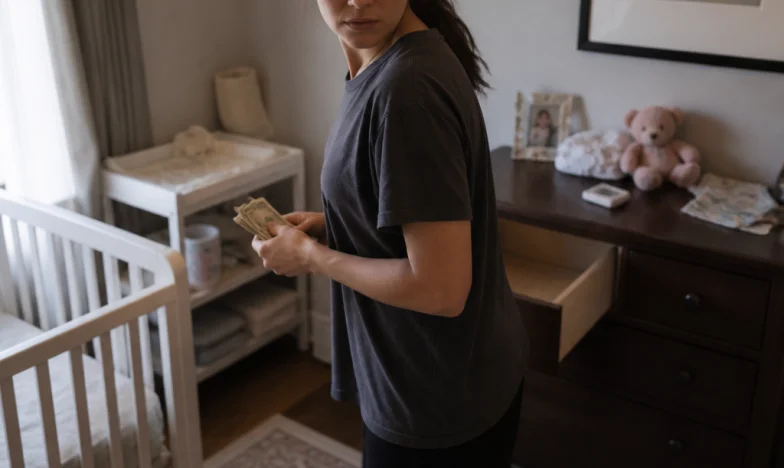
I froze. My heart hammered in my chest. I watched as she ended the call, glanced around, and then—God—she went into our bedroom. She rifled through my nightstand, pulling out the envelope where I kept emergency cash. She counted the bills, then put them back, her face tight with calculation.
I couldn’t breathe. I rewound the footage, watched it again, and again. It was real. I wasn’t crazy.
—
The next morning, I confronted Mark. He stared at the screen, his face pale.
“Oh my God, Naomi. I’m so sorry. I should have listened.”
We called the agency, reported Jessica, and changed the locks. I spent the next week in a daze, clutching Ruby to my chest, haunted by what could have happened. The agency apologized, promised a full investigation, but the damage was done.
I couldn’t sleep. Every time I closed my eyes, I saw Jessica’s face, heard her voice. I replayed every moment, every smile, every touch. How close had I come to losing everything?
—
My mother came to stay with us for a while. She held me as I cried, whispering, “You did the right thing, Naomi. You protected your daughter.”
But the guilt lingered. I questioned every decision, every instinct. Was I too paranoid? Or not paranoid enough?
Mark tried to reassure me. “We’ll find someone else. Someone we can trust.”
But trust felt impossible now. I watched everyone with suspicion. Friends, neighbors, even family. I saw danger everywhere.
—
One afternoon, as I rocked Ruby to sleep, I whispered, “I’m sorry, baby. I’m so sorry.”
She looked up at me, her eyes wide and trusting. I realized then that motherhood is a constant balancing act—between fear and faith, vigilance and letting go. I couldn’t protect Ruby from every danger, but I could trust my instincts, even when everyone else doubted me.
—
Months passed. We never hired another nanny. I found a part-time job I could do from home. Mark and I grew closer, united by the ordeal. But the scars remained—small, invisible, but always there.
Sometimes, late at night, I replay those days in my mind. I wonder what would have happened if I hadn’t listened to that voice inside me. If I had ignored the signs, dismissed my fears.
I know now that trust is fragile, easily broken, hard to rebuild. But I also know that a mother’s love is fierce, unyielding, and sometimes, it’s the only thing standing between safety and disaster.
Would I do it all again? In a heartbeat.
Because in the end, Ruby’s safety was worth everything.
Based on a true story.