I overheard my boss talking about me through the break room wall

I was standing in the break room at the Ridgeline Medical Clinic, trying to get the coffee machine to work, when I heard my name through the wall. Not my first name. My full name, said in that tone people use when they’re reading something official.
“Danielle Pruitt has been with us for eleven years,” the voice said. It was Dr. Harmon, the clinic director. “She’s reliable. But reliability isn’t the same as leadership.”
I stopped pressing the button on the coffee machine. The wall between the break room and his office was thin, the kind of drywall that came with the building when it was built in the nineties. I could hear his chair creak.
“I’m not saying she hasn’t earned a raise,” he went on. “I’m saying the budget doesn’t allow for two senior billing coordinators. And between Danielle and Mark, Mark has the MBA.”
Mark. Mark Delgado, who’d been at the clinic for three years. Who called me “Dani” even though I’d asked him twice not to. Who once told me that medical billing was “just data entry with extra steps.”
I’d trained Mark. I’d shown him how to code a denied claim for a Medicare crossover, how to handle a patient who’d been sent to collections by mistake, how to read an explanation of benefits like it was a map. He took notes on his phone and never said thank you.
I walked back to my desk and sat down. My hands were shaking a little, so I put them flat on the keyboard. The screen in front of me showed a queue of thirty-four claims that needed review. I opened the first one and stared at it without reading a word.
That was a Tuesday. The following Monday, Dr. Harmon called me into his office and told me the clinic was restructuring the billing department. My position was being “absorbed.” He said it with a straight face, like he was doing me a favor by telling me in person.
“You’ll receive two weeks of severance,” he said. “And a letter of recommendation.”
I asked him why Mark was staying and I wasn’t. He said it wasn’t about performance. It was about “strategic alignment.”
I went home that night and sat on the couch in my apartment, still wearing my coat. My sister called and I let it go to voicemail. I didn’t want to say the words out loud yet.
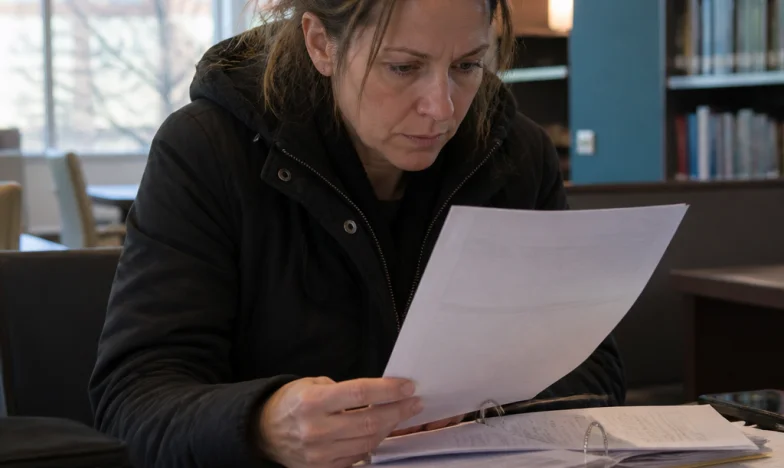
The next morning, I drove to the public library and used their scanner. I’d been at that clinic for over a decade. I had every performance review, every email about process improvements I’d suggested, every thank-you note from a patient who’d gotten a bill fixed. I’d kept them in a plastic bin under my bed, not because I thought I’d need them, but because I’m the kind of person who keeps receipts.
I started reading through them at a table near the window. My reviews were good. Not perfect, but good. “Exceeds expectations” in most categories. “Dependable.” “Thorough.” “Patient-focused.” The words blurred together after a while.
I called the state labor board the next day. The woman who answered asked me what I wanted to file a complaint about. I said I wasn’t sure. Wrongful termination? Age discrimination? I was forty-eight. Mark was thirty-one. I didn’t have proof of anything except a conversation I’d overheard through a wall.
She told me I could file a claim for unpaid wages if I thought I was owed anything. I said I didn’t think I was. She gave me the number for a legal aid clinic and wished me luck.
I almost let it go. That’s the part I think about most. I almost put the bin back under my bed and started looking for another job. My rent was due in three weeks. My car needed new brakes. I didn’t have time to be angry.
But then I remembered something. Six months earlier, I’d trained a new front-desk clerk named Tanya. She’d asked me how long I’d been at the clinic, and when I told her, she’d said, “That’s longer than I’ve been alive.” We’d laughed about it. She was twenty-two.
I found her on social media and sent her a message. I said I wasn’t sure if she still worked at the clinic, but if she did, I had a question. She replied the same day. She said she’d quit two months after I was let go. She said Mark had started calling her “the girl at the front” and she got tired of it.
I asked her if she’d ever heard Dr. Harmon say anything about me after I left. She didn’t reply for a day. Then she sent a long message. She said she’d been in the break room one afternoon when Dr. Harmon and Mark were talking. Mark said something about how much easier billing was now that “the old lady” was gone. Dr. Harmon laughed and said, “Easier and cheaper.”
She said she’d written it down in her notes app because it made her uncomfortable. She sent me a screenshot. The date was three weeks after my termination.
I didn’t know what to do with it. I’m not a lawyer. I’m a billing coordinator who got fired from a job she was good at. But I knew a woman from my old church named Renee who worked as a paralegal. I called her and asked if she’d look at what I had.
Renee met me for coffee at a diner off the highway. She read through my reviews, the screenshot from Tanya, and the termination letter. She asked me if I’d ever been written up. I said no. She asked if I’d ever been late on a project. I said no. She asked if I’d ever complained about Dr. Harmon or Mark. I said no.
She closed the folder and looked at me. “You might have a case for age discrimination,” she said. “It’s not a slam dunk. But it’s not nothing.”
I filed a complaint with the Equal Employment Opportunity Commission two weeks later. The process was slow. I had to fill out forms, wait for responses, send more documents. I got a part-time job at a grocery store to cover my bills. I worked the register and bagged groceries and tried not to think about the fact that I’d spent eleven years learning a job that didn’t want me anymore.
The clinic’s lawyer called me after the EEOC investigation started. He offered me three months’ pay to drop the complaint. I said no. He called again a month later and offered six. I said no again. My sister told me I was being stubborn. She said I should take the money and move on. I told her I wasn’t ready.
The EEOC issued a finding in my favor. They said there was reasonable cause to believe I’d been discriminated against because of my age. The clinic denied it. They said my position had been eliminated for budgetary reasons. They said Mark had more education. They said I was “difficult to work with.”
That last part made me laugh. I’d never been difficult. I’d been invisible. There’s a difference.
We went to mediation. I sat across from Dr. Harmon at a long table in a conference room downtown. He didn’t look at me. He looked at his hands, at the wall, at the mediator. He said he didn’t remember the conversation in the break room. He said he didn’t remember calling me “the old lady.” He said he’d always respected my work.
I didn’t say anything. I just pushed the screenshot across the table.
The mediator read it. Dr. Harmon’s face went a little gray. His lawyer asked for a recess.
They settled. I can’t say the exact amount because I signed a confidentiality agreement. But it was enough to pay off my car, cover my rent for a year, and give me time to find a job I actually wanted. I work at a community health center now. The pay is lower, but nobody calls me “the old lady.”
I still have the plastic bin under my bed. I don’t know why I keep it. Maybe because it reminds me that I wasn’t crazy. That I heard what I heard. That I was right.
I saw Dr. Harmon at a gas station about a year after the settlement. He was pumping gas into a silver SUV. He looked at me for a second, then looked away. I got in my car and drove off. I didn’t feel triumphant. I just felt tired.
But I also felt like I could finally breathe.