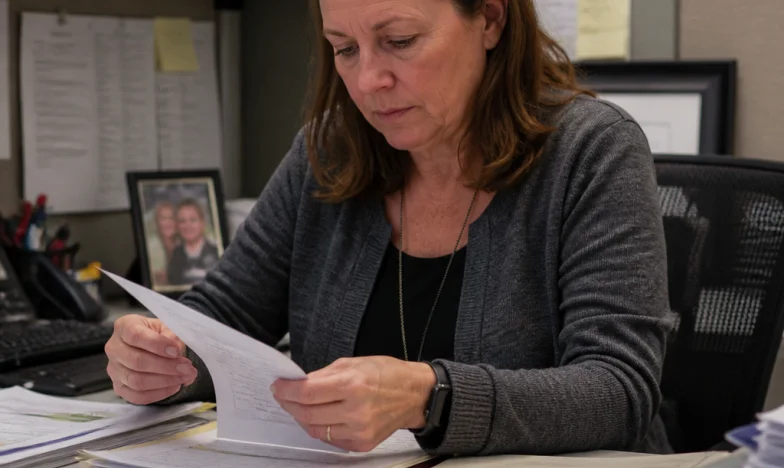
My manager took credit for my work and then fired me

I was standing in the break room at the Ridgeline Medical Center, staring at the vending machine, when I realized I had exactly four dollars and thirty-one cents in my checking account. The machine had a turkey sandwich for four twenty-five. I remember thinking, if I buy that, I can’t put gas in the car to get home tomorrow. That’s the kind of math I was doing in my head every single day.
My name is Denise Kowalski. I’m fifty-two years old. I worked as a medical billing specialist at Ridgeline for eleven years. I raised two kids on that job after my husband left. I wasn’t looking for a promotion or a pat on the back. I just wanted to do my work and get my paycheck.
The trouble started when they brought in a new billing manager named Todd Fennell. Todd was maybe thirty-five, wore expensive shoes, and talked about “streamlining revenue cycles” like he’d invented the phrase. He didn’t know our system. He didn’t know our patients. But he knew how to make himself look good in meetings.
About six months after Todd arrived, he called me into his office. He said the department was “restructuring” and my position was being “transitioned to a performance-based model.” I asked what that meant. He smiled and said, “It means we’re all going to have to work a little smarter, Denise.”
What it actually meant was that Todd started assigning me the oldest, most tangled accounts—the ones nobody else wanted. Claims that had been denied three times. Patient files with missing information. Insurance companies that had changed their policies mid-year. He’d dump a stack on my desk Friday afternoon and say, “These need to be cleaned up by Monday.”
I worked weekends. I worked evenings. I skipped my daughter’s parent-teacher conference because Todd said we had a “hard deadline” with a state Medicaid audit. And every time I cleared a batch, Todd would send an email to the regional director saying he’d “personally overseen the resolution of several high-priority accounts.”
He was taking credit for my work. Not just once. Every single week.
I started keeping a log. I know that sounds paranoid, but my mother always said, “If it isn’t written down, it didn’t happen.” So I wrote down every account number, every date, every hour I worked. I saved emails where Todd gave me assignments. I saved the emails where he claimed credit.
Then came the day Todd called me in and said my performance was “not meeting expectations.” He had a spreadsheet. It showed my numbers were down. I said, “Todd, those numbers are down because you reassigned half my accounts to the new girl so she could learn the system.” He said, “I don’t think that’s accurate.”
I went home that night and couldn’t sleep. I kept thinking about my mortgage. My car payment. My son’s college tuition. I was fifty-two years old. Who was going to hire a fifty-two-year-old medical biller if I got fired?
The next week, Todd put me on a “performance improvement plan.” That’s HR language for “we’re building a file so we can fire you.” I knew it. My coworker, a woman named Renee who’d been there even longer than me, pulled me aside in the parking lot. She said, “Denise, you need to go to HR. This isn’t right.”
I said, “HR works for them, not us.”
She said, “Then go to the labor board. Or a lawyer. Just don’t let him do this to you.”
I didn’t have money for a lawyer. But I did have my log. And I had Renee.
A few weeks later, Todd fired me. He said I’d “failed to meet the terms of my improvement plan.” He had a folder full of paperwork. He didn’t look sorry. He looked relieved.
I sat in my car in the parking lot for a long time. Then I drove home and called the state labor board. I told them I believed I’d been wrongfully terminated and that my manager had been taking credit for my work. The woman on the phone was kind. She said, “Do you have documentation?”
I said, “Yes, ma’am. I have everything.”
It took four months. Four months of waiting. Four months of borrowing money from my sister. Four months of applying for jobs and getting rejected because I was “overqualified” or “not the right fit.” Four months of waking up at three in the morning wondering if I was going to lose my house.
But I kept calling the labor board. I kept sending emails. I kept following up. And then one day, I got a letter in the mail. It said the state had investigated my claim and found that Ridgeline Medical Center had violated state labor laws. They were ordering the company to pay me back wages for the hours I’d worked off the clock, plus a penalty. It came to a little over eighteen thousand dollars.
It wasn’t a fortune. It didn’t give me my job back. But it was enough to catch up on my mortgage and keep the lights on while I found something else.
Todd Fennell was fired a few months later. I heard from Renee that the regional director finally figured out Todd didn’t actually know how to do anything except take credit for other people’s work. She said he cleaned out his desk on a Tuesday and didn’t say goodbye to anyone.
I’m working at a small family practice now. The pay is less, but the people are decent. I still keep a log of everything I do. Old habits, I guess.
Sometimes I think about that turkey sandwich in the vending machine. Four dollars and twenty-five cents. I never did buy it. I drove home on fumes that night and ate a can of soup.
But I kept the receipt from the gas station. Just in case.