No Woman Lasted a Day with the Mountain Man’s Five Kids—Until a Little Girl Changed Everything

The wind howled like a wounded animal, rattling the windows of the old log cabin. My boots crunched on the icy porch as I hesitated, suitcase in hand, heart pounding. Inside, I could hear shouting—children’s voices, wild and sharp, echoing through the thin walls.
“Get off me, Sam! I said let go!”
A crash. A boy’s laughter, edged with something desperate. I swallowed hard. This was nothing like the foster homes I’d known—no tidy lawns, no smiling social workers. Just the Bitter Mountains, snow swirling like ghosts, and a family everyone else had given up on.
I knocked. The door swung open, and there he was: Elias Boon. Tall, broad-shouldered, beard flecked with gray and frost. His eyes were blue, cold as the river ice, but there was something broken in them, too. He looked me up and down—just a kid, barely twelve, skinny as a sapling.
“You’re the new one?” he grunted.
I nodded, clutching my suitcase tighter. “I’m Laya.”
He stepped aside. “Come in, then. If you can last the night.”
—
The cabin was chaos. Five boys, all under fifteen, darted around like wild animals—shoving, shouting, wrestling. The youngest, Jamie, hid behind a battered armchair, eyes wide. The oldest, Sam, glared at me, arms crossed, daring me to speak.
“Another one?” he sneered. “How long you think you’ll last?”
I didn’t answer. I just set my suitcase down and took in the room: patched blankets, a wood stove, the faint smell of wet dog and old smoke. No pictures on the walls. No sign of a woman’s touch.
Elias watched me, silent. I could feel his judgment, heavy as the snow on the roof.
—
That first night, I lay awake on a lumpy mattress, listening to the wind and the boys’ muffled arguments. I thought about running—just slipping out into the snow, disappearing. But I’d run before, and it had never led anywhere good.
Instead, I got up. I crept to the kitchen, found a battered kettle, and made tea. The next morning, I set out mugs for everyone, even though I knew they’d probably throw them at each other.
“Why’d you do that?” Jamie asked, peering at me over the rim of his mug.
I shrugged. “Seemed like we could all use something warm.”
Sam snorted. “You’re weird.”
But he drank the tea.
—
Days blurred into weeks. The boys tested me—hiding my shoes, locking me outside, calling me names. Elias barely spoke, except to bark orders or mutter about chores. I learned to chop wood, to patch holes in the roof, to cook with whatever we had. I learned to dodge snowballs and insults.
But I also learned their secrets. Jamie was afraid of the dark. Ben, the middle one, drew pictures of wolves in the margins of his schoolbooks. Sam, for all his bravado, cried at night when he thought no one could hear.
One evening, as the storm raged outside, I found Elias sitting by the fire, staring into the flames. I sat beside him, silent.
He didn’t look at me. “You’re tougher than you look.”
I shrugged. “I’ve had to be.”
He nodded, as if that explained everything.
—
The turning point came in the dead of winter. Jamie got sick—feverish, shivering, his breaths ragged. The nearest doctor was twenty miles down the mountain, and the roads were buried in snow.
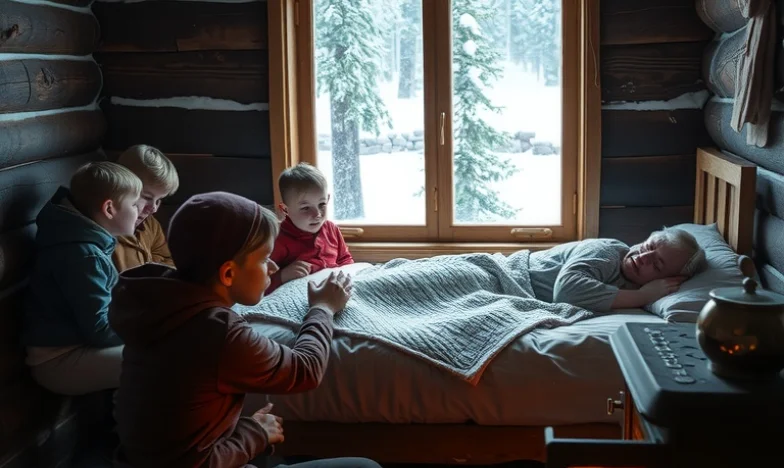
Elias paced, helpless. The boys hovered, scared. I remembered my mother—before she left—singing to me when I was sick. I sat by Jamie’s bed, holding his hand, singing softly. The other boys crept in, one by one, listening.
Elias watched from the doorway, fists clenched. “He’ll be fine,” he said, but his voice shook.
I looked up at him. “He needs you.”
He hesitated, then crossed the room and knelt by Jamie’s bed. He took his son’s hand, rough and trembling. For the first time, I saw tears in his eyes.
—
Jamie pulled through. After that, something shifted. The boys stopped hiding my things. Sam started helping me with chores. Ben showed me his drawings. Even Elias softened, just a little—he let me help him fix the roof, taught me how to set a trap line.
One night, as we sat around the fire, Sam asked, “Why’d you stay? All the others ran off.”
I thought about it. “Because I know what it’s like to be left behind.”
Elias looked at me, really looked, and I saw understanding in his eyes.
—
Spring came slowly to the Bitter Mountains. The snow melted, revealing patches of green. The boys grew quieter, less wild. We planted a garden together, laughing as we got mud on our faces. Elias built a swing for Jamie, and I taught Ben how to bake bread.
One evening, as the sun set behind the peaks, Elias sat beside me on the porch.
“You changed this place,” he said quietly. “Changed us.”
I smiled, feeling something warm bloom in my chest. “Maybe you changed me, too.”
He nodded. “You’re family now, Laya. If you want to be.”
Tears stung my eyes. I nodded, unable to speak.
—
Sometimes, I still wake up in the night, heart pounding, afraid it will all disappear. But then I hear the boys’ laughter, the crackle of the fire, Elias’s steady breathing. I know I’m home.
Family isn’t always what you expect. Sometimes, it’s forged in the hardest places, by the most unlikely people. Sometimes, it takes a little girl to melt a mountain man’s heart.
Based on a true story.