Fifteen Summers Without You: The Letter That Changed Everything

The sun was already high and merciless when I heard my daughter’s laughter echo across the sand, mixing with the crash of the waves. “Mom! Dad! Look at me!” Emily called, her small arms flailing as she tried to keep her balance on the boogie board. My husband, Mark, grinned and jogged toward her, his flip-flops slapping against his heels. I remember thinking, as I watched them, that this was the kind of day you wanted to bottle up and keep forever—a perfect American summer, the Fourth of July bunting still fluttering from the boardwalk, the smell of sunscreen and grilled hot dogs in the air.
But forever is a lie we tell ourselves. I learned that the hard way.
It was supposed to be a simple vacation. We’d driven down from our home in Des Moines, Iowa, to the quiet beaches of San Juan, La Unión, hoping to escape the crowds and the noise. Mark had been working too much, and Emily was growing up too fast. I wanted us to be a family again, if only for a week.
I remember the moment everything changed. I was laying out towels, humming along to a Bruce Springsteen song on the radio, when I heard Emily scream—not the playful kind, but a sharp, terrified sound that sliced through the air. I looked up and saw Mark running into the surf, his arms outstretched. Emily was caught in a rip current, her board spinning away. I dropped everything and ran, but by the time I reached the water, they were both gone.
The next hours blurred into a nightmare. Lifeguards, police, helicopters. I screamed their names until my throat was raw. The sun set, and still, nothing. No bodies, no footprints, just the endless, indifferent ocean. The official report called it a tragic accident. I called it the end of my world.
For fifteen years, I lived in the shadow of that day. I moved back to Iowa, sold the house, and tried to build a life out of the ashes. People told me to move on, to find closure, but how do you close a door when you don’t know what’s on the other side? Every holiday was a reminder—empty chairs at Thanksgiving, unopened gifts at Christmas, the ache of silence on birthdays. My parents tried to help, but grief is a private country. You can’t bring anyone with you.
I went through the motions. I taught English at the local high school, baked casseroles for church potlucks, smiled when people asked how I was doing. But inside, I was frozen in that moment on the beach, waiting for someone to come back.
Then, this morning, everything changed again.
I was sorting through the mail—bills, junk, a postcard from my sister in Chicago—when I saw it. A plain white envelope, no return address, postmarked from New Orleans. My hands started to shake before I even opened it. Inside was a single sheet of paper, folded neatly. The handwriting was unmistakable: Emily’s, round and looping, the way she wrote when she was ten.
“Dear Mom,” it began. “I hope this letter finds you. I know you must have so many questions. I do too. I’m safe. I’m with Dad. We’re together. I can’t explain everything yet, but I want you to know I never stopped thinking about you. I love you. Please don’t give up on us. I’ll write again soon. Love, Emily.”
I dropped the letter. My knees buckled, and I sat on the kitchen floor, clutching the paper to my chest. Was this some cruel joke? A scam? But how could anyone know the nickname Mark used for me—Lulu—scribbled in the margin? How could anyone fake the little heart Emily always drew over her i’s?
I called the police, but they were skeptical. “Ma’am, people get all kinds of letters,” the officer said. “It’s probably a prank.” But I knew. A mother knows.
I spent the day pacing the house, replaying every memory, every possibility. Had they survived? Had someone taken them? Why hadn’t they come back? My mind spun with questions, each more impossible than the last. I called my best friend, Susan, and she drove over with a bottle of wine. We sat on the porch, watching the fireflies, the letter between us like a live wire.
“What if it’s really her?” Susan whispered. “What if they’re alive?”
“I don’t know what to believe,” I said, my voice breaking. “But I can’t let go. Not now.”
The next day, I took the letter to a private investigator. His name was Tom Jenkins, a retired cop with a soft spot for lost causes. He read the letter, then looked at me with kind, tired eyes. “I’ve seen stranger things,” he said. “Let’s see what we can find.”
The weeks that followed were a blur of phone calls, emails, dead ends. Tom traced the postmark to a small post office in the French Quarter. He found security footage of a young woman—maybe late teens, early twenties—mailing a letter. She wore a baseball cap and sunglasses, her hair pulled back in a ponytail. Was it Emily? The footage was grainy, but my heart leapt at the possibility.
I started to hope again, and hope is a dangerous thing. It wakes up all the old wounds, makes you believe in miracles. I began to imagine what I would say if I saw them again. Would Mark still have that crooked smile? Would Emily remember the lullabies I used to sing?
Then, another letter arrived. This time, it was longer. Emily wrote about memories only we shared—the time we got caught in a rainstorm at the Iowa State Fair, the way Mark used to make pancakes shaped like Mickey Mouse. She said they were safe, but couldn’t come home yet. She promised to explain everything soon.
I showed the letter to Tom. He nodded. “She’s trying to tell you something. Maybe she can’t say more. Maybe someone’s watching.”
I started to notice things. A car parked outside my house for hours. Hang-up calls in the middle of the night. Was I being paranoid, or was someone trying to keep us apart?
One night, I dreamed of the beach. Mark and Emily were there, waving at me from the water. I ran to them, but the waves kept pulling me back. I woke up sobbing, the sheets tangled around me like seaweed.
I decided to go to New Orleans. I needed answers. I packed a bag, left a note for my parents, and drove south, the letter tucked in my purse like a talisman. The city was alive with music and heat, the air thick with secrets. I walked the streets, searching faces, hoping for a miracle.
At the post office, I showed the clerk Emily’s photo. He shook his head. “Sorry, ma’am. Lots of folks come through here.”
I wandered the French Quarter, stopping at every café, every park, scanning the crowds. I felt foolish, desperate, but I couldn’t stop. I sat on a bench in Jackson Square, watching the street performers, the tourists snapping photos. I thought about all the families together, laughing, arguing, living their lives. I wondered if I would ever have that again.
As the sun set, my phone buzzed. A text from an unknown number: “Go to Café du Monde. Table by the window.”
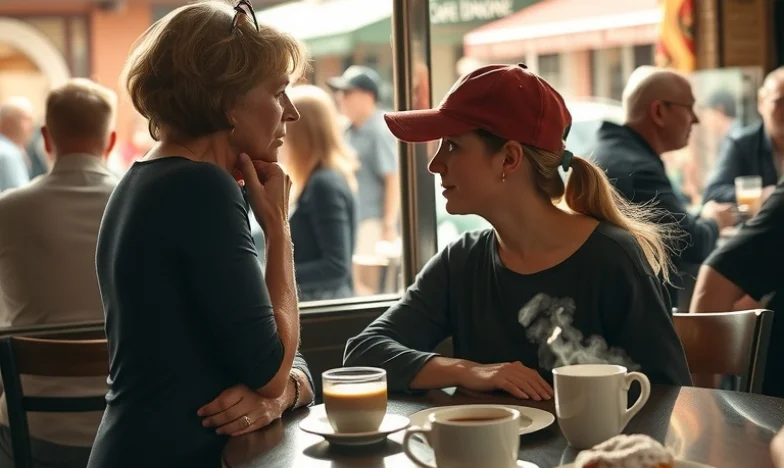
My heart hammered in my chest as I hurried through the streets. The café was crowded, the smell of beignets and coffee in the air. I scanned the tables, my hands shaking. And then I saw her—a young woman, her hair pulled back, a baseball cap on the table. She looked up, and our eyes met.
“Mom?” she whispered.
I ran to her, tears streaming down my face. We hugged, clinging to each other like drowning swimmers. She was older, taller, but it was her. My Emily.
Mark wasn’t there. Emily explained, her voice trembling, that after the accident, they’d been rescued by a fisherman who spoke little English. Mark had been injured, confused. They’d been taken in by a family who lived off the grid, afraid of the authorities, afraid of being separated. Mark had died two years ago, but Emily had stayed, too scared to reach out until now.
We cried, we laughed, we talked for hours. I told her about Iowa, about the empty house, about the years I’d spent searching. She told me about her life, the kindness of strangers, the pain of missing me.
We went home together. The house felt alive again, filled with laughter and stories. The empty chairs at Thanksgiving were filled. The ache in my heart began to heal.
Sometimes, I still wake up in the night, afraid it was all a dream. But then I hear Emily’s voice, see her smile, and I know we found our way back to each other.
Fifteen summers without you, and now you’re home. Is it possible to forgive the years we lost? Or do we simply start again, one day at a time?