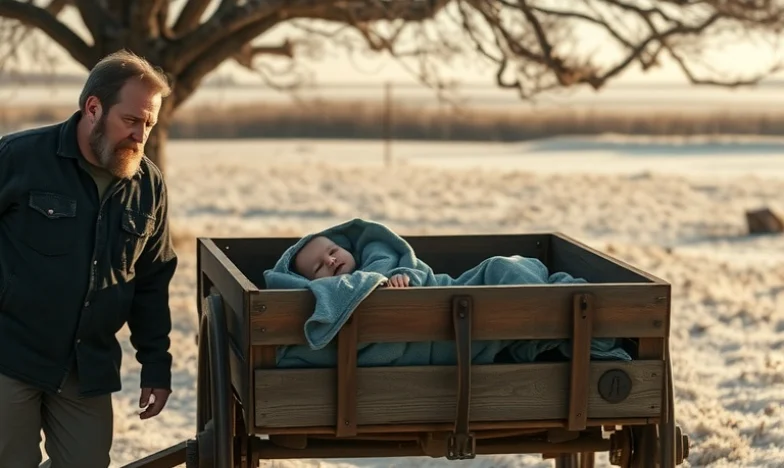
A Baby Left in an Old Wagon Changed My Life Forever

The wind was sharp that morning, slicing through my flannel shirt as I trudged across the frostbitten field behind my house in rural Nebraska. My boots crunched over the brittle grass, and my breath came out in clouds. I was heading to the old wagon—my father’s wagon, the one I’d sworn I’d fix up but never did. It was just a relic now, parked under the cottonwoods, a reminder of everything I’d lost.
I was halfway there when I heard it—a thin, desperate wail. At first, I thought it was a stray cat. But as I got closer, the sound grew sharper, more urgent. My heart started pounding. I broke into a run, the cold forgotten.
There, in the bed of the wagon, wrapped in a faded blue blanket, was a baby. A real, living baby, red-faced and screaming, fists balled tight against the morning chill.
I froze. For a second, I just stared, my mind refusing to catch up. Then instinct took over. I scooped the baby up, cradling him to my chest, and ran back to the house, yelling for my wife, Linda.
“Linda! Linda, call 911! There’s a baby—someone left a baby in the wagon!”
She came running, her eyes wide with shock. “Oh my God, Tom, what—who would do this?”
We wrapped the baby in towels, trying to warm him up. My hands shook so badly I could barely dial the phone. The operator’s voice was calm, but I could hear the urgency beneath it. “Stay with the baby. Help is on the way.”
As we waited for the sirens, Linda rocked the baby, humming softly. I watched her, remembering the years we’d spent trying for a child of our own. The miscarriages. The silence that had grown between us. The way we’d stopped talking about hope.
The sheriff arrived first, followed by an ambulance. They took the baby, asked us questions, took statements. I watched them drive away, the baby’s cries fading into the distance. I felt hollow, like something had been ripped out of me.
That night, I couldn’t sleep. I kept seeing the baby’s face, the way he’d clung to my finger. I wondered who his mother was, what desperation had driven her to leave him in my wagon. I wondered if he’d be okay.
Days passed. The sheriff called, said they hadn’t found the mother. The baby was in foster care, safe, but alone. Linda and I talked, really talked, for the first time in years. She said, “Maybe this is a sign, Tom. Maybe we’re meant to help.”
We started the process to foster the baby. It wasn’t easy. There were interviews, background checks, home visits. The social worker, Ms. Carter, was kind but firm. “You need to be sure. This is a big commitment.”
I was sure. I’d never been more sure of anything in my life.
The day we brought the baby home, Linda cried. I did too, though I tried to hide it. We named him Samuel. Sammy. He was tiny, but fierce—he fought for every bottle, every nap. He filled our house with noise and chaos and laughter.
But not everyone was happy. My mother, who lived down the road, was furious. “You don’t know where that baby came from! What if his family comes back? What if he’s trouble?”
I tried to explain, but she wouldn’t listen. She stopped coming by. My brother, Mark, said I was crazy. “You’re too old for this, Tom. You’re setting yourself up for heartbreak.”
Maybe I was. But every time I looked at Sammy, I knew I couldn’t turn away.
The months blurred together—diapers, midnight feedings, first smiles. Sammy grew stronger, louder. He loved trucks and dogs and the sound of Linda’s singing. He hated peas and naps and being left alone.
One night, as I rocked him to sleep, I whispered, “You saved us, kid. You saved me.”
But the past wasn’t done with us. One afternoon, a woman showed up at our door. She was thin, her hair tangled, her eyes hollow. She looked at me and said, “I’m his mother.”
My heart stopped. Linda came to the door, her face pale.
The woman’s name was Jessica. She told us her story—how she’d been homeless, addicted, desperate. How she’d left Sammy in the wagon because she thought he’d be safer with us than with her. She cried as she spoke, her hands shaking.
“I’m clean now,” she said. “I’m in a program. I want to see him. Please.”
We called Ms. Carter. There were meetings, supervised visits. Sammy didn’t know her, but he didn’t cry. Jessica brought him a stuffed bear, sat with him on the floor, sang him lullabies. I watched from the doorway, torn between anger and pity.
Linda and I fought. She wanted to help Jessica, to give her a chance. I wanted to protect Sammy, to keep our family whole. The tension grew, thick and choking.
One night, after a visit, Linda said, “We can’t keep him from her, Tom. She’s his mother.”
I slammed my fist on the table. “We’re his parents now! We’re the ones who stayed!”
Linda’s eyes filled with tears. “This isn’t about us. It’s about what’s best for him.”
I stormed out, drove for hours, the fields blurring past. I thought about my own father, how he’d left when I was ten, how I’d sworn I’d never abandon anyone. I realized I was doing the same thing—holding on so tight I was suffocating the people I loved.
I came home, sat with Linda in the dark. “I’m scared,” I said. “I don’t want to lose him.”
She took my hand. “We might. But we can’t let fear make us cruel.”
The court hearings were long and painful. Jessica fought for custody. We fought for Sammy. In the end, the judge ruled for shared custody—Jessica would have supervised visits, but Sammy would stay with us.
It wasn’t perfect. It wasn’t what I wanted. But it was fair.
Years passed. Sammy grew. He called us Mom and Dad, but he knew Jessica too. He knew he was loved, by all of us, in different ways.
My mother came around, eventually. She saw how happy Sammy was, how much he belonged. Mark apologized, said he was wrong.
Sometimes, I still think about that morning—the cold, the fear, the way my life changed in an instant. I think about how easy it would have been to turn away, to let someone else deal with the mess. But I didn’t. I chose to stay. I chose to love.
And that made all the difference.
Based on a true story.