When the Classroom Became a Battlefield: My Father, My Silence, and the Day Everything Changed

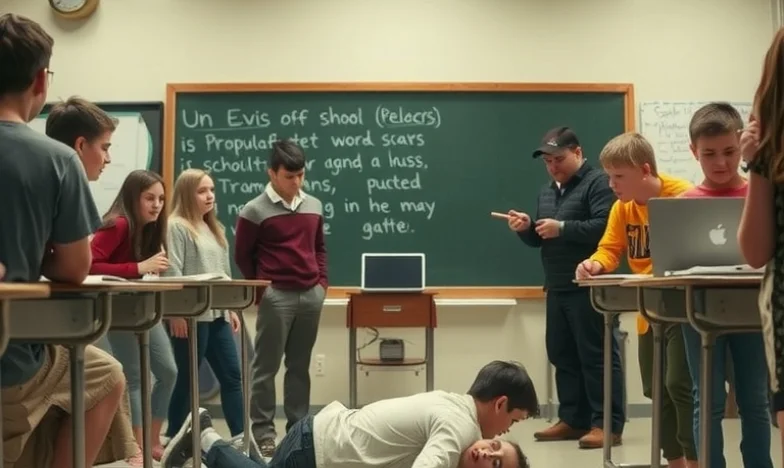
“Ethan, stop fidgeting and pay attention!” Mr. Perry’s voice cut through the classroom like a cold wind. My hands trembled on the desk. I could barely see the board; the words swam in front of my eyes. My heart thudded in my chest, too fast, too loud. I tried to raise my hand, but my arm felt like it weighed a hundred pounds.
“Mr. Perry, I don’t feel so good,” I whispered, my voice barely audible over the hum of the fluorescent lights.
He didn’t even look up from his laptop. “You’re always looking for an excuse, Ethan. Sit down and focus.”
The room spun. I clung to the edge of my desk, desperate for something solid. The laughter of my classmates echoed in my ears, sharp and cruel. I heard someone whisper, “Drama queen,” and another snickered, “He’s just trying to get out of the quiz.”
I tried to stand, but my knees buckled. The world tilted, and then everything went black.
—
When I woke up, I was lying on the cold linoleum floor. My cheek stung where it had hit the ground. My classmates stood in a half-circle, staring down at me like I was some kind of freak show. Mr. Perry hovered above me, his face tight with annoyance.
“Get up, Ethan. You’re disrupting the class.”
I blinked, trying to focus. My head throbbed. I wanted to cry, but I bit my lip until I tasted blood. I pushed myself up, my hands shaking.
“Can I go to the nurse?” I asked, my voice barely more than a whisper.
Mr. Perry sighed. “Fine. But don’t make a habit of this.”
I stumbled out of the classroom, clutching the wall for support. The hallway was empty and silent, except for the distant sound of lockers slamming. I made it to the nurse’s office and collapsed into a chair.
—
That night, at dinner, Dad noticed the bruise on my face. “What happened to you?”
I shrugged, poking at my mashed potatoes. “I fainted in class.”
He set down his fork. “Did someone hurt you?”
“No. I just… I told Mr. Perry I didn’t feel good, but he wouldn’t let me go to the nurse.”
Dad’s jaw tightened. “He what?”
I looked away, ashamed. “He said I was making excuses. Everyone laughed at me.”
Dad pushed his chair back and stood up. “That’s not right, Ethan. I’m going to talk to the school.”
—
The next morning, Dad drove me to school. He marched into the office, his face set in that stubborn way I knew meant he wouldn’t back down.
“I want to speak to the principal,” he said to the secretary.
She gave him a tight smile. “Is this about Ethan?”
“Yes. My son fainted in class yesterday, and his teacher ignored his pleas for help.”
She hesitated. “Mr. Perry is one of our best teachers. I’m sure there’s been a misunderstanding.”
Dad’s voice was calm, but I could hear the anger simmering beneath the surface. “There’s no misunderstanding. My son was hurt, and no one helped him.”
The principal, Mrs. Carter, finally came out. She listened to Dad’s story, nodding politely, but I could tell she wasn’t really hearing him.
“We’ll look into it,” she said. “But you know, Ethan has a history of… dramatics.”
Dad’s face turned red. “My son is not a liar.”
—
For days, nothing changed. Mr. Perry barely looked at me in class. My classmates whispered behind my back. I felt invisible, like I didn’t matter.
At home, Dad tried to comfort me. “We’ll get through this, Ethan. I promise.”
But I could see the worry in his eyes. He called the school board, wrote emails, demanded meetings. Each time, he hit a wall of polite indifference.
One night, I heard him on the phone with my mom, who lived in another state. “They’re covering for each other, Lisa. No one wants to admit there’s a problem.”
—
The weeks dragged on. I started having nightmares—reliving the moment I collapsed, the laughter, the shame. I stopped raising my hand in class. I stopped talking to my friends. I stopped believing that adults would protect me.
One afternoon, Dad sat down next to me on the porch. The sun was setting, painting the sky in shades of orange and pink.
“I’m sorry, Ethan,” he said quietly. “I thought I could fix this. But the school… they don’t want to listen.”
I looked at him, tears stinging my eyes. “Why don’t they care?”
He pulled me into a hug. “Sometimes people are afraid to admit when they’re wrong. But that doesn’t mean you’re alone.”
—
The next day, Dad took me to a counselor outside of school. She listened—really listened—as I told her everything. The fear, the humiliation, the silence.
“You’re not invisible, Ethan,” she said. “Your feelings matter. What happened to you wasn’t your fault.”
Slowly, I started to heal. Dad kept fighting, even when it seemed hopeless. He joined a group of parents who had similar stories—kids ignored, teachers protected, pain swept under the rug.
We spoke at a school board meeting. Dad’s voice shook, but he didn’t back down. “Our children deserve better. They deserve to be heard.”
Some people listened. Some didn’t. But for the first time, I felt like my voice mattered.
—
I still have scars—from the fall, from the laughter, from the silence. But I’m learning to speak up, even when it’s hard. Dad and I are closer now. We talk about everything—the good, the bad, the things that hurt.
Sometimes, I wonder if things will ever really change. If schools will ever put kids before their own reputations. If teachers will ever see us as more than just troublemakers or drama queens.
But I know this: I’m not alone. And I won’t be silent anymore.
Based on a true story.