A Letter from Mom: When the Past Knocks on Your Door

The envelope was thin, trembling in my hands as if it carried the weight of a thousand unsaid words. I stood in my tiny Brooklyn apartment, sunlight slanting through the blinds, dust motes swirling in the air. My heart hammered in my chest. I hadn’t seen my mother’s handwriting in over a decade.
I tore the envelope open, hands shaking. The first line read: “Emily, I need your help.”
I sank onto the couch, letter clutched tight. My mind raced back to the last time I’d seen her—Thanksgiving, 2012. The shouting, the slammed door, the way she’d said, “If you walk out now, don’t bother coming back.” I’d walked out. I’d never looked back.
But here I was, a decade later, staring at her plea. My mother, the woman who’d raised me on casseroles and country music, who’d taught me to be tough, was asking for help.
I read on. She was sick. The words blurred: “diagnosed… can’t do this alone… please, Emmy.”
I pressed the letter to my chest and let the tears come. I’d built my life on the ruins of our relationship—new friends, a job at the library, a cat named Oscar. I’d told myself I was fine. But now, the past was at my door, demanding to be let in.
—
I called my best friend, Rachel. “She wants me to come home,” I whispered. “She’s sick.”
Rachel was quiet. “Do you want to?”
“I don’t know,” I said. “I’m scared.”
“Of what?”
“Of everything. Of her. Of what I’ll find.”
Rachel’s voice was gentle. “You don’t have to decide tonight.”
But I knew I would. I’d always been the one to fix things, even when I was a kid. I’d patch up Dad’s old jeans, smooth over Mom’s temper. But this—this was different. This was about forgiveness. About pride. About wounds that never healed.
—
The bus ride to upstate New York was long and gray. I watched the city fade into fields, the skyline replaced by bare trees and broken fences. My childhood home was just as I remembered—white paint peeling, porch swing creaking in the wind.
I knocked. The door opened slowly. My mother stood there, smaller than I remembered, her hair thinner, her eyes rimmed red.
“Emmy,” she whispered.
I swallowed hard. “Hi, Mom.”
She reached for me, hesitated, then pulled me into a hug. I stiffened, then let myself melt into her arms. For a moment, we were just mother and daughter again.
Inside, the house smelled like cinnamon and old books. The kitchen table was cluttered with pill bottles and unopened mail. She sat, coughing, and I saw the fear in her eyes.
“I’m sorry,” she said. “For everything.”
I stared at my hands. “Why now?”
She looked away. “I didn’t know how to ask before. I was proud. Stubborn.”
I nodded. “Me too.”
—
The days blurred together. I cooked her meals, drove her to appointments, sorted through old photographs. We talked—about the weather, about my job, about Dad, gone five years now. But the real conversations, the ones about the past, hovered unspoken between us.
One night, as rain battered the windows, she said, “Do you remember that summer you ran away?”
I flinched. “I was sixteen.”
“I never forgave myself,” she whispered. “I should have listened. I should have protected you.”
I felt the old anger rise up. “You didn’t believe me. About Uncle Joe.”
She covered her face with her hands. “I was scared. I didn’t want to believe it. I failed you.”
Silence stretched between us, heavy and raw.
“I hated you for a long time,” I said, voice shaking. “I thought you chose him over me.”
She sobbed. “I’m so sorry, Emmy. I was wrong.”
I reached for her hand. “I know.”
—
The weeks passed. I saw her strength fade, her body betray her. I became the caretaker, the adult. I resented it, sometimes. I wanted to run, to escape the weight of her need, her regret.
But I stayed. I cooked her favorite soup, read to her from her old romance novels. We watched Jeopardy and argued about the answers. Slowly, the walls between us crumbled.
One afternoon, she handed me a box. “These are for you.”
Inside were letters—dozens of them, all addressed to me. “I wrote every birthday, every Christmas. I never sent them. I didn’t think you’d want them.”
I read them late into the night. Apologies, memories, hopes. I cried for the years we’d lost, for the words we’d never said.
—
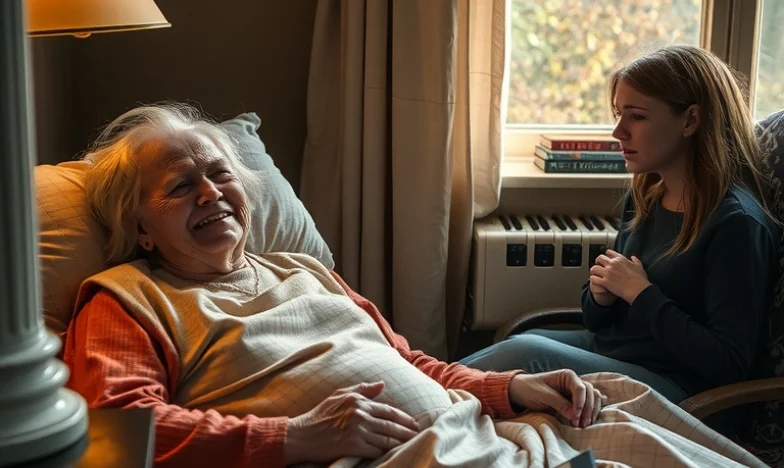
The day she died, I sat by her bed, holding her hand. She squeezed my fingers, her voice barely a whisper. “Thank you for coming home.”
I kissed her forehead. “I love you, Mom.”
She smiled, and for the first time in years, I saw peace in her eyes.
—
After the funeral, I stood on the porch, the autumn wind tugging at my hair. Rachel called. “How are you holding up?”
“I don’t know,” I said. “But I’m glad I came. I think—I think I finally forgave her. Maybe I forgave myself, too.”
There’s still pain. There are still questions. But there’s also hope. Maybe that’s what forgiveness is—a door you open, even when you’re scared of what’s on the other side.
If you’re reading this, and you have someone you need to forgive, or someone you need to ask for forgiveness—don’t wait. The past will always knock. It’s up to you whether you answer.
Based on a true story.