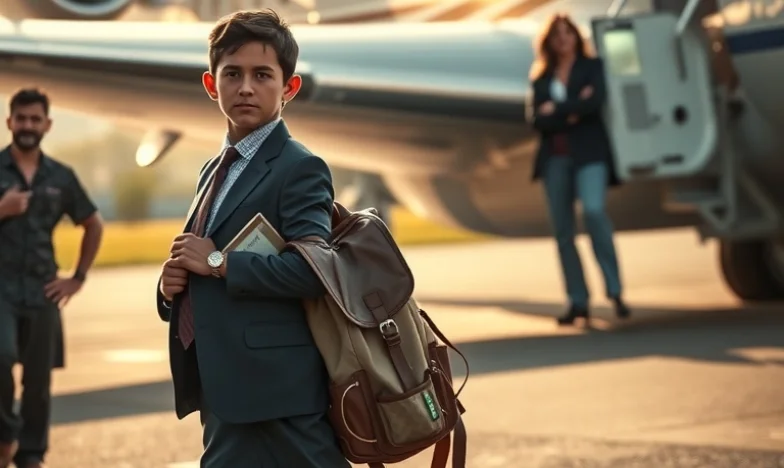
A Billionaire’s Flight Stopped by a Twelve-Year-Old: The Day Everything Changed

“Don’t get on that plane!”
The words cut through the humid Florida morning like a siren. I froze, my hand still gripping the polished handle of my Gulfstream’s stairway. The tarmac, usually a blur of efficiency, fell silent. My assistant, Karen, looked at me, her eyes wide with confusion. The cameras from CNBC, there to film my latest business triumph, swung toward the commotion.
A boy—no older than twelve, skinny, dirt-smudged, with a mop of unruly brown hair—stood just beyond the security line. His voice cracked, but his eyes burned with a determination I hadn’t seen in years. Not since I was a kid myself, fighting for scraps in a foster home in Detroit.
“Sir, we need to move,” Karen whispered, tugging at my sleeve. But I couldn’t. Something about the boy’s desperation rooted me to the spot.
He darted past a stunned TSA agent, clutching a battered backpack to his chest. Security lunged, but I raised a hand. “Let him through.”
The boy stumbled to a halt in front of me, panting. “Please, Mr. Miller. Don’t get on that plane. You have to see this.”
I glanced at the cameras, at my team, at the jet gleaming behind me. I was supposed to be in New York by noon for a board meeting that could make or break my company’s next merger. But the boy’s urgency—his fear—was unmistakable.
“What’s your name?” I asked, kneeling so I could look him in the eye.
“Eli,” he whispered. “Eli Carter.”
He fumbled with his backpack, pulling out a small, homemade device—wires, a cracked screen, duct tape holding it together. My security chief, Frank, stepped forward, hand on his holster.
“It’s not a bomb,” Eli said quickly, tears welling in his eyes. “It’s proof. Proof that someone’s trying to kill you.”
The world tilted. I stared at the device, then at the boy. “What are you talking about?”
“My brother—he works for you. In IT. He found something. He tried to warn you, but they fired him. He’s missing. Please, you have to believe me.”
I felt the old anger rising—at the world, at myself, at the system that chews up kids like Eli and spits them out. But I also felt something else: fear. Real, bone-deep fear.
I stood, motioning for Frank to back off. “Let’s go inside.”
—
Inside the terminal, I sat across from Eli in a glass-walled conference room. My team hovered outside, whispering into phones. Eli’s hands shook as he set the device on the table.
“My brother, Marcus, said someone hacked your flight plan. He found code in the system—something that would override the autopilot. He tried to tell his boss, but they said he was crazy. Then he disappeared.”
I stared at the device. “And this?”
“It’s a recorder. Marcus hid it in your server room. It picked up everything. I copied the files.”
I pressed play. Static, then voices—familiar ones. My COO, my head of security. Talking about ‘making sure Miller doesn’t make it to New York.’
My stomach dropped. Betrayal, sharp and cold. I’d built MillerTech from nothing, clawed my way up from foster care, sacrificed everything—my marriage, my health, my son’s childhood. And now, the people I trusted most were plotting against me.
I looked at Eli. “Why risk this? Why come here?”
He shrugged, wiping his nose. “Marcus always said you were different. That you cared about people like us. I figured… if I didn’t try, nobody would.”
I thought of my own son, Tyler, now twenty and barely speaking to me. I’d missed his high school graduation, his first heartbreak, his struggle with addiction. All for this company, this life.
—
The hours blurred. FBI agents arrived, whisking away the device. My COO was arrested on live TV. The merger collapsed. My name was dragged through the mud—first as a victim, then as a fool who let his own people turn on him.
But none of that mattered. Not compared to the boy sitting across from me, waiting for news of his brother.
I called Tyler that night. He didn’t answer. I left a message, voice shaking. “I’m sorry, son. I’m so sorry.”
Days passed. Marcus was found, alive but beaten, hiding in a motel outside Orlando. Eli clung to me when he heard the news, sobbing into my jacket. For the first time in years, I felt something crack open inside me—a flood of guilt, relief, gratitude.
—
The press called Eli a hero. I called him family. I set up a scholarship in his name, hired Marcus back with a promotion, and started showing up for my son, for the first time in a decade.
But the scars remained. Every time I board a plane, I remember that morning—the silence, the fear, the boy who risked everything to save a stranger.
Sometimes, late at night, I wonder: How many other kids are out there, screaming into the void, hoping someone will listen? How many second chances do we get before it’s too late?
Based on a true story.