They Laughed When I Had No Money—But She Changed My Life With One Gesture

“Sir, your card’s been declined again.”
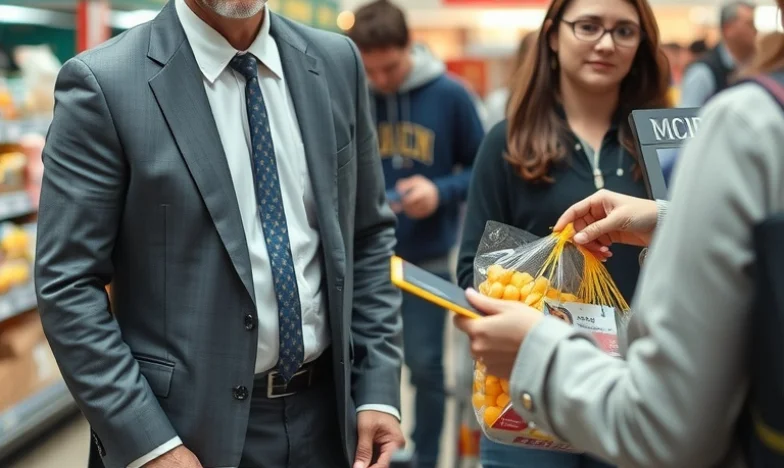
The cashier’s voice cut through the supermarket’s monotone hum, louder than the whirring AC or the beep of the scanner. I could feel the eyes of the people behind me—impatient, judgmental, some even smirking. My hands shook as I fumbled with my wallet, searching for a miracle that wasn’t there. I wore my best suit, the one I’d bought back when I still had a job, back when I thought I was going places. Now, it felt like a costume, a desperate attempt to cling to dignity I no longer possessed.
“Maybe you should try another card?” the cashier suggested, her tone polite but her eyes tired. I could hear a woman behind me whisper, “Why’s he dressed like that if he can’t even pay for groceries?”
I wanted to disappear. My face burned. I glanced at the items on the conveyor belt—just bread, milk, eggs, and a box of mac and cheese. Essentials. I’d counted every penny before coming here, but I’d forgotten about the overdraft fee that hit my account this morning. I swallowed hard, trying to keep my voice steady. “I’m sorry. I… I’ll just leave these.”
As I started to gather my things, a voice behind me spoke up. “Hey, wait. I’ve got it.”
I turned, startled. She couldn’t have been more than twenty, with messy brown hair pulled into a ponytail and a faded hoodie that said ‘University of Michigan.’ She smiled—genuine, not pitying—and handed her card to the cashier. “Add his stuff to mine.”
The cashier hesitated, then shrugged and scanned my groceries. The girl winked at me. “Don’t worry about it. We all have rough days.”
I tried to protest, but she shook her head. “Seriously, it’s nothing. Just pay it forward someday.”
I stumbled out of the store, groceries in hand, my pride in tatters but my heart strangely lighter. I sat in my car for a long time, staring at the steering wheel, replaying the moment over and over. Why would she help me? She didn’t know me. She didn’t know that I’d lost my job at the law firm three months ago, that my wife had left me two weeks later, taking our daughter with her. She didn’t know that I’d been sleeping in my car, too ashamed to tell anyone, too stubborn to ask for help.
That night, I ate mac and cheese in the backseat of my Honda Civic, thinking about her words. Pay it forward. I’d heard that before, but it never meant much until now. I thought about my daughter, Emily, and how I’d promised her I’d always take care of her. I’d failed at that, but maybe I could start again.
The next morning, I went to the library to use the free Wi-Fi. I updated my resume, applied to every job I could find—anything, even if it wasn’t law. I called my brother in Ohio, swallowing my pride, and asked if I could crash on his couch for a while. He was surprised, but he said yes. “You should’ve called sooner, Mike,” he said. “Family’s family.”
I drove to Ohio that weekend, my car packed with everything I owned. My brother’s house was chaos—three kids under ten, a dog that barked at everything, and a kitchen that always smelled like burnt toast. But it was warm, and it was safe. My sister-in-law, Jenna, hugged me tight. “You’re staying as long as you need, okay?”
I got a job at a hardware store, stocking shelves and helping customers find the right screws. It wasn’t glamorous, but it was honest work. Every paycheck, I put a little aside for Emily. I called her every Sunday, and sometimes she’d talk to me, sometimes she wouldn’t. My ex-wife, Sarah, was civil but distant. “You need to get your life together, Mike,” she said. “Emily needs stability.”
I kept thinking about that girl in the supermarket. Her kindness haunted me, pushed me forward. I started volunteering at a local food bank on my days off, handing out groceries to families who reminded me of myself. One afternoon, a woman came in with her son, embarrassed and apologetic. “I’m sorry, I just… I lost my job, and I don’t know what else to do.”
I smiled at her, remembering how it felt to be on the other side of the counter. “It’s okay. We all have rough days. Take what you need.”
Thanksgiving came, and my brother’s house filled with relatives. I sat at the kids’ table with Emily, who’d come for the weekend. She was quiet at first, but after a while, she started telling me about her new school, her friends, her favorite teacher. I listened, grateful for every word. After dinner, I took her for a walk around the block. The air was crisp, the leaves crunching under our feet.
“Dad, are you okay now?” she asked, her voice small.
I knelt down so we were eye to eye. “I’m getting there, Em. Thanks to some good people.”
She hugged me, and I felt something inside me heal, just a little.
Christmas was hard. I couldn’t afford much, but I found a used bike at a garage sale and fixed it up for Emily. When she saw it, her face lit up. “You fixed it yourself?”
“Yeah,” I said, grinning. “Just needed a little love.”
She rode it up and down the driveway, laughing. My brother watched from the porch, a beer in his hand. “You’re doing good, Mike. Proud of you.”
I started taking night classes at the community college, studying business management. It wasn’t law, but it was a start. My boss at the hardware store noticed my hard work and promoted me to assistant manager. I saved every extra dollar, determined to get my own place again.
One Saturday, while volunteering at the food bank, I saw her—the girl from the supermarket. She was handing out bags of groceries, her hair still in that messy ponytail. I walked over, heart pounding.
“Hey,” I said, “I don’t know if you remember me…”
She looked up, smiled. “Of course I do. You’re the guy in the suit who forgot his wallet.”
I laughed, embarrassed. “Yeah, that was me. I just wanted to say thank you. You really changed my life.”
She shrugged. “It was just groceries.”
“No,” I said, “it was hope. And I’m trying to pay it forward, just like you said.”
She grinned. “That’s all that matters.”
We talked for a while, about school, about life, about second chances. Her name was Rachel. She was studying social work, wanted to help people who’d fallen through the cracks. I told her about Emily, about my new job, about how things were finally looking up.
That night, I sat on my brother’s porch, watching the stars. I thought about how quickly life can change—how one moment of kindness can ripple out, touching lives you never even see.
People laughed at me when I had nothing. They judged me by my empty wallet, my faded suit, my broken pride. But they didn’t know my story. They didn’t know how a stranger’s gesture could pull someone back from the edge.
Sometimes I wonder—how many lives could we change if we just reached out, even once? What if we all paid it forward, just a little?