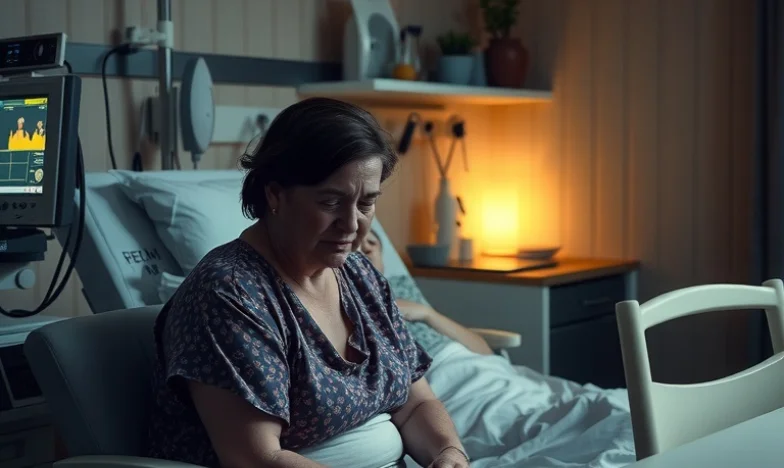
Carrying It All: The Story of the Daughter Who Always Had to Be Strong

“You’re always so strong, Emily. I don’t know what I’d do without you.”
My mother’s voice trembled as she gripped my hand from her hospital bed, her eyes searching mine for reassurance. The beeping of machines and the sterile scent of disinfectant pressed in on me, making it hard to breathe. I forced a smile, but inside, I was screaming.
I glanced at the empty chair beside me—the one my brother, Michael, should have been sitting in. He’d promised to come, but as usual, something had come up. Work, his kids, his life. There was always an excuse.
I remember being eight years old, standing in the kitchen while Mom fussed over Michael’s science project. “He’s got so much potential, Emily. You understand, right?” I nodded, invisible, as she handed me a plate to wash. I always understood. I always did what needed to be done.
Now, at thirty-six, nothing had changed. Except now, the stakes were higher. Mom’s cancer diagnosis had turned my world upside down. I was the one who took her to appointments, managed her medications, paid her bills, and listened to her fears in the dead of night. Michael sent flowers and texts. Sometimes.
One night, after a particularly grueling chemo session, Mom broke down. “I don’t want to be a burden,” she whispered. I wanted to scream, “Then why am I the only one here?” But I just squeezed her hand tighter.
I started to resent Michael. I resented the way he breezed in for holidays, bringing expensive gifts and stories about his new promotion, while I juggled two jobs and Mom’s care. I resented the way Mom’s eyes lit up when he walked in, even though he never stayed long. I resented the way everyone assumed I could handle it all.
One Sunday, Michael finally showed up. He hugged Mom, barely glancing at me. Over dinner, he said, “Em, you’re amazing. I don’t know how you do it.”
I snapped. “You don’t know because you never try.”
The room went silent. Mom looked at me, shocked. Michael’s face hardened. “I have a family, Em. I can’t just drop everything.”
“And I don’t?” I shot back. “I have a life, too. But someone has to be here.”
He stood up, his chair scraping the floor. “You always make me out to be the bad guy.”
I wanted to scream that he was, but the words caught in my throat. Instead, I left the table, locking myself in the bathroom, sobbing into a towel so Mom wouldn’t hear.
That night, I lay awake, staring at the ceiling. I thought about all the times I’d put my own needs aside—skipping college to stay close to home, turning down job offers, ending relationships because I couldn’t leave Mom. I wondered if anyone would ever see how much I’d given up.
The next morning, Mom apologized for Michael. “He’s just busy, honey. He loves you.”
I wanted to believe her, but I couldn’t. I felt like a ghost in my own life—present, but unseen.
Weeks passed. Michael called less and less. Mom’s health declined. I grew more exhausted, more bitter. Friends stopped inviting me out. My boss noticed my mistakes at work. I felt like I was drowning, but I couldn’t let go.
One afternoon, after Mom fell and I had to rush her to the ER, I broke down in front of the nurse. “I can’t do this anymore,” I whispered.
She squeezed my shoulder. “You don’t have to do it alone.”
But I did. Because no one else would.
That night, I sat by Mom’s bed, watching her sleep. I thought about boundaries—about how much of myself I could give before there was nothing left. I wondered if love meant sacrificing everything, or if it was okay to want something for myself.
When Mom woke up, she looked at me with tears in her eyes. “I’m sorry, Emily. I never meant for you to carry this alone.”
I cried then, really cried, for the first time in years. I told her how lonely I felt, how angry I was at Michael, how scared I was of losing her—and of losing myself.
We talked for hours. For the first time, she really listened. She promised to ask Michael for more help, to let me take breaks, to see me—not just as the strong one, but as her daughter.
It wasn’t perfect. Michael never became the brother I needed. Mom’s health never fully recovered. But I learned to set boundaries, to ask for help, to say no. I learned that being strong didn’t mean being invisible.
Sometimes, I still wonder where the line is—how much to give, how much to keep for myself. But I know now that my worth isn’t measured by how much I can endure.
And maybe, just maybe, that’s enough.
Based on a true story.