My son thought his wife was exaggerating until she collapsed

The first time I saw the inside of my son’s house after his wife got sick, I understood why she’d ended up on the kitchen floor.
It was a Tuesday. I’d driven over with a casserole because my son, Mark, had called and said, “Mom, can you come watch the kids for a couple hours? Jen’s got some kind of bug.” He made it sound like she had a cold. But when I walked in, the baby was screaming in his bouncy seat, the three-year-old was standing on a chair trying to reach the cereal, and Jen was crumpled next to the dishwasher with her face pressed against the tile.
I dropped my purse. “Jen. Honey.”
She opened her eyes. They were glassy and red. “I just sat down for a minute,” she whispered. “I got dizzy.”
I helped her to the couch. She was shaking. The house wasn’t dirty, exactly, but it had that look of a place where nobody had stopped moving in weeks. Laundry piled on the dining table. A half-empty bottle of formula on the counter. The toddler had peanut butter in her hair.
I got the kids settled and made Jen some toast. She ate two bites and started crying. Not loud, just tears running down her face while she stared at the wall.
“I can’t do it anymore,” she said. “I’m so tired I can’t see straight.”
I called Mark at work. He’s a project manager for a construction company. Good job. Good benefits. He answered on the second ring.
“Hey, Mom. How’s she doing?”
“She collapsed, Mark. On the floor. With the kids alone in the house.”
He paused. “She said she was just tired. I told her to take a nap when the baby naps.”
I felt something hot rise in my chest. “When does the baby nap? When does she nap? She’s got a three-year-old who doesn’t nap and a six-month-old who’s up three times a night. You told me last week you’ve been sleeping in the guest room because the baby wakes you up.”
“Well, yeah. I have to work.”
“And she doesn’t?”
He made a sound, half laugh, half sigh. “Mom, come on. It’s different. She’s home. She’s got the dishwasher, the washing machine, the Roomba. It’s not like she’s out in the fields.”
I closed my eyes. I remembered his father saying almost the same thing to me in 1994, standing in our kitchen while I held a screaming baby and a grocery list and a job that paid less than his. I remembered how I used to lock myself in the bathroom just to cry for three minutes.
“Mark,” I said, “I’m going to stay here tonight. You’re going to come home and listen to your wife. And if you say one more word about how easy she has it, I will take her and those kids to my house and let you see how easy it is alone.”
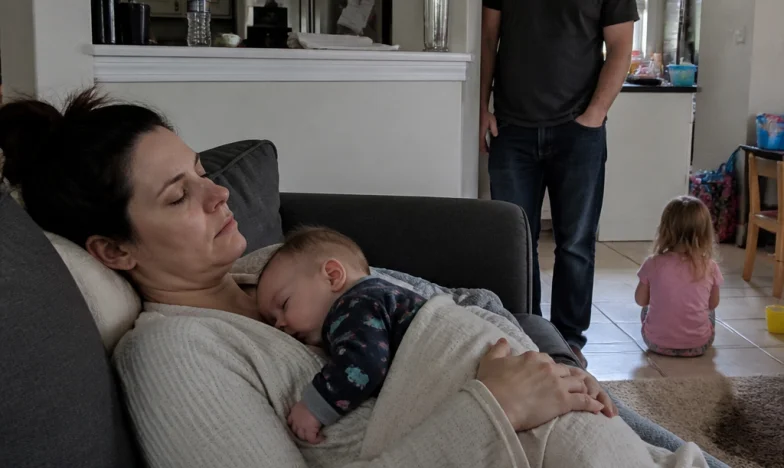
He came home at six. Jen was asleep on the couch, the baby on her chest. The toddler was watching cartoons with a bowl of goldfish. I had cleaned the kitchen and folded the laundry, but I didn’t say anything about it.
Mark stood in the doorway, looking at his wife. His face changed. I think he finally saw her. The dark circles. The way her hands were chapped and raw. The way she didn’t even stir when he walked in.
“She’s not sick,” I said quietly. “She’s exhausted. There’s a difference.”
He sat down at the kitchen table. I made coffee. We talked for a long time. He told me he thought he was a good husband because he went to work and mowed the lawn and took out the trash. He said he didn’t know she was drowning.
“She told you,” I said. “She told you last month she needed help. You said you’d try to do more, and then you didn’t.”
He looked at his hands. “I thought she was exaggerating.”
“She wasn’t.”
That night, Mark slept in the baby’s room. He got up twice with the baby. The next morning, he made the toddler’s breakfast and packed her lunch for daycare. He called in late to work and took the baby to his mother-in-law’s so Jen could sleep until ten.
It didn’t fix everything. Jen still does most of the housework. But Mark started coming home at five instead of seven. He takes the kids to the park on Saturdays so Jen can go to the gym or get coffee alone. He does bath time three nights a week. He stopped saying things like “I help her” and started saying “I do my share.”
A few weeks later, I went over for dinner. Jen was laughing at something the toddler said. The baby was on Mark’s lap, grabbing at his fork. The house was messy, but it was a lived-in mess, not a drowning mess.
After dinner, Mark walked me to my car. He hugged me and said, “Thanks, Mom. For not letting me be an idiot.”
I patted his cheek. “You’re still an idiot. Just a little less.”
He laughed. But I could see he was tired, too. Good. That’s what sharing the load looks like.
I drove home thinking about Jen on that kitchen floor. I’m glad she got up. I’m glad Mark finally saw her. But I also thought about all the women who don’t have a mother-in-law with a casserole and a sharp tongue. The ones still locked in the bathroom, crying for three minutes.
I didn’t say anything to Mark about that. Some things you have to learn on your own.