My husband spent our entire house savings without telling me

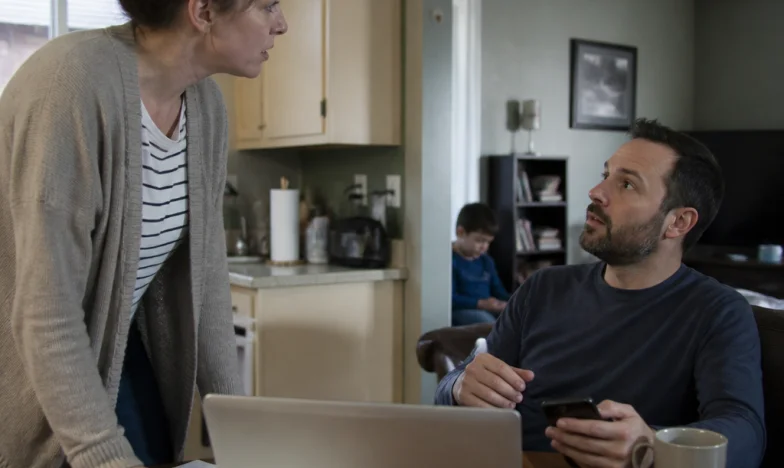
The kitchen smelled like burnt coffee and the lemon-scented cleaner I’d used on the counters an hour ago. I was still in my work clothes, a cardigan with a frayed cuff, and I had the mortgage pre-approval form open on my laptop. The number on the screen didn’t match anything we’d talked about.
“Dan,” I said, not looking up. “Where’s the rest of the savings?”
He was at the table, scrolling his phone. He didn’t answer right away. Our son, Owen, was in the living room watching something with too much yelling in it. I could hear cartoon explosions.
“Dan.”
“What savings?” he said, like I’d asked about a TV show he didn’t watch.
I turned the laptop toward him. “The savings we’ve been putting money into for eight years. The emergency fund. The account I was going to use for the down payment.”
He glanced at the screen, then back at his phone. “I moved some of it.”
“Moved it where?”
“Into crypto. A few different coins. Some of them are down right now, but it’s temporary.”
I waited for him to say it was a joke. He didn’t. I could feel my pulse in my neck, that tight, hot feeling like when you’re about to cry but you’re too angry to let it out.
“How much?” I asked.
“Most of it.”
I sat down across from him. The chair scraped the floor. “Dan, that was forty-one thousand dollars.”
“It was sitting there doing nothing,” he said. “Inflation eats it alive. I’m trying to build something for Owen. College isn’t getting cheaper.”
“That was our emergency fund. That was for the roof, for the car, for if one of us got sick.”
“I make enough to cover the roof,” he said. “And you have your little design jobs.”
I stared at him. “My little design jobs pay for Owen’s swim lessons and half the groceries. You don’t get to call them little.”
He put his phone down and leaned back. “Look, I’m the one bringing in the real income. I should have some say in how we invest it. You’ve never been interested in this stuff.”
“I’m interested in not losing our house,” I said. “I’m interested in not having to tell Owen we can’t afford his braces because Daddy bet the savings on internet coins.”
“It’s not betting,” he said, his voice rising. “It’s a calculated risk. You wouldn’t understand.”
I closed the laptop. My hands were shaking a little. “I understand that you didn’t tell me. You didn’t ask. You just took money we both saved and lit it on fire.”
“I didn’t light it on fire. It’s down, but it’ll come back. You have to give it time.”
“How much is left?”
He looked at the ceiling. “Maybe eighteen.”
“Eighteen thousand.”
“Give or take.”
I stood up and walked to the sink. I poured the burnt coffee down the drain and watched it swirl. I wanted to throw the mug at the wall. I didn’t.
“You need to liquidate it,” I said. “Put whatever’s left back into the high-yield account. Today.”
“No.”
I turned around. “Excuse me?”
“I’m not selling at a loss. That’s the worst thing you can do. I need more time to recover it.”
“We don’t have more time. We have a mortgage application. We have a kid. We have a life we built together, and you just decided you were the only one who mattered.”
He stood up, pushing his chair back. “That’s not fair.”
“Fair?” I laughed, but it wasn’t funny. “You don’t get to talk about fair.”
Owen came into the kitchen then, holding a half-eaten granola bar. “Can I have a juice box?”
Dan looked at him, then at me. “We’ll talk later.”
“No,” I said. “We’ll talk now. Owen, go back to the living room for a minute, okay?”
He shrugged and walked away, leaving crumbs on the floor.
Dan crossed his arms. “I’m not selling. The market’s volatile. If I pull out now, we lock in the loss. If I wait, we could get it all back and more.”
“And if it keeps dropping?”
“It won’t.”
“You don’t know that.”
“I know more than you do,” he said.
I felt something shift in my chest, like a door closing. “That’s what this is about, isn’t it? You think because you make more money, you get to make all the decisions. You think I’m just here to fold laundry and pack lunches.”
“I didn’t say that.”
“You didn’t have to.”
I walked past him to the hallway, then stopped. “I’m calling the bank tomorrow. I’m going to see what our options are. And I’m going to talk to a financial advisor. Not your friend from work. A real one.”
“That’s a waste of money.”
“We don’t have any money to waste,” I said. “You made sure of that.”
That night I slept in the guest room. Not because I was being dramatic, but because I couldn’t lie next to him without wanting to scream. I kept thinking about the day we opened that savings account. We’d gone out for pancakes after, and Dan had said, “This is for our future.” I didn’t know then that his future only included me when it was convenient.
The next morning, I called the bank. The woman on the phone was polite, but she couldn’t do much. The account was joint, but the money was gone. She suggested I speak to a financial counselor. I wrote down the number on the back of an old envelope.
I called my sister that afternoon. She lives in Indianapolis, works as a nurse. She listened without interrupting, which I appreciated.
“He’s being an idiot,” she said. “But you already know that.”
“I don’t know what to do. I don’t want to divorce him. I want him to understand what he did.”
“He won’t understand until it hurts,” she said. “So make it hurt a little. Separate your finances. Open your own account. Put your freelance money in there. Tell him the joint account is for bills only.”
“That feels like giving up.”
“It’s not giving up. It’s protecting yourself.”
I did it that week. I opened a checking account at a different bank, one of those online ones with no fees. I changed my direct deposit. I didn’t tell Dan right away. When he noticed, about two weeks later, he was confused.
“Where’s your income going?” he asked.
“My own account,” I said. “For now.”
“That’s ridiculous.”
“No, what’s ridiculous is you gambling with our son’s future and then telling me I’m overreacting.”
He didn’t have a response to that. He just shook his head and went outside to mow the lawn.
The months after that were quiet and cold. We still ate dinner together, still took Owen to soccer practice, still slept in the same bed most nights. But there was a wall between us, and we both knew it.
Then, in late October, Dan came home from work and sat down at the kitchen table. He looked tired, older than he had a year ago.
“I sold it,” he said.
I was chopping onions for chili. I didn’t stop. “Sold what?”
“The crypto. What was left of it.”
I put the knife down. “How much?”
“A little over fifteen.”
I nodded slowly. “Okay.”
“I’m sorry,” he said. “I thought I could fix it. I thought if I just waited long enough, it would come back. But it didn’t.”
I wiped my hands on a towel and sat down across from him. “I’m not going to say it’s fine, because it’s not. We lost a lot of money. Money we worked for. Money we saved together.”
“I know.”
“But I’m glad you told me. And I’m glad you sold it.”
He looked at me, and for the first time in months, he didn’t look defensive. He just looked sad.
“I was scared,” he said. “I didn’t want to admit I’d messed up.”
“I get that,” I said. “But you can’t do that again. You can’t make decisions like that without me. We’re supposed to be partners.”
“I know,” he said again.
We didn’t hug. We didn’t cry. We just sat there while the onions sat half-chopped on the cutting board and the chili meat browned on the stove.
It took a long time to rebuild. We didn’t move to a bigger house. We stayed in the same one, with the same creaky floors and the same small bathroom. We put money back into the high-yield account, a little at a time. Dan started showing me the investment statements every month, even the boring ones. I started being more involved in the finances, not because I wanted to, but because I needed to.
Owen never knew. He just knew that sometimes his parents were quiet at dinner, and sometimes they weren’t.
We’re okay now. Not perfect. But okay. And I don’t think Dan will ever touch our savings again without talking to me first. Not because he’s afraid of me, but because he finally understands that “ours” means both of us.